

Choosing the right door locks can make or break your business security and insurance coverage. For British commercial property managers and business owners in Bristol, neglecting proper lock standards can result in rejected insurance claims and vulnerable premises. With over 60 percent of business burglaries traced back to outdated or non-compliant hardware, understanding which locks meet legal and insurance requirements is a must. This guide distills crucial information to help you select secure, compliant locks tailored for modern British business environments.
Table of Contents
- Step 1: Assess Business Security And Compliance Needs
- Step 2: Evaluate Door Types And Usage Requirements
- Step 3: Identify Approved Lock Standards And Features
- Step 4: Compare Lock Options And Select Suitable Hardware
- Step 5: Test Locks And Verify Installation Quality
Quick Summary
| Key Insight | Explanation |
|---|---|
| 1. Regular Security Assessments Are Essential | Document vulnerabilities and update security measures quarterly to adapt to evolving risks. This ensures your strategies remain relevant and effective. |
| 2. Select Doors Based on Usage Needs | Assess traffic patterns and security needs to choose suitable door types that enhance protection while meeting accessibility standards. |
| 3. Understand Lock Standards Thoroughly | Familiarise yourself with compliance indicators and industry standards to ensure lock selection meets security requirements and insurance specifications. |
| 4. Consider Various Lock Types Before Selection | Evaluate mechanical, electronic, and smart locks based on business needs, ensuring the chosen hardware supports operational workflow and security. |
| 5. Conduct Thorough Testing of Security Installations | Test locks under diverse scenarios to verify functionality and compliance, documenting results for accountability and ongoing security assurance. |
Step 1: Assess Business Security and Compliance Needs
Evaluating your business security requirements is a critical first step in protecting your organisation’s physical and digital assets. This process involves systematically identifying potential risks, understanding legal obligations, and developing robust protective strategies tailored to your specific business environment.
To conduct a comprehensive security assessment, start by documenting potential vulnerabilities using HSE risk assessment guidelines. Begin with a thorough walkthrough of your commercial premises, noting potential entry points, existing security infrastructure, and areas that might require enhanced protection. Consider factors such as physical access controls, digital network security, employee identification protocols, and potential external threats specific to your industry.
Your assessment should include a detailed examination of legal compliance requirements. This means reviewing regulations like data protection standards, workplace safety guidelines, and industry-specific security mandates. Consulting academic security frameworks can help develop a structured approach to identifying organisational vulnerabilities. Pay particular attention to areas such as IT systems, physical access controls, document management, and employee training programmes that might impact your overall security posture.
Practical Tip: Create a living security assessment document that you review and update quarterly, ensuring your protective strategies remain current and responsive to evolving business risks.
Step 2: Evaluate Door Types and Usage Requirements
Selecting the appropriate door types and understanding their specific usage requirements is fundamental to ensuring robust business security. This crucial step involves carefully analysing your commercial space, traffic patterns, and specific functional needs to make informed locking mechanism selections.
Approved government documentation provides comprehensive guidance on selecting doors that meet accessibility and security standards. When evaluating door types, consider critical factors such as anticipated foot traffic, frequency of use, location within the premises, and specific security requirements. For instance, high traffic entrance areas might require more durable materials and advanced locking mechanisms compared to internal office doors. Factors like fire safety regulations, disability access requirements, and emergency exit considerations should also influence your selection process.
Beyond physical characteristics, your door evaluation must account for technological integration and security protocols. Academic architectural standards recommend thoroughly assessing door performance across multiple dimensions, including fire resistance, security ratings, durability, and compatibility with existing access control systems. Pay special attention to how different door types interact with potential electronic security infrastructure such as keycard systems, biometric access points, or integrated alarm mechanisms.
Practical Tip: Always request technical specifications and security ratings from manufacturers before finalising your door and lock selections, ensuring they meet both your functional requirements and relevant British safety standards.
Step 3: Identify Approved Lock Standards and Features
Navigating the complex landscape of lock standards requires a systematic approach to ensuring your commercial security meets legal and industry requirements. This critical step involves understanding the specific technical specifications and performance criteria that define acceptable security measures for business premises.
British Standards Online provides comprehensive guidelines for identifying authoritative lock standards. When evaluating lock features, focus on key compliance indicators such as resistance to forced entry, durability ratings, and compatibility with modern security systems. Look specifically for locks that meet British Standard BS3621 for insurance-approved security, which indicates the product has passed rigorous testing for strength and reliability. These standards cover crucial aspects like key retention, attack resistance, and overall mechanical performance that directly impact your business security infrastructure.
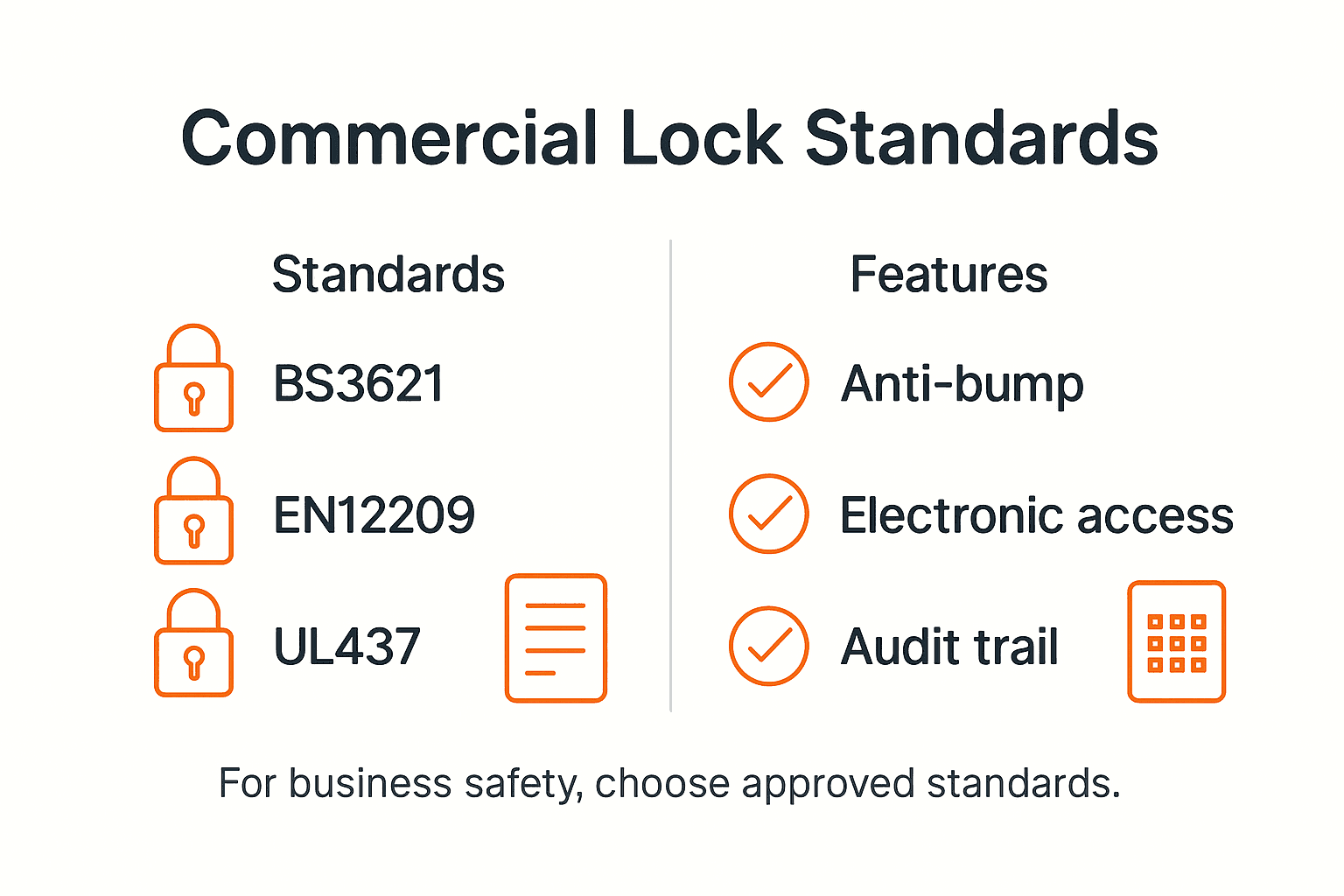
Beyond basic mechanical requirements, modern commercial locks must integrate seamlessly with technological security solutions. Academic resources highlight the importance of understanding comprehensive standards that govern lock manufacturing and installation. This means considering electronic access controls, compatibility with alarm systems, and potential future upgrade paths. Pay particular attention to standards that address emerging security technologies such as biometric integration, smart lock capabilities, and networked access management systems that can provide enhanced monitoring and control.
Practical Tip: Consult with a professional security consultant who specialises in British commercial lock standards to ensure your lock selection meets all current regulatory requirements and insurance specifications.
Below is a quick reference of major British door and lock standards relevant to security:
| Standard Name | Area Covered | Business Benefit |
|---|---|---|
| BS3621 | Locks and security devices | Insurance approval, attack resistance |
| BS EN 179 | Emergency exit hardware | Safe evacuation, legal compliance |
| BS EN 1634-1 | Fire resistance for doors | Fire safety meets building regs |
Step 4: Compare Lock Options and Select Suitable Hardware
Choosing the right commercial door lock requires a strategic approach that balances security requirements with practical operational needs. Your goal is to select hardware that provides robust protection while supporting your business’s unique workflow and accessibility demands.

Academic research offers a systematic comparison of commercial door lock technologies. When comparing options, evaluate three primary lock categories: mechanical, electronic, and smart locks. Mechanical locks remain cost-effective and reliable for areas with limited traffic. Electronic locks provide enhanced access control through keycard or PIN systems. Smart locks offer advanced features like remote management, detailed access logs, and integration with broader security networks. Consider factors such as frequency of use, number of users, required access levels, and potential future scalability when making your selection.
To help you compare lock categories, here is a summary of their business suitability:
| Lock Type | Key Advantages | Best Use Cases | Notable Limitations |
|---|---|---|---|
| Mechanical | Reliable, cost-effective | Low-traffic internal doors | No remote access, lower auditability |
| Electronic | Advanced access control | Main entrances, staff areas | Requires power, card management |
| Smart | Remote management, access logs | External doors, high security | Higher cost, network dependence |
Beyond technical specifications, your lock selection must align with specific business security requirements and legal compliance standards. Construction law perspectives emphasise the importance of choosing hardware that meets safety regulations and insurance specifications. This means verifying that your selected locks meet British Standard BS3621, provide appropriate fire safety access, and support emergency evacuation protocols. Assess each lock option against your risk assessment findings, ensuring the hardware provides appropriate protection without unnecessarily restricting employee movement or creating potential bottlenecks during critical situations.
Practical Tip: Request demonstration and trial periods for potential lock systems, allowing your team to evaluate real-world performance and user experience before making a final investment decision.
Step 5: Test Locks and Verify Installation Quality
After selecting your commercial door locks, comprehensive testing becomes crucial to ensure they perform exactly as expected under real-world conditions. This verification process protects your investment and guarantees the security infrastructure meets your business requirements.
University safety protocols provide structured frameworks for systematically testing security installations. Begin by conducting thorough functional tests across multiple scenarios. Verify each lock’s mechanical operation by testing key insertion, rotation, and release mechanisms. Check electronic locks for consistent authentication, ensuring PIN codes and keycards work reliably under different conditions. Simulate potential stress scenarios like rapid consecutive entries, power fluctuations, and emergency access requirements to confirm consistent performance.
Beyond immediate functionality, your testing must encompass broader security and compliance considerations. Safety verification guidelines recommend comprehensive performance validation against organisational standards. This involves assessing how locks integrate with existing security systems, checking fire safety compliance, and verifying emergency exit protocols. Pay close attention to installation precision, measuring alignment, testing door closure mechanisms, and confirming that locks do not impede quick evacuation. Document all test results meticulously, creating a formal record that demonstrates your commitment to maintaining robust security standards.
Practical Tip: Engage a professional security auditor to conduct an independent verification of your lock installation, providing an unbiased assessment of your security infrastructure.
Secure Your Business with Expert Commercial Lock Solutions
Selecting the right commercial door locks is essential for protecting your business against security threats and ensuring compliance with British safety standards. You need robust, reliable locking systems that meet the high expectations outlined in standards like BS3621 and integrate smoothly with your existing security infrastructure. At AHLP Locksmiths, we understand the challenge of balancing security, accessibility, and legal compliance while keeping your premises safe.
Our professional Locksmith Services cover everything from insurance-approved lock installations to advanced electronic and smart lock systems tailored for your business needs. Whether you require comprehensive security upgrades or emergency lock repairs, our trusted local team is ready to provide efficient, non-destructive solutions. Protect your assets and gain peace of mind now by contacting our Local Locksmith experts. Don’t wait for a security breach to happen. Act today and arrange your bespoke security consultation at AHLP Locksmiths for prompt, professional assistance.
Frequently Asked Questions
What should I consider when selecting commercial door locks for business security?
To select the right commercial door locks, assess your specific security needs, traffic patterns, and potential risks. Evaluate lock types based on the level of use in each area and ensure compliance with relevant security standards.
How do I determine the best type of lock for different areas of my business?
Different areas may require different lock types. For example, high-traffic entrances might benefit from electronic locks, while low-traffic internal doors could use mechanical locks for reliability and cost-effectiveness.
What are the key compliance standards I should look for in commercial lock selection?
Focus on compliance standards such as British Standard BS3621, which ensures locks meet rigorous testing for forced entry resistance. Ensuring compliance can enhance your security posture and may also satisfy insurance requirements.
How can I verify that my selected door locks are properly installed and functioning?
Conduct functional tests by checking key insertion, lock rotation, and emergency access scenarios. Document your findings to verify that all locks perform reliably under different conditions and ensure a solid security infrastructure.
What ongoing maintenance should I perform on my commercial door locks?
Regularly inspect your door locks for wear and functionality, ideally on a quarterly basis. Perform tests on mechanical and electronic components and address any issues to maintain security and operational efficiency.