

Lock bumping is a real and hidden threat for homeowners across Bristol, exposing families to burglary without the obvious signs many expect. This technique allows criminals to defeat common lock types quickly and quietly, making traditional security measures less reliable than many assume. Raising your awareness about lock bumping and understanding the risks to your home gives you the power to make smart upgrades and safeguards that genuinely protect what matters most.
Table of Contents
- Lock Bumping Explained And Key Misconceptions
- How Lock Bumping Works And Affected Lock Types
- Legal Status Of Bump Keys In The UK
- Risks For Homeowners And Insurance Issues
- Preventing Lock Bumping: Effective Solutions
Key Takeaways
| Point | Details |
|---|---|
| Understanding Lock Bumping | Lock bumping is a quick technique burglars use to bypass standard locks, especially basic pin tumbler locks. Homeowners often underestimate the vulnerability of their locks. |
| Importance of Upgrading Locks | Investing in British Standard TS007 3-star rated locks with anti-bump features significantly improves home security. Older locks, particularly those pre-2000, are especially at risk. |
| Insurance Implications | Vulnerable locks can lead to insurance claim rejections, increasing financial risks for homeowners. Adequate security measures are critical for maintaining valid insurance coverage. |
| Comprehensive Security Measures | A multi-layered security approach, combining advanced locks, regular assessments, and additional physical barriers, is essential to protect against lock bumping. |
Lock bumping explained and key misconceptions
Lock bumping represents a subtle yet dangerous technique burglars use to gain unauthorised entry into homes across Bristol and surrounding areas. Unlike traditional breaking and entering methods, this intrusive approach allows criminals to bypass standard lock mechanisms with minimal evidence of tampering. Common misconceptions about lock bumping often downplay the genuine security risks homeowners face.
At its core, lock bumping involves using a specially crafted key-like tool that temporarily disrupts internal lock pins, enabling the cylinder to rotate and unlock without conventional key insertion. Criminals can execute this technique rapidly, typically within seconds, making it an attractive method for opportunistic burglars seeking quick property access. Standard residential locks without advanced anti-bump protection remain particularly vulnerable to this technique.
Many homeowners mistakenly believe their existing locks provide sufficient protection against such intrusions. However, traditional pin tumbler locks can be surprisingly susceptible to bumping techniques, regardless of the perceived complexity of the locking mechanism. Older lock designs frequently lack the sophisticated security features necessary to prevent skilled intruders from exploiting these mechanical weaknesses.
Pro tip: Invest in British Standard high-security locks with anti-bump features, and consider having a professional locksmith assess your current home security infrastructure to identify potential vulnerabilities.
How lock bumping works and affected lock types
Lock bumping exploits fundamental vulnerabilities in traditional mechanical locking systems, particularly targeting pin tumbler locks that are prevalent in residential properties across Bristol. Understanding the mechanical principles of lock mechanisms reveals why certain lock types remain susceptible to this intrusive technique.
The process involves a specially designed bump key that momentarily disrupts the internal pin configuration. When struck with precise force, the bump key causes all pin stacks to jump simultaneously, creating a brief window where the lock cylinder can rotate freely. This technique works by exploiting the mechanical tolerances within standard pin tumbler locks, allowing criminals to bypass traditional security measures with minimal technical skill or specialised equipment.

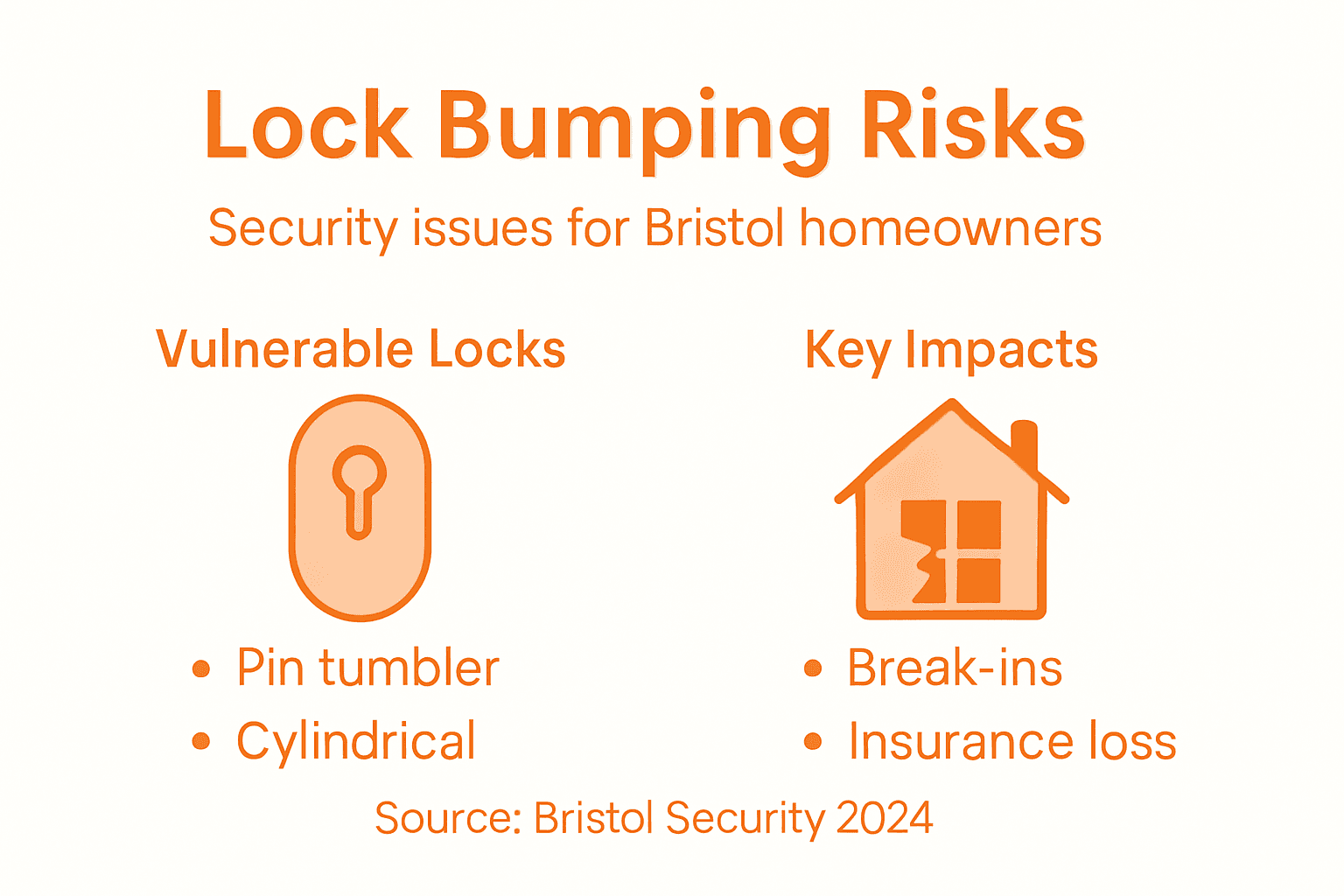
Certain lock types are significantly more vulnerable to bumping techniques. Older cylindrical locks, particularly those manufactured before 2000 and lacking advanced anti-bump features, represent the most significant risk. Euro cylinder locks without security ratings, standard residential mortice locks, and basic padlocks are especially prone to this method. Modern high-security locks incorporate additional mechanisms like spool pins, mushroom pins, and sidebar systems specifically designed to prevent bumping attempts.
To help clarify the real impact of lock bumping, below is a comparison of commonly used residential locks and their susceptibility to bumping:
| Lock Type | Vulnerability to Bumping | Typical Anti-Bump Features |
|---|---|---|
| Basic euro cylinder (pre-2000) | Highly vulnerable | None, basic pin tumbler design |
| Modern euro cylinder (standard) | Moderately vulnerable | Some models have basic security |
| British Standard TS007 3-star | Very low vulnerability | Spool/mushroom pins, sidebars |
| Basic mortice lock | Moderately vulnerable | Simple mechanisms, few protections |
| High-security padlock | Low to moderate | Hardened materials, anti-bump pins |
Pro tip: Request a professional security assessment to identify which of your existing locks might be vulnerable to bumping, and prioritise upgrading to British Standard TS007 3-star rated cylinders that provide comprehensive protection against sophisticated intrusion techniques.
Legal status of bump keys in the UK
The legal landscape surrounding bump keys in the United Kingdom is complex and nuanced, with significant implications for homeowners and potential offenders. Possession laws regarding lock-related tools emphasise intent as the critical determining factor in potential criminal prosecution.
Under current UK legislation, particularly the Offensive Weapons Act 2019, the possession of bump keys is not inherently illegal. However, the context and intended use are paramount. If law enforcement determines that an individual possesses bump keys with the intention of committing burglary or unauthorised property entry, this becomes a serious criminal offence. The key legal distinction revolves around demonstrating criminal intent rather than the mere possession of the tool itself.
Professional locksmiths, security researchers, and legitimate trade professionals may possess bump keys for valid purposes such as security testing, lock mechanism analysis, or training. These individuals typically maintain documentation and professional credentials that clearly establish the lawful nature of their possession. Conversely, individuals without professional justification carrying bump keys near residential or commercial properties might face significant legal scrutiny and potential criminal charges.
Pro tip: Consult with local law enforcement or a legal professional if you have any uncertainty about the legal status of lock-related tools in your specific circumstances, and always prioritise transparent, legitimate purposes for possessing such equipment.
Risks for homeowners and insurance issues
Homeowners face significant financial and security challenges when their properties become vulnerable to lock bumping techniques. Insurance claims for burglary can become remarkably complex when intruders use methods that leave minimal forensic evidence, potentially compromising insurance coverage and creating substantial economic risks.
Insurance providers are increasingly stringent about security requirements, often stipulating specific lock standards to maintain policy validity. Vulnerable locks can lead to automatic claim rejection, meaning homeowners might bear the entire financial burden of theft or property damage. Many insurers now require documented proof of high-security lock installations, with British Standard TS007 3-star rated cylinders becoming a minimum expectation for comprehensive coverage.
The potential consequences extend beyond immediate financial losses. A successful lock bumping incident can result in increased insurance premiums, potential policy cancellation, and long-term challenges in obtaining future home insurance. Homeowners without appropriate security measures may find themselves categorised as high-risk, facing significantly higher insurance costs or even difficulty securing coverage for their properties.
The following table outlines the links between home security upgrades and insurance policy outcomes:
| Security Measure | Effect on Insurance Coverage | Long-Term Benefit |
|---|---|---|
| Upgraded to anti-bump locks | Essential for valid claims | Lower risk classification |
| Routine locksmith assessment | Proof of ongoing diligence | Maintains lower premium rates |
| Failure to meet lock standards | Likely claim rejections | Higher premiums or policy denial |
| Documented lock installations | Eases claim authorisation | Strengthens the homeowner’s position |
Pro tip: Schedule an annual security assessment with a professional locksmith to ensure your locks meet current insurance standards and maintain comprehensive protection against sophisticated intrusion techniques.
Preventing lock bumping: effective solutions
Protecting your home against lock bumping requires a strategic approach that combines advanced lock technology and professional security measures. Engineering precise lock mechanisms demonstrates that custom manufacturing and professional installation are critical in reducing vulnerability to intrusion techniques.
Homeowners can implement multiple defensive strategies to counteract lock bumping risks. Anti-bump locks featuring sophisticated pin configurations, such as British Standard TS007 3-star rated cylinders, provide significantly enhanced protection. These advanced locks incorporate complex internal mechanisms like mushroom pins, sidebar systems, and magnetic elements that prevent traditional bumping techniques from successfully manipulating the lock mechanism.
Beyond technological solutions, comprehensive security involves professional assessment and regular maintenance. This includes replacing older cylindrical locks, ensuring proper lock alignment, and installing additional security features like reinforced strike plates, security pins, and alarm systems. Professional locksmiths can conduct comprehensive security audits, identifying potential vulnerabilities and recommending tailored solutions specific to your property’s unique characteristics.
Pro tip: Consider implementing a multi-layered security approach by combining high-quality anti-bump locks with additional physical barriers and electronic monitoring systems to create comprehensive home protection.
Protect Your Bristol Home From Lock Bumping Threats
Lock bumping exposes hidden vulnerabilities in basic pin tumbler locks that many Bristol homeowners unknowingly face. This technique allows intruders to bypass traditional locking mechanisms quickly and quietly, putting your family’s safety and property at serious risk. Recognising the importance of upgrading to high-security, anti-bump locks such as British Standard TS007 3-star rated cylinders is essential to strengthen your home’s defences and comply with insurance requirements.
Don’t wait until it is too late. Our trusted Local Locksmith – Auto Home Lock Pro team specialises in professional lock upgrades, repairs, and comprehensive security consultations tailored to counteract these advanced intrusion methods. With fast, transparent service and no call-out fees, AHLP Locksmiths are ready to safeguard your property today. Contact us through our website or explore our Locksmith Services – Auto Home Lock Pro to arrange a security assessment or emergency lock solution. Protect your Bristol home now with expert support you can depend on.
Frequently Asked Questions
What is lock bumping and how does it work?
Lock bumping is a technique used by burglars to gain unauthorised entry into homes by using a specially crafted bump key that temporarily disrupts internal lock pins, allowing the lock cylinder to rotate and unlock without a normal key.
Which types of locks are most vulnerable to bumping?
Older pin tumbler locks, especially those manufactured before 2000, basic euro cylinder locks, standard mortice locks, and basic padlocks are particularly susceptible to bumping techniques.
How can I prevent lock bumping on my property?
Invest in high-security locks such as British Standard TS007 3-star rated cylinders that incorporate anti-bump features. Additionally, regular security assessments by professional locksmiths can help identify and mitigate vulnerabilities.
What are the legal implications of owning a bump key?
In the UK, possession of a bump key is not illegal by itself; however, using it with the intent to commit burglary can lead to serious criminal charges, making the context of possession crucial in determining legality.