How to Find a Trustworthy Locksmith (and Avoid Getting Stung)
If you are locked out, dealing with a broken lock or trying to secure your home after losing your keys, you are usually in a hurry. Unfortunately, that is exactly when it is easiest to make an expensive mistake.
Most locksmiths are honest tradespeople. But rogue operators and misleading advertising do exist, and a cheap-looking call-out can become a much larger bill once somebody is standing at your door.
The good news is that you do not need to be a lock expert to protect yourself.
This guide explains how to choose a trustworthy locksmith, how to check whether a company is genuinely local, what warning signs to look for, what common locksmith jobs should roughly cost, and what security standards to ask about.
It also includes two real examples showing why choosing the right locksmith matters.
The Short Answer: How Do You Choose a Trustworthy Locksmith?
Before booking anyone, check these six things:
- A named person and a genuine local presence. Find out who will actually be coming to your property and where the business is based.
- A clear price before work starts. Avoid vague quotes that can change dramatically once the locksmith arrives.
- Non-destructive entry as the first approach. Drilling should generally be a last resort, not automatically the first thing a locksmith does.
- No suspiciously cheap headline price. A £29 or £49 advertised starting price may not represent what you will actually pay.
- Proper qualifications and genuine independent reviews. Read recent Google reviews rather than relying solely on testimonials published on the company’s own website.
- A proper itemised receipt or invoice. If a lock is replaced, you should also receive the appropriate keys supplied with it.
One extra check takes only a few seconds: look at the phone number.
For a Bristol locksmith, an 0117 number or a genuine local mobile number is a useful sign of local presence. It does not prove that the company is local, but it gives you another clue. National operators commonly advertise 0800, 0333 and other non-geographic numbers while creating location-specific pages designed to look local.
If in doubt, ask the simplest possible question:
“Where are you actually based, and is the person I am speaking to the locksmith who will attend?”
A genuine local locksmith should be able to answer clearly.
A Real Example: a £180 Job That Cost £946
A lady called us recently, worried. She had a UPVC door with a euro cylinder lock that needed opening and changing, a common, straightforward job. She had chosen a company advertising a low call-out fee, the kind of “£49” headline price that pulls people in. By the time the locksmith left, she had been charged £946, and she was worried she had been scammed. She was also uneasy that only two keys had been left with her.
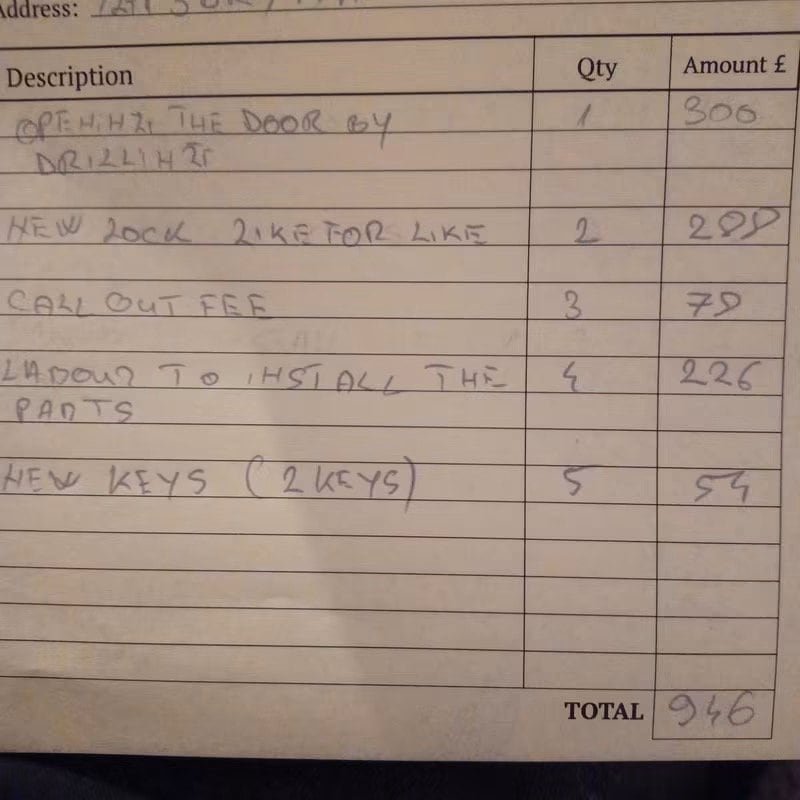
Look at what she was charged for:
- Opening the door by drilling – £300. This is the big red flag. A euro cylinder lock can almost always be opened by picking it or using other non-destructive methods. Drilling destroys the lock and should be a genuine last resort, not the first move. Charging £300 to drill a lock that could have been picked is where the overcharging starts.
- Two new locks – £280. A single door needs one cylinder. Charging for two locks on a one-cylinder job is difficult to justify.
- Call-out fee – £75. On top of the “low” advertised call-out price that got them the booking.
- Labour to install – £226. A euro cylinder swap takes a few minutes and does not warrant this.
- New keys (2 keys) – £54. Here is the other worry. A new cylinder normally comes with a set of three keys as standard. She was left with two. Where is the third?
If we had been called to this job and been able to pick the original lock, which for a euro cylinder is usually possible, the whole job would have been around £180, including the new cylinder and a full set of keys. Instead she paid £946 and was left one key short.
This is not a one-off. It is a pattern, and once you know the pattern, it is easy to avoid.
The Warning Signs of a Locksmith Scam
1. An Unrealistically Cheap Advertised Price
Be cautious when a company advertises an emergency locksmith for £15, £29, £39 or £49 without making it clear what that price actually includes.
The figure may only cover a basic starting labour charge. Call-out charges, parts, VAT, additional labour and other costs can then be added.
Ask for the total expected price for the job, not simply the starting price.
2. They Will Not Give You a Price Before Starting
A locksmith may not always be able to diagnose a complicated fault over the phone, but they should still be able to explain their pricing and provide a realistic estimate or fixed price where the problem is clear.
Before allowing work to begin, ask:
“What will I pay in total if the job is exactly as I have described?”
If the answer remains deliberately vague, consider calling somebody else.
3. The Drill Comes Out Immediately
For many common lockouts, a competent locksmith will first consider picking, bypassing or another non-destructive entry technique.
There are situations where drilling is genuinely necessary. But it should not automatically be the first approach.
If drilling is suggested immediately, ask:
“Why can’t this lock be opened non-destructively?”
A professional locksmith should be able to explain the reason.
4. You Cannot Work Out Who the Locksmith Actually Is
Look beyond the polished website.
Can you find:
- the locksmith’s name?
- genuine photographs?
- a real business location?
- recent local reviews?
- a clear phone number?
- information about qualifications?
- the areas they genuinely serve?
If the website claims to be a local locksmith in dozens or hundreds of towns but never identifies the people behind the business, investigate further.
5. They Pressure You Into Immediate Payment
You should be given an opportunity to understand what work has been completed and what you are being charged for.
A reputable locksmith should also provide a proper receipt or invoice showing the work carried out and the parts supplied.
Local Locksmith or National Call Centre: Who Are You Actually Calling?
One reason choosing a locksmith has become confusing is that the business at the top of a search result is not necessarily a locksmith based in your town.
Some national businesses operate as dispatch or lead-generation services. You call the advertised number, speak to an operator and your job is then passed to a subcontractor who carries out the work.
That is a fundamentally different arrangement from calling a local independent locksmith directly.
There is nothing inherently wrong with a company using subcontractors. The important thing is that you understand who you are dealing with, who will carry out the work and who is responsible if something goes wrong.
National operators also have another business in the transaction to pay for: the company finding and dispatching the job. That company may receive a commission or fee before the attending locksmith is paid.
The useful point for customers is simpler: ask whether you are speaking directly to the locksmith or to a company that will pass the job to somebody else.
How to Check Whether a Locksmith Is Really Local
A website saying “Local Bristol Locksmith” does not necessarily mean the company is based in Bristol.
Use several checks together.
Check the Phone Number
For Bristol, look for an 0117 area code or a genuine mobile number.
An 0117 number does not guarantee that somebody is local, and an 0800 or 0333 number does not automatically mean they are not. Numbers can be redirected.
However, the number is a useful first clue.
Ask Where They Are Coming From
Do not just ask whether they “cover Bristol”.
Ask:
“Where is the locksmith travelling from?”
A genuinely local business should normally be able to give you a straightforward answer.
Look at Their Google Reviews
Do the reviews mention Bristol, South Gloucestershire and nearby areas?
Do customers repeatedly mention the same locksmith by name?
Do the reviews describe specific jobs?
A genuine history of detailed local reviews tells you far more than a collection of anonymous testimonials on the company’s own website.
Look at the About Page
Independent tradespeople usually have a person behind the company.
Look for genuine photographs of the locksmith, their vehicle and their work rather than relying entirely on stock imagery.
Check the Address
If an address is given, check it.
Be particularly cautious when a business claims to have offices in large numbers of different towns without explaining how those locations operate.
Real Case: the Emersons Green Customer Who Was Facing an £800 Door Replacement
The difference between diagnosing a problem correctly and simply replacing everything can be substantial.
A customer in Emersons Green had a problem with a uPVC door and had been led to believe that the door needed replacing, at a cost of around £800.
After the door was properly assessed, the problem could be dealt with without replacing the entire door.
The customer avoided an unnecessary £800 replacement.
This is why diagnosis matters.
A fault with a uPVC door does not automatically mean that the door itself has failed. Problems can come from the cylinder, gearbox, multipoint locking mechanism, alignment or other individual components.
A good locksmith should identify what has actually failed before recommending what needs replacing.
The same principle applies to a lockout. If a lock can be opened non-destructively, destroying it and selling the customer a replacement should not be the default solution.
What Should a Locksmith Cost?
There is no single UK price for locksmith work. Prices depend on the lock, the fault, the parts required, the time of day and the complexity of the job.
However, knowing some realistic figures gives you a useful sanity check.
At AHLP, current starting prices for common jobs include:
| Job | AHLP Price From |
|---|---|
| Simple lockout on a Yale-type front door or euro cylinder, opened without damage | £80 |
| Lock change per door, including labour and parts | £95 |
| 3-star anti-snap cylinder, supplied and fitted | £120 |
| uPVC multi-point mechanism replacement | £180 |
These are not universal industry prices. Another reputable locksmith may legitimately charge more or less depending on the job, parts, location and time.
The important comparison is between a plausible price for the work required and a bill such as the £946 example above.
A quote that differs from these figures is not automatically suspicious. A quote that starts very low and then multiplies after work begins deserves much closer scrutiny.
What Is a TS007 3-Star Lock?
If you have a uPVC or composite door with a euro cylinder, you may hear a locksmith recommend a TS007 3-star cylinder.
TS007 is a security standard for replacement cylinders and associated door hardware. Products tested to the standard can receive different star ratings, and BSI’s product certification directory includes cylinders certified at the 3-star level.
For homeowners, the important point is that a genuine TS007 3-star cylinder provides enhanced resistance to common attacks against euro-cylinder locks, including lock snapping.
You can usually identify a certified cylinder by markings on the face of the lock showing the standard and star rating.
If somebody quotes you for a “high-security” or “anti-snap” cylinder, ask:
“Is it TS007 3-star rated?”
And if you are paying for a 3-star cylinder, check the markings on the product being fitted.
For timber doors using mortice locks, a different standard may apply. BS3621 is commonly associated with thief-resistant locks for external timber doors and is often relevant to home insurance requirements.
The correct standard therefore depends on the type of door and locking system you have.
Cheap Is Not the Same as Good Value
The aim is not to find the cheapest locksmith in Bristol.
A skilled locksmith has training, specialist tools, insurance, stock, vehicle costs and years of experience. Professional work has a legitimate cost.
What you should avoid is artificially cheap advertising followed by unexpectedly expensive work.
A trustworthy quote should make it clear:
- what the locksmith is going to do;
- what parts are included;
- whether there is a call-out charge;
- whether VAT applies;
- whether the quoted figure is fixed or estimated;
- what could legitimately cause the price to change.
A £100 quote that clearly includes everything can be much better value than a £39 advert that tells you almost nothing about the final bill.
What Qualifications Should a Locksmith Have?
The locksmith trade is not regulated in the same way as professions where practitioners must hold a particular government licence before trading.
That makes your own checks more important.
Ask what training and qualifications the locksmith has and whether they have experience with your particular type of lock or door.
At AHLP, Sam is NCFE Level 4 qualified and CLS Certified.
Qualifications should not be your only test, though. Combine them with genuine customer reviews, transparent pricing, non-destructive working practices and a traceable local business.
Membership of recognised organisations such as the Master Locksmiths Association can also be a useful indicator. However, not every reputable independent locksmith is an MLA member, so no single badge should replace the other checks in this guide.
What About British Standard Locks and Home Insurance?
If you are replacing or upgrading a lock, ask what standard the replacement meets.
Depending on your door, you may encounter standards including:
- TS007 3-star cylinders for enhanced euro-cylinder security;
- BS3621 locks commonly used on timber external doors.
Do not assume that simply because a lock is new it provides the level of security you need.
It is also worth checking your own home insurance policy. Insurers can specify minimum security requirements, and those requirements can differ between policies.
If you are uncertain, ask the locksmith to identify the lock being fitted and confirm the relevant standard before installation.
Questions to Ask Before You Book a Locksmith
You can screen most locksmiths with a short phone conversation.
Ask:
- Where are you based?
- Are you the locksmith who will actually attend?
- What is the expected total price?
- Is there a call-out charge?
- Are parts and VAT included?
- Will you attempt non-destructive entry before drilling?
- What qualifications do you hold?
- What lock will you fit if mine needs replacing?
- Does it meet the appropriate British Standard or TS007 rating?
- Will I receive an itemised receipt or invoice?
You do not need perfect answers full of technical terminology.
You are looking for clear, confident and transparent answers.
What to Check When the Locksmith Arrives
Your checks do not have to stop when you make the booking.
Before work starts:
- confirm the agreed price;
- ask what the locksmith intends to do;
- clarify whether the existing lock really needs replacing;
- ask before agreeing to drilling or destructive entry;
- confirm the price of any replacement lock;
- check what security standard the replacement meets.
If the diagnosis suddenly changes and the price rises dramatically, you are entitled to ask why before authorising additional work.
Do not let the fact that somebody has already travelled to your property pressure you into agreeing to work you do not understand.
What to Do If You Think a Locksmith Has Overcharged You
If you believe you have been misled or seriously overcharged, keep as much evidence as possible.
Save:
- the invoice;
- the original advertised price;
- screenshots of the website or advert;
- text messages and WhatsApp conversations;
- call records;
- photographs of the old and new locks;
- card-payment records.
You can contact Citizens Advice for guidance on your consumer rights. Information may also be passed to Trading Standards where appropriate.
If you believe deliberate fraud has taken place, you can report it to Action Fraud, the UK’s national fraud reporting service.
If you paid by card, contact your bank or card provider as well. Depending on the circumstances and payment method, they may be able to explain whether a payment dispute or other protection is available.
The Trustworthy Locksmith Checklist
Before allowing somebody to work on your door, ask yourself:
- Do I know the name of the locksmith or company?
- Can I establish where they are genuinely based?
- Does the phone number make sense for the area they claim to serve?
- Have I checked recent independent reviews?
- Do I know the price before work begins?
- Do I understand what is included in that price?
- Will they attempt non-destructive entry first?
- Have they explained why drilling is necessary if they recommend it?
- Do they have appropriate training and experience?
- If a lock is being replaced, do I know what product and security standard I am getting?
- Will I receive an itemised invoice or receipt?
- Do I know who to contact if something goes wrong afterwards?
If you cannot get straightforward answers to several of those questions, call somebody else.
Local vs National Is Really About Transparency
Being local does not automatically make somebody trustworthy, just as being a national company does not automatically make them dishonest.
The real difference you should look for is transparency and accountability.
You want to know:
Who am I speaking to? Who is coming to my property? What are they going to do? What will it cost? And who is responsible afterwards?
With a genuine independent locksmith, those questions are often easier to answer because you may be speaking directly to the person who will carry out the job.
With a national service, establish whether the attending locksmith is an employee or subcontractor and who will handle any problem afterwards.
Make your decision based on the answers rather than the size of the company or how high its advert appears in Google.
Need a Locksmith in Bristol or South Gloucestershire?
If you need a locksmith, the worst time to discover that the company you called is not what you expected is after your lock has already been drilled.
Take two minutes to check who you are calling, ask for the price and find out how they intend to solve the problem.
At AHLP Locksmiths, you deal directly with Sam, a qualified local locksmith based in the area and covering Bristol, South Gloucestershire and surrounding locations.
We provide fixed pricing before work begins, charge no call-out fee and prioritise non-destructive entry wherever possible.
If a lock or mechanism genuinely needs replacing, we will explain why and tell you the price before carrying out the work.
Call Sam directly on 07700 100146 for straightforward advice or locksmith assistance.
Frequently Asked Questions About Choosing a Trustworthy Locksmith
1. How can I tell if a locksmith is trustworthy?
A trustworthy locksmith should provide clear pricing, explain what work is required before starting, have genuine independent reviews and be able to confirm where they are based. They should also prioritise non-destructive entry where possible and provide an itemised receipt or invoice after the work is completed.
2. How can I check if a locksmith is genuinely local?
Check the company’s address, recent local reviews and phone number, and ask where the attending locksmith will be travelling from. In Bristol, an 0117 number can be a useful indication of local presence, although phone numbers can be redirected and should not be relied on as the only check.
3. Should a locksmith give me a price before starting work?
A reputable locksmith should usually be able to provide a fixed price or realistic estimate before work begins. If the problem cannot be fully diagnosed over the phone, they should still explain their pricing structure and tell you about any call-out charges, labour costs, parts or VAT that may apply.
4. Is drilling a lock always necessary during a lockout?
No. Many common locks can be opened using non-destructive methods such as picking or bypass techniques. Drilling may sometimes be necessary, but it should generally be considered after suitable non-destructive options have been assessed rather than automatically being the first approach.
5. How much should a locksmith cost?
The cost depends on the type of lock, the work required, replacement parts and the time of the call-out. As a general guide, AHLP prices currently start from £80 for a simple non-destructive lockout, £95 for a lock change, £120 for a supplied and fitted TS007 3-star cylinder and £180 for a uPVC multi-point mechanism replacement.
6. What is a TS007 3-star lock?
A TS007 3-star cylinder is a security-rated euro cylinder designed to provide enhanced resistance against common attack methods, including lock snapping. If you are having a cylinder replaced on a uPVC or composite door, ask the locksmith whether the replacement is TS007 3-star rated and check the markings on the fitted lock.
7. Is it better to use a local locksmith or a national locksmith company?
Neither is automatically better, but it is important to know who you are dealing with. Some national services operate through call centres and subcontract work to independent locksmiths, whereas a local locksmith may allow you to speak directly to the person carrying out the job. Always confirm who will attend, how pricing works and who is responsible if there is a problem afterwards.
8. What should I ask a locksmith before booking them?
Ask where they are based, whether the person you are speaking to will carry out the work, what the expected total cost will be, whether there is a call-out charge and whether parts and VAT are included. You can also ask whether they will attempt non-destructive entry before drilling and what security standard any replacement lock will meet.
9. What should I do if I think a locksmith has overcharged me?
Keep the invoice, screenshots of any advertised prices, messages, call records, photographs and payment records. You can contact Citizens Advice for guidance on your consumer rights and, where appropriate, report concerns to Trading Standards or Action Fraud. If you paid by card, you can also contact your bank or card provider to ask what dispute options may be available.
10. What qualifications should a locksmith have?
There is no single government licence that every UK locksmith must hold, so it is sensible to look at training, qualifications, experience and independent reviews together. You can also ask whether the locksmith belongs to a recognised industry organisation and whether they have experience with the specific type of lock or door you need help with.