
TL;DR:
- Garage security often overlooks the emergency release cord, which thieves can exploit easily without proper safeguards. Layering physical barriers, electronic monitoring, and good habits significantly enhances protection, especially for renters with removable solutions. Upgrading interior doors and using modern, coded or physical locks are crucial steps to prevent unauthorised access through your garage.
Your garage is one of the most overlooked entry points in your home. About 9% of break-ins happen through garage doors, yet most people spend far more time securing their front door than the large, motorised panel sitting right beside it. Whether you own your property or rent it, the good news is that protecting your garage does not require a big budget or specialist knowledge. This article walks you through practical, layered garage security tips that combine physical hardening with modern technology, giving you real protection rather than a false sense of it.
Table of Contents
- Key takeaways
- 1. Understand your garage’s weakest points first
- 2. Secure the emergency release mechanism
- 3. Reinforce the garage door itself
- 4. Fit the best garage locks for your door type
- 5. Upgrade to a smart or rolling-code garage door opener
- 6. Install motion-activated lighting outside your garage
- 7. Add security cameras and alarm sensors
- 8. Secure the interior door connecting your garage to your home
- 9. Build better daily habits around your garage
- 10. Compare your options and prioritise what matters most
- My honest take on what actually works
- How AHLP can help you secure your garage
- FAQ
Key Takeaways
| Point | Details |
|---|---|
| Layer your defences | Combining physical locks, electronic monitoring, and good habits protects against multiple entry methods. |
| Protect the emergency release | Shielding or zip-tying the release cord is one of the quickest wins in garage security. |
| Treat the interior door seriously | The door linking your garage to your home deserves a deadbolt and reinforced frame. |
| Renters have good options too | Removable sensors and plug-in cameras provide real security without breaching tenancy agreements. |
| Habits matter as much as hardware | Keeping the door closed, removing remotes from your car, and testing your kit regularly closes the gaps hardware alone cannot. |
1. Understand Your Garage’s Weakest Points First
Before spending a penny on garage security solutions, know where your vulnerabilities actually are. The most common weak spots are the emergency release cord, gaps at the top of the door, side doors and windows, and the interior door connecting the garage to your home.
Layered garage security that addresses all of these is far more effective than fixing just one. A thief who cannot fish the emergency release cord may simply kick in the side door instead. Thinking in layers from the start prevents that kind of lateral thinking from working against you.
Renters and homeowners face slightly different constraints here. Homeowners can make permanent structural changes, while renters need to focus on reversible upgrades. Both can achieve strong protection with the right approach.
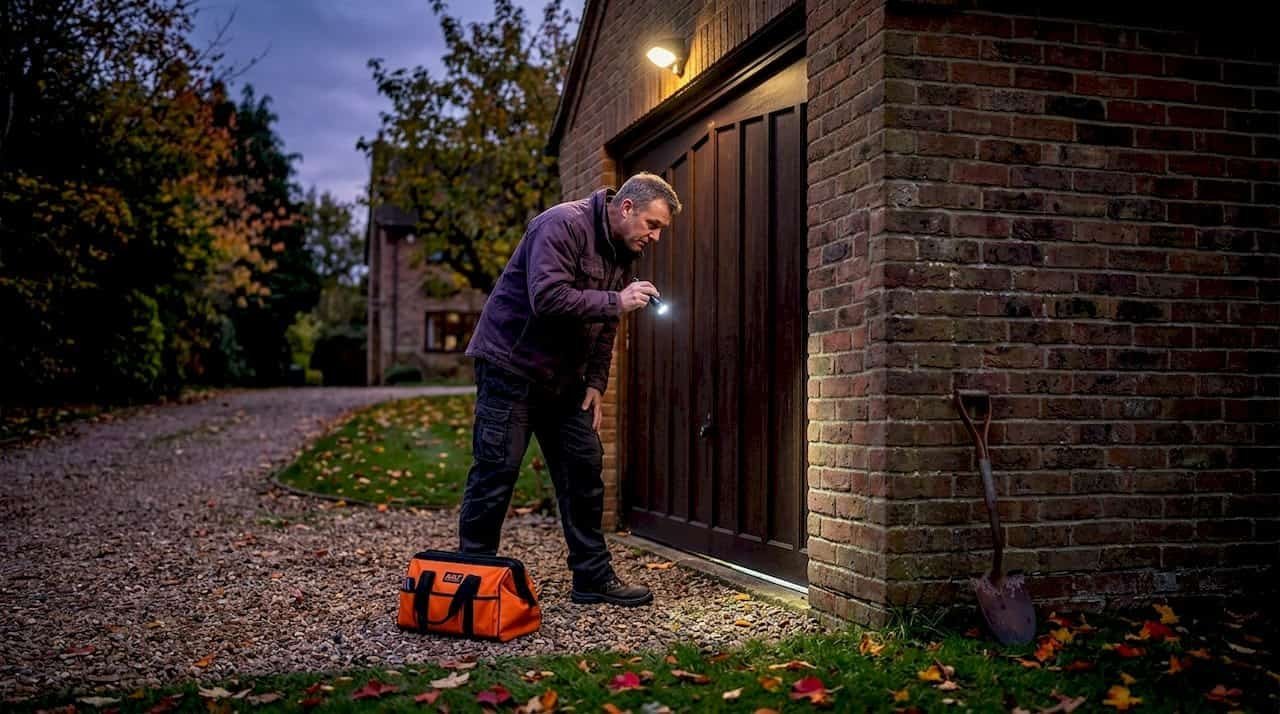
Pro Tip: Walk around your garage at night and look at it the way a would-be intruder might. Poor lighting, gaps under the door, and a visible remote clipped to your sun visor are all invitations.
2. Secure The Emergency Release Mechanism
The emergency release cord is the single most exploited weak point in a standard garage door. A thin wire coat hanger, fed through the gap at the top of the door, can hook the cord and trigger the release in seconds. It is a technique widely known among burglars and takes under a minute.
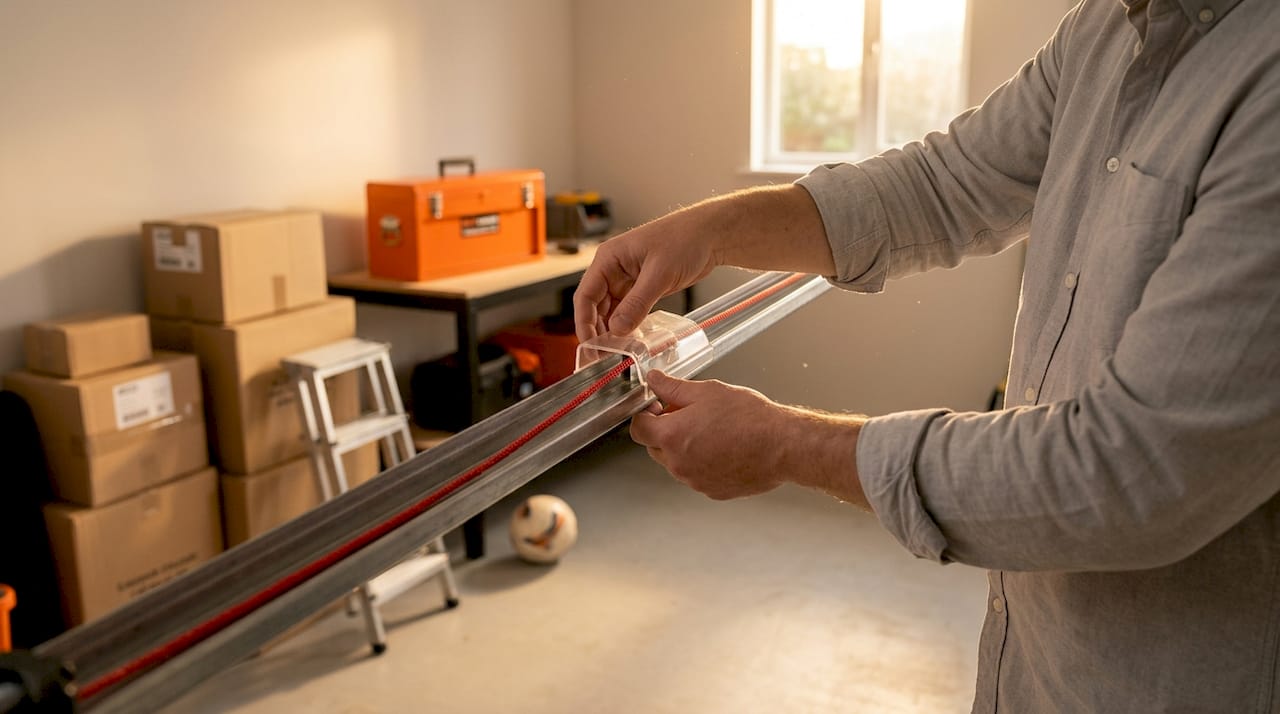
There are two practical ways to address this. The first is to install a plastic emergency release shield for around £15 to £20. It clips over the lever and blocks hook access while still allowing you to pull the cord from inside in a genuine emergency. The second method involves using a light zip-tie threaded through the release cord’s hole. Zip-ties break on a firm pull from inside, so they do not trap you, but they prevent casual exploitation from outside.
Both options take minutes to install and require no tools or landlord permission, making them ideal for renters and homeowners alike.
3. Reinforce The Garage Door Itself
A standard up-and-over or roller door can flex significantly under force. Adjusting the door limits on your opener to eliminate the gap at the top of the door removes one of the most common fishing entry routes. While you are at it, inspect the door panels for damage. Cracked or thin panels offer less resistance and are worth replacing if your door is ageing.
Adding slide bolts to the inside of the door tracks when the garage is not in use is a low-cost and highly effective physical measure. These prevent the door from being lifted even if the opener is bypassed. Keeping rollers and tracks well maintained also helps, as a door that moves smoothly is harder to force than one that rattles and flexes.
For homeowners looking at upgrading door locks across their property, a garage door hasp and padlock using a British Standard-approved lock is worth considering for doors that are rarely used as the main entry.
4. Fit The Best Garage Locks For Your Door Type
Not all garage doors take the same locking hardware, so matching the lock to the door matters. Side-hinged garage doors can accept a mortice deadlock or a high-security padlock with a hardened steel shackle. Roller and sectional doors often benefit from additional barrel bolts or T-handle locking kits.
For up-and-over doors, a garage defender or floor-mounted lock post placed in front of the door when it is down provides a visible, physical barrier that deters opportunistic attempts. These are particularly useful overnight or when you are away for extended periods.
When choosing the best garage locks, look for products that are British Standard BS EN 12209 approved or equivalent. Insurance providers sometimes require this standard, so it is worth checking your policy before purchasing.
Pro Tip: If your garage door is older than ten years, the locking mechanism itself may be worn or outdated. A locksmith can assess whether a repair or full replacement offers better value.
5. Upgrade To a Smart or Rolling-Code Garage Door Opener
If your garage door opener is more than a decade old, it may still use a fixed access code. That means a determined thief with a code grabber device can capture your signal and replay it to open your door. Rolling-code technology changes the access code after every single use, making signal capture pointless.
Modern smart openers go further still. They allow you to open and close your door from a smartphone app, receive alerts when the door opens, and review an activity log showing every entry and exit. That kind of visibility means you know immediately if something is wrong, rather than discovering it hours later.
For renters who cannot modify the existing opener, a battery-operated smart controller that attaches to standard garage doors without wiring is a practical alternative.
6. Install motion-Activated Lighting Outside Your Garage
Darkness is a burglar’s best friend. Motion-activated lights placed above or beside your garage door remove that advantage instantly. When someone approaches, the sudden flood of light is enough to make most opportunists walk away.
Solar-powered motion lights cost under £30 and require no wiring at all, making them ideal for renters or anyone who wants a fast, fuss-free upgrade. Position them so they cover both the main door and any side access points, and check monthly that the sensor angle has not shifted.
Good lighting also works in combination with cameras, since footage recorded in well-lit conditions is far more useful to police than blurry dark images.
7. Add Security Cameras and Alarm Sensors
Garage alarms with real-time notifications and visible outdoor cameras serve two purposes: deterrence and evidence. A camera positioned above the garage door and clearly visible signals to anyone approaching that they are being recorded. Some models include a built-in siren and strobe light that activates on motion, which adds another layer of active deterrence.
Inside the garage, a door contact sensor alerts you the moment the door opens unexpectedly. Tilt sensors on the door and window sensors on any side openings round out a thorough system. For reliability, choose devices with battery and cellular backup, so a power cut or internet outage does not leave you unprotected. Testing your system during a power outage and at night confirms it works when it matters most.
Non-invasive removable sensors with no-drill mounts and plug-in cameras are widely available and work well in rented properties without leaving marks or requiring permission.
| Security measure | Cost range | Suitable for renters | Installation difficulty |
|---|---|---|---|
| Motion-activated lights | £15 to £40 | Yes | Easy |
| Door contact sensors | £20 to £50 | Yes | Easy |
| Smart garage opener | £80 to £200 | Conditional | Moderate |
| Emergency release shield | £15 to £25 | Yes | Easy |
| Floor-mounted door lock post | £40 to £80 | Yes (removable) | Easy |
| Security camera | £30 to £120 | Yes (plug-in) | Easy to moderate |
8. Secure The Interior Door Connecting Your Garage to Your Home
Most people think of garage security as protecting the garage door itself. But if a burglar does get inside your garage, the door connecting it to your home is usually the next target. Many of these doors are hollow-core or fitted with basic locks that would not be acceptable on a front door.
Treat this interior door as an exterior entry point. That means fitting a five-lever mortice deadlock or a quality anti-snap Euro cylinder, reinforcing the frame with a steel strike plate, and making sure the door is solid-core. These changes are also among the most cost-effective security upgrades you can make, because a well-secured interior door significantly limits what a burglar can do even if the garage itself is compromised.
If you are unsure whether your interior door meets a reasonable security standard, the team at Ahlp can assess and upgrade it quickly. We cover Bristol, South Gloucestershire, and Gloucester, using British Standard and insurance-approved hardware throughout.
9. Build Better Daily Habits Around Your Garage
Hardware alone will not keep your garage secure if habits work against it. The most common and preventable garage crimes are opportunistic. They happen because a remote was left in plain sight in a car, a door was left open for convenience, or no one thought to check the side door latch.
Here are the behavioural changes that make the biggest practical difference:
- Remove your garage door remote from your car and switch to a keypad or smartphone app instead. Thieves target visible remotes in parked cars as a direct route into your home.
- Keep the garage door closed whenever it is not actively in use, even for short periods. A door left open for ten minutes is an opportunity.
- Lock side doors and windows even when the main door is down.
- Do not store ladders, tools, or crowbars where they could be used to break into the house if someone gets inside the garage.
- If you have neighbours you trust, ask them to alert you to anything suspicious near your property when you are away.
- Test your sensors, lights, and opener every month or two to confirm everything is working as expected. Regular maintenance checks are one of the simplest parts of a garage security checklist that people forget.
10. Compare Your Options and Prioritise What Matters Most
Not every homeowner needs every measure. Understanding what each option offers helps you put your money and effort where it counts most.
| Measure | Best for | Limitations | Cost |
|---|---|---|---|
| Emergency release shield | All properties | Does not address other entry points | Low |
| Physical slide bolts | Infrequently used garage | Manual use only | Low |
| Smart garage opener | Regular daily use | Requires Wi-Fi and power backup | Medium |
| Motion-activated lighting | All properties | Deterrence only, not a barrier | Low |
| Security camera | Monitoring and evidence | No physical barrier | Low to medium |
| Interior door upgrade | All attached garages | Requires installation | Medium |
| Alarm with cellular backup | High-value contents | Monthly subscription may apply | Medium |
Quick wins for a modest budget include the emergency release shield, motion lights, and a floor-mounted lock post. For longer-term investment, a smart opener with rolling codes and a properly secured interior door offer the most significant improvement to your overall home garage protection. Renters should start with removable sensors, plug-in cameras, and the release shield, all of which can come with you when you move.
My Honest Take on What Actually Works
I’ve seen a lot of garages over the years, and the pattern is almost always the same. People spend money on cameras or smart openers and then completely neglect the emergency release cord and the interior door. A camera records a break-in. A proper physical barrier stops one.
In my experience, the single most impactful thing most people can do costs under £20. That is protecting the emergency release cord with a shield or zip-tie. It removes what is probably the most exploited garage entry method, and it takes five minutes.
Where I see people go wrong is treating any single measure as the whole answer. Stacking physical barriers with electronic monitoring creates a genuinely difficult target. On its own, each measure has a workaround. Together, they do not.
And please, upgrade that interior door. It should be solid-core with a proper deadlock. Treat it the way you would your front door, because if someone gets into your garage, it is your front door.
— Martyn
How AHLP can Help You Secure Your Garage
If you have read through this and realised your garage has gaps worth addressing properly, Ahlp is ready to help. We provide professional garage and home locksmith services across Bristol, South Gloucestershire, and Gloucester, covering everything from upgrading interior door locks and fitting high-security hardware to full security consultations and emergency callouts. There are no call-out fees, and we use only British Standard and insurance-approved hardware on every job. Whether you need a five-lever mortice lock fitted to your connecting door, a new Euro cylinder, or advice on the best garage locks for your specific setup, our team will give you a straight answer and a fair price. Call us on 07700 100146 or visit ahlp.co.uk to arrange a visit.
FAQ
How do most burglars get into a garage?
The most common method is fishing the emergency release cord through the gap at the top of the door using a thin hooked wire. Installing an emergency release shield or zip-tie costs under £20 and blocks this technique entirely.
What are the best garage locks for an up-and-over door?
A floor-mounted lock post or garage defender combined with slide bolts inside the door tracks offers strong protection. Look for British Standard BS EN 12209-approved hardware for insurance compliance.
Can renters improve garage security without damaging the property?
Yes. Removable sensors and plug-in cameras with no-drill mounts provide reliable security without permanent installation, making them well-suited to rental properties.
How does rolling-code technology improve garage door security?
Rolling-code openers generate a new access code after every use, which prevents thieves from capturing your remote signal and replaying it to open the door.
Should I secure the door between my garage and house?
Absolutely. That interior door should be treated as an exterior entry point, fitted with a solid-core panel, a five-lever mortice deadlock or anti-snap Euro cylinder, and a reinforced steel strike plate.