

Over half of commercial break-ins happen due to outdated or poorly specified locking systems. For British property managers and business owners in Bristol, security is more than just peace of mind—it is a regulatory and insurance requirement. Understanding the different commercial lock types, along with their compliance to British and European standards, helps you safeguard assets, support emergency planning, and protect your business from costly risks.
Table of Contents
- Defining Commercial Locks and Their Role
- Comparing Common Commercial Lock Types
- Key Features and Security Standards Explained
- British Standards and Insurance Compliance
- Selecting, Installing, and Maintaining Commercial Locks
Key Takeaways
| Point | Details |
|---|---|
| Importance of Commercial Locks | Commercial locks are essential for safeguarding business premises and must comply with rigorous security standards and regulations. |
| Diverse Lock Types | Various commercial lock types, such as Mortice Locks and Electronic Access Control, cater to specific security needs and usage scenarios. |
| Security Standards and Insurance Compliance | Adherence to British Standards, like BS3621 and TS007, is crucial for insurance coverage and minimising liability risks. |
| Strategic Lock Management | Regular audits and professional installation are key to maintaining optimal lock performance and security compliance. |
Defining Commercial Locks and Their Role
Commercial locks represent specialised security mechanisms designed to protect business premises, assets, and personnel. Unlike residential locks, these systems address more complex security requirements for organisations across various sectors.
In professional environments, commercial locks serve multiple critical functions beyond basic entry prevention. Comprehensive locking hardware specifications demonstrate how these mechanisms integrate into broader building safety frameworks. They must comply with rigorous British and European standards, ensuring not just security but also critical considerations like fire resistance, emergency escape route management, and accessibility.
Key characteristics of commercial locks include enhanced durability, sophisticated access control mechanisms, and the ability to manage multiple user permissions. Businesses typically require locks that can:- Restrict access to sensitive areas- Track and log entry attempts- Support multiple key holders- Withstand high-traffic environments- Integrate with electronic security systems
Pro tip: When selecting commercial locks, prioritise systems that offer granular access control and robust audit trail capabilities to maximise both security and operational efficiency.
Comparing Common Commercial Lock Types
Commercial properties require sophisticated security solutions that go beyond standard residential lock mechanisms. Comprehensive lock type comparisons reveal several critical lock categories designed to address diverse security challenges across different business environments.
The primary commercial lock types include mortice locks, Euro cylinder locks, electronic access control systems, magnetic locks, and master key systems. Each type offers unique advantages tailored to specific security requirements. Mortice locks provide exceptional security for solid doors, featuring a robust mechanism installed within the door’s thickness. Euro cylinder locks offer remarkable versatility, functioning effectively across multiple door materials and providing straightforward replacement options.

Electronic access control systems represent the most advanced commercial lock technology, enabling businesses to manage entry permissions with unprecedented precision. These systems allow organisations to:- Restrict access to sensitive areas- Create individualised user credentials- Monitor and log entry attempts- Implement time-based access restrictions- Integrate with broader security infrastructure
The following table summarises the unique strengths of common commercial lock types for business settings:
| Lock Type | Key Strength | Suitable Business Use |
|---|---|---|
| Mortice Lock | High physical security | Banks, museums, government buildings |
| Euro Cylinder Lock | Flexibility, easy replace | Offices, shops, mixed-use properties |
| Electronic Access Control | Advanced permission logic | Data centres, corporate campuses |
| Magnetic Lock | Seamless access, no moving parts | Healthcare, schools, large complexes |
| Master Key System | Multi-level access | Hotels, schools, facilities management |
Pro tip: When selecting commercial locks, consult security professionals who can assess your specific premises and recommend lock systems that balance robust protection with operational flexibility.
Key Features and Security Standards Explained
Commercial lock security extends far beyond simple mechanical barriers. Precise key control and security protocols represent critical components in establishing comprehensive organisational protection strategies. Modern commercial locks must meet rigorous standards that address not just physical security, but also sophisticated access management and compliance requirements.
The essential features of high-grade commercial lock systems include robust durability, advanced access control, comprehensive audit capabilities, and integration potential. These systems are engineered to withstand significant physical stress, resist tampering, and provide granular control over who can access specific areas within a business premises. Organisations require locks that can:- Restrict access to sensitive zones- Generate detailed entry logs- Support multiple permission levels- Operate across integrated security networks- Maintain functionality under extreme conditions
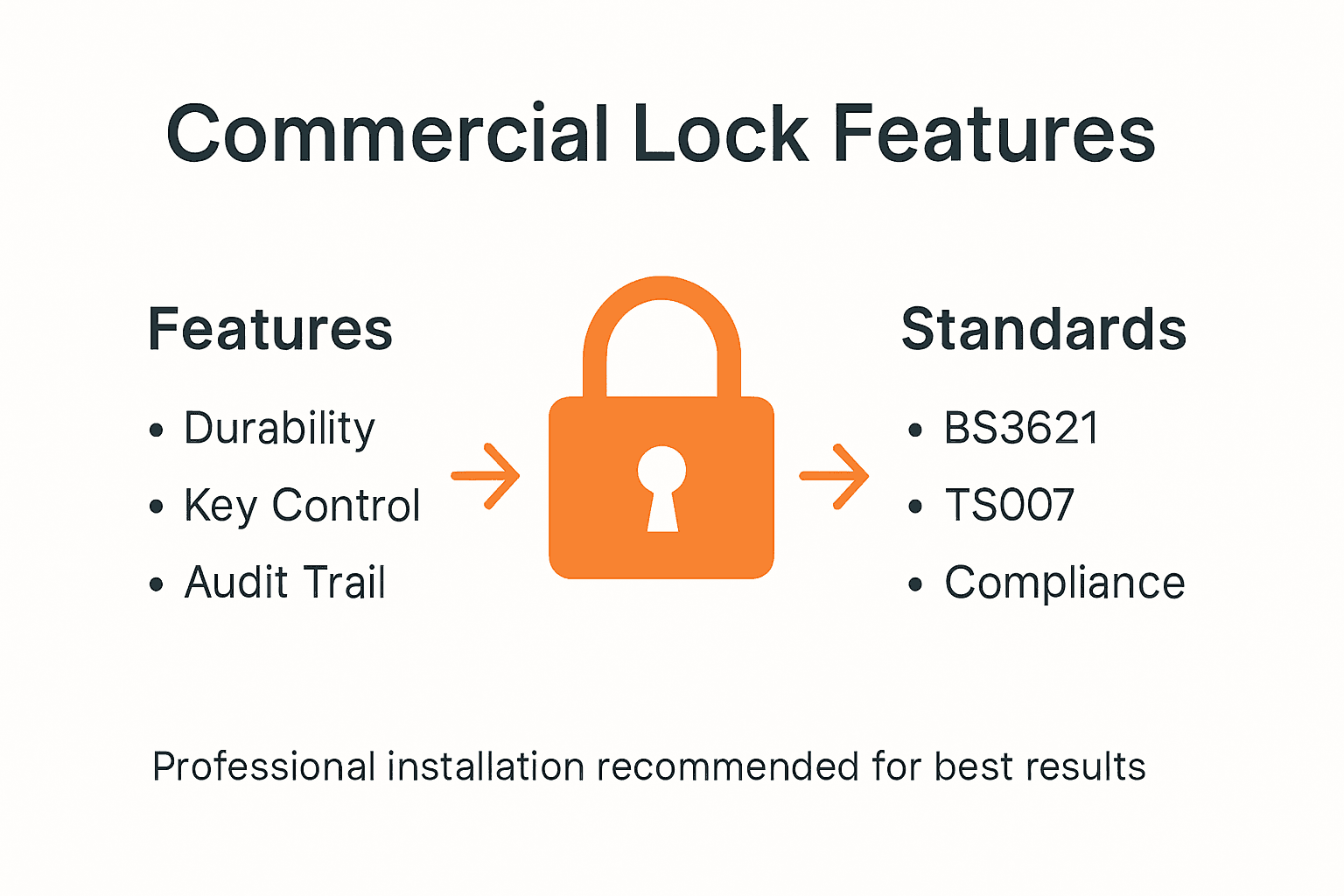
Security standards for commercial locks involve multiple layers of compliance, including British and European regulations that mandate specific performance criteria. These standards evaluate locks based on factors such as resistance to picking, drilling, and forced entry, ensuring that commercial properties maintain robust protective mechanisms. Electronic and mechanical systems must demonstrate consistent reliability, with manufacturers required to submit extensive testing documentation proving their products meet stringent safety and performance benchmarks.
Pro tip: Conduct annual security audits to ensure your commercial lock systems remain compliant with current industry standards and effectively address evolving security challenges.
British Standards and Insurance Compliance
Commercial lock security transcends mere mechanical protection and enters the critical realm of legal and insurance compliance. Insurance policy requirements for lock standards demonstrate the intricate relationship between lock quality, security performance, and financial protection for businesses.
Two primary British Standards dominate commercial lock specifications: BS3621 and TS007. These rigorous standards establish comprehensive criteria for lock performance, focusing on critical attributes such as resistance to picking, drilling, and forced entry. The British Standards kitemark serves as a crucial indicator, signalling that a lock has undergone extensive testing and meets stringent security benchmarks required by insurance providers. Businesses must ensure their lock systems comply with these standards to:- Maintain valid insurance coverage- Demonstrate proactive security management- Reduce potential liability risks- Protect against potential financial losses- Ensure comprehensive property protection
Here is a reference guide to major British commercial lock standards and their business insurance implications:
| Standard | Focus Features | Insurer Benefit | Where Required |
|---|---|---|---|
| BS3621 | Pick & force resistance | Meets base security requirements | External doors, entrances |
| TS007 | Cylinder attack resistance | Reduces forced entry risk | uPVC and composite doors |
| Kitemark | Independently verified | Confirms tested reliability | All compliant lock products |
Insurance providers meticulously evaluate lock systems, considering factors beyond mere mechanical functionality. They assess installation quality, overall security infrastructure, and the specific vulnerabilities of commercial premises. Non-compliant lock systems can result in reduced coverage, increased premiums, or even complete denial of insurance claims in the event of a security breach.
Pro tip: Consult with your insurance provider annually to confirm your current lock systems meet the latest British Standards and maintain full policy compliance.
Selecting, Installing, and Maintaining Commercial Locks
Navigating the complex landscape of commercial lock selection requires strategic planning and a comprehensive understanding. Professional security protocols for lock management emphasise the critical importance of methodical approaches to procurement, installation, and ongoing maintenance.
The lock selection process demands careful consideration of multiple factors, including security rating, durability, compatibility with existing infrastructure, and long-term maintenance requirements. Businesses should evaluate locks based on:- Specific security vulnerabilities of their premises- Traffic volume and access frequency- Regulatory compliance requirements- Budget constraints- Potential integration with broader security systems
Professional installation represents a crucial stage in ensuring lock effectiveness. Qualified locksmiths must perform precise measurements, ensure proper alignment, and test mechanical and electronic mechanisms thoroughly. This process involves verifying:- Correct mounting and alignment- Smooth operational functionality- Compatibility with door materials- Electrical system integration (for electronic locks)- Compliance with British Standards and insurance requirements
Pro tip: Schedule professional lock system audits every 12 months to identify potential vulnerabilities, ensure ongoing compliance, and maintain optimal security performance.
Secure Your Business with Trusted Commercial Lock Solutions
Understanding the importance of commercial locks means recognising the need for robust security that meets British Standards and insurance requirements. If you are concerned about protecting sensitive areas, managing multiple users, or enhancing your property’s safety with reliable, compliant locks, AHLP Locksmiths offers expert solutions tailored to your business. Our team specialises in professional lock installation, maintenance, and upgrades, including master key systems and anti-snap lock enhancements designed to keep your premises secure and accessible only to authorised personnel.
Don’t wait until a security breach or lock failure puts your business at risk. Whether you require urgent assistance or a comprehensive security upgrade, our Local Locksmith – Auto Home Lock Pro services deliver trusted expertise across Bristol, South Gloucestershire, and Gloucester. Contact us now to benefit from transparent pricing, fast response times, and a family-run locksmith service committed to your peace of mind. Arrange a visit or discuss your commercial lock needs at ahlp.co.uk/contact/ today. For immediate help with lock emergencies, explore our Emergency Locksmith – Auto Home Lock Pro services and secure your business with confidence.
Frequently Asked Questions
What are commercial locks?
Commercial locks are specialised security mechanisms designed to protect business premises, assets, and personnel. They offer enhanced durability and advanced access control to meet complex security requirements in various sectors.
Why are commercial locks important for businesses?
Commercial locks are critical for safeguarding sensitive areas, tracking entry attempts, and supporting multiple key holders in high-traffic environments. They integrate with electronic security systems and adhere to rigorous standards, ensuring overall security and compliance.
How do commercial locks differ from residential locks?
Unlike residential locks, commercial locks are designed to address more complex security needs, such as higher durability, sophisticated access control mechanisms, and the ability to manage multiple user permissions tailored to specific business requirements.
What key features should I look for in commercial locks?
When selecting commercial locks, consider features such as durability, advanced access control, audit capabilities, and compliance with security standards. It’s essential to evaluate how these locks can protect sensitive areas and operate under the specific conditions of your premises.
Recommended
- Commercial vs Residential Locks: Security and Legal Differences
- Locksmith Terminology Explained: What Every Homeowner Needs
- Why Regular Lock Maintenance Matters for Security
- Commercial Locksmith Services Bristol |AHLP Locksmiths
- Why Renovate Commercial Property: Boost Value and Success – Astrotech Construction