
TL;DR:
- Acting quickly after losing a key reduces costs and security risks.
- Proper documentation is essential before replacing keys, including proof of ownership and ID.
- Local locksmiths are faster and cheaper than dealerships for key replacement services.
Losing a key is one of those moments that turns an ordinary day upside down. Whether it slips from your pocket during a trip across Bristol or snaps off in the lock on a cold morning, the immediate worry is always the same: is your home or car now at risk? Many homeowners and tenants make the mistake of waiting, hoping the key will turn up, but every hour of delay increases your security exposure. This guide walks you through exactly what to do, what to prepare, and how to avoid the costly mistakes that make a stressful situation even worse.
Table of Contents
- What you need before replacing a key
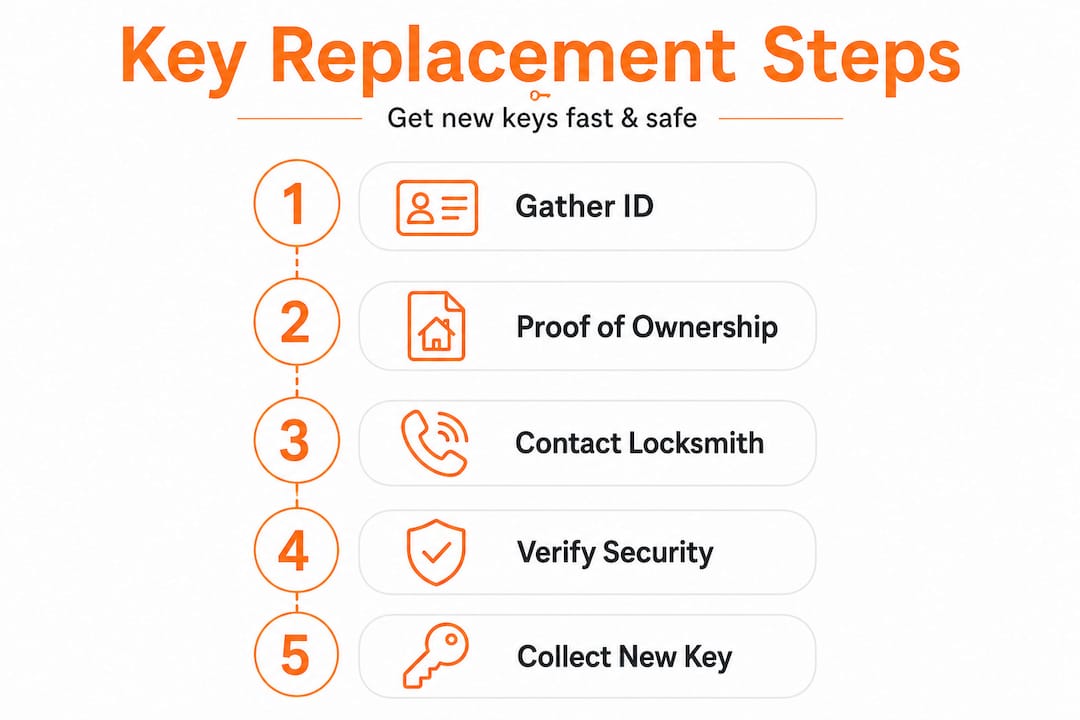
- Step-by-step key replacement process
- Troubleshooting and edge cases
- What to expect: costs, response times and results
- Why it pays to act quickly: the reality behind key replacement
- Find reliable locksmith help for your key replacement
- Frequently asked questions
Key Takeaways
| Point | Details |
|---|---|
| Prepare your documents | Having ID and proof of ownership ready speeds up key replacement and avoids delays. |
| Check locksmith options | Local locksmiths often offer faster, more affordable key solutions than dealerships. |
| Act quickly for security | Replacing lost keys fast reduces security risks for your home or vehicle. |
| Know your costs | Prices vary from £20 for a standard key up to £500+ for smart keys, so ask for a quote in advance. |
What You Need Before Replacing Your Key
Now that you know the importance of fast action, let’s look at what you need before you start.
Before you call a locksmith or visit a key-cutting service, gathering the right documents and information will save you a significant amount of time. Turning up unprepared can delay the entire job, sometimes by hours, so it pays to have everything ready in advance.
Documents and items you will need:
- A valid form of photo ID such as a passport or driving licence
- Proof of your current address, for example a recent utility bill or bank statement
- Proof of ownership for key replacement such as your V5C logbook for a vehicle, or a tenancy agreement and mortgage statement for a property
- The make, model and year of your vehicle if replacing a car key
- Any existing key codes or lock reference numbers if you have them
- Your insurance documents, as some policies cover key replacement costs
It is worth noting that proof of ownership is required before any legitimate locksmith or dealer will cut or programme a replacement key. This requirement exists to protect you as much as anyone else. A reputable locksmith will always ask for this documentation, and you should be cautious of any service that does not.
Typical cost ranges for different key types:
| Key type | Locksmith cost (approx.) | Dealer cost (approx.) |
|---|---|---|
| Standard door key | £5 to £20 | £10 to £40 |
| Basic car key (cut only) | £20 to £60 | £50 to £150 |
| Transponder car key | £80 to £180 | £150 to £400 |
| Smart/proximity fob | £100 to £250 | £200 to £500 |
| UPVC or mortice lock key | £15 to £50 | Not typically available |
As you can see, the cost difference between a local locksmith and a franchised dealer is substantial. For restoring security after lost keys, a local professional is almost always the smarter, faster and more affordable choice.
Several factors can speed up or delay the process significantly. Having the lock brand and serial number, a spare key to copy, or the key code stamped inside your vehicle’s door frame all make the job faster. Without these details, the locksmith may need additional time to identify the correct blank or programming sequence.
Pro Tip: Photograph the label on your lock barrel or the key code plate inside your car door before you ever lose a key. Storing this image in your phone’s photos folder means you can retrieve it in seconds when you need it most.
Step-By-Step Key Replacement Process
Once you’ve gathered everything you need, you’re ready to begin the actual process.
The process differs slightly depending on whether you’re replacing a home key, a basic car key, or a modern smart fob. Understanding each route in advance helps you avoid wasted calls and unnecessary delays.
Home key replacement:
- Confirm whether your lock needs rekeying or a straight key copy. If the key was lost in a public place, rekeying is strongly recommended.
- Contact a local locksmith in Bristol and describe the lock type, whether it’s a Yale-style night latch, a Euro cylinder, a mortice deadlock, or a multipoint UPVC lock.
- Provide your ID, proof of address and proof of ownership on arrival.
- The locksmith will either cut a new key from a blank, rekey the existing lock cylinder, or replace the cylinder entirely if rekeying is not possible.
- Test every new key before the locksmith leaves the property.
Standard and transponder car key replacement:
- Identify your key type. Basic cut keys are straightforward. Transponder keys contain a microchip that must be programmed to communicate with your vehicle’s immobiliser.
- Confirm whether your locksmith carries the relevant programming equipment for your make and model.
- Provide your V5C and photo ID on arrival.
- The locksmith will cut the key and, for transponder keys, use specialist software to programme the chip to your vehicle.
- Test the key in the ignition and all doors before signing off the job.
Smart key and proximity fob replacement:
- Contact a locksmith who specifically handles smart key systems and ask in advance whether they cover your vehicle brand.
- Provide full documentation including your V5C, insurance certificate and photo ID.
- The locksmith will programme the new fob to your car’s onboard computer, often using brand-specific diagnostic software.
- Confirm all functions work, including remote locking, unlocking and engine start.
When comparing your options, local locksmiths consistently outperform main dealers on both speed and cost. Locksmiths are cheaper than dealers for car key replacement in most cases, often by a margin of 40 to 60 per cent. A comparison of Bristol locksmiths shows that many local providers can attend within the hour and carry parts for the most common vehicles on the road.
Pro Tip: When you call a locksmith, ask directly whether they carry blanks and programming equipment for your specific vehicle make and model. This single question can save you a wasted callout and get you mobile again much faster.
Understanding emergency locksmith procedures before you need them means you will not be caught off guard during what is already a stressful situation.
Troubleshooting and Edge Cases
Even with a smooth process, issues can crop up — here is how to solve them quickly.
Some key replacement jobs are straightforward. Others throw up complications that catch people off guard. Knowing the most common problem scenarios in advance keeps you calm and in control.
Common problems and how to handle them:
- Fob battery replacement followed by lost sync: Modern key fobs use a CR2032 or CR2025 battery. After replacing the battery, the fob may lose its synchronisation with the vehicle. In most cases you can resync the fob by standing near the car, pressing the lock and unlock buttons simultaneously, then starting the engine. If this does not work, a locksmith with diagnostic tools can resync it within minutes.
- All keys lost for a vehicle: This is one of the most serious situations. If no keys remain, the vehicle’s immobiliser cannot simply be bypassed with a new blank. A full lock and immobiliser replacement may be required. Contact a locksmith immediately rather than a dealer to keep costs as low as possible.
- All keys lost for a home: Do not sleep on this. Contact a locksmith the same day for a full lock replacement service. Even if you believe the key may have been dropped somewhere private, you cannot be certain who has found it.
- UPVC multipoint lock failure: If the key turns but the door mechanism does not engage, this is usually a mechanical fault in the gearbox rather than a key issue. A locksmith can diagnose this quickly.
- Key snapped in the lock: Do not attempt to remove it yourself with sharp objects, as this often pushes the broken key further into the barrel. A locksmith uses specialist extraction tools that remove the fragment without damaging the lock.
“If all keys have been lost for a vehicle, the entire lock system and programming may need to be replaced to maintain security.”
Mistakes to avoid:
- Calling a franchised dealer before checking local locksmith availability. Dealers typically have waiting times of several days and charge considerably more.
- Trying to copy a key at a hardware shop without confirming the lock type. Poorly cut blanks cause long-term wear to your lock barrel.
- Waiting to see if a lost key turns up. Every day without replacement is a day your property is potentially exposed.
What to Expect: Costs, Response Times and Results
Understanding the possible outcomes can help you stay calm and make the best choices after a stressful lockout.
Knowing what good service looks like before you need it puts you in a much stronger position when comparing providers. Not all locksmiths operate to the same standard, and Bristol has a wide range of providers with varying response times, pricing structures and levels of transparency.
Price guide by key type (Bristol area, 2025):
| Service | Low estimate | High estimate |
|---|---|---|
| Home key cutting (standard) | £8 | £25 |
| Euro cylinder replacement and key | £60 | £120 |
| Basic car key cut | £30 | £70 |
| Transponder key programming | £90 | £200 |
| Smart/proximity fob programming | £120 | £280 |
| Emergency out-of-hours callout | £80 | £180 |
Response times across Bristol vary, but reputable local locksmiths typically arrive within 20 to 60 minutes for emergency key replacement callouts. This is far faster than most dealers, who often cannot book you in for two to five working days.
When assessing emergency locksmith response times in Bristol, the key differentiators between a good and poor provider come down to a few clear signals. A reliable locksmith will give you a clear price estimate over the phone before attending, will not charge a call-out fee, will carry DBS certification and valid identification on arrival, and will offer a written receipt or invoice for every job. They will also use non-destructive entry methods wherever possible, protecting your door and lock hardware.
Red flags to watch for include vague pricing, refusal to provide ID, and any suggestion that the lock or security hardware must be replaced when a simpler solution is available. Transparency is the single biggest sign of a trustworthy provider.
Why It Pays To Act Quickly: The Reality Behind Key Replacement
From years of working with homeowners and tenants across Bristol and South Gloucestershire, we have seen a consistent pattern. The people who act within the first few hours of losing a key almost always face lower costs, less disruption and no security incidents. Those who wait, hoping the key will resurface, often face a more complicated and expensive outcome.
There is a commonly held belief that replacing a key is a purely reactive step, something you do only when you absolutely must. We think this is wrong. If a key is lost in a public space, your lock is effectively compromised the moment it leaves your hand. Someone picking it up may not know your address, but a modern key fob can be scanned, and your address is often not as difficult to trace as you might hope.
There is also an insurance angle that many people overlook. Some home insurance policies contain clauses that reduce your cover or void a claim if you failed to take reasonable steps to secure your property after a known key loss. Acting quickly is not just about peace of mind. It is about maintaining your legal and financial protection.
We also encourage people to think about key replacement proactively rather than reactively. Choosing best home lock choices with British Standard cylinders, anti-snap locks and restricted key profiles makes future key replacement much more manageable. Restricted keys can only be cut by authorised locksmiths, which means even if a key falls into the wrong hands, it cannot simply be copied at a hardware counter.
Local Bristol companies offer something that national chains rarely can: genuine familiarity with the area, the ability to respond fast, and the flexibility to tailor solutions to your specific home or vehicle. Speed and security are not mutually exclusive when you work with the right people.
Find Reliable Locksmith Help For Your Key Replacement
At AHLP Locksmiths, we offer fast, professional key replacement across Bristol, South Gloucestershire and Gloucester. Whether you need a standard door key cut, a transponder car key programmed, or a full lock replacement following a key loss, our team is ready to help. Explore our trusted locksmith services to see the full range of what we cover, or read our key replacement explained guide for more detail on how the process works. For a side-by-side look at what to expect from local providers, our locksmith comparison guide is a useful starting point. We operate with no call-out fees, transparent pricing and fast response times. Call us on 07700 100146 or visit ahlp.co.uk to book a visit or ask any questions.
Frequently Asked Questions About Key Replacement
How quickly can I get a new key replaced in Bristol?
Most locksmiths in Bristol respond within 20 to 60 minutes for emergency key replacement callouts, making them far faster than dealerships for urgent situations.
Do I need to show proof of ownership to get a replacement house or car key?
Yes, proof of ownership is required before any reputable locksmith will cut or programme a new key, whether for a vehicle or a property.
Are locksmiths cheaper than car dealerships for key replacement?
In most cases, yes. Locksmiths are cheaper than dealers for car key replacement, often by a significant margin, especially for transponder and smart key programming.
What happens if all keys are lost for my car or home?
If all keys are lost, a locksmith will likely need to replace the lock system entirely to ensure the property or vehicle is fully secure again.