

TL;DR:
- Proper key control protects against unauthorised access, insurance issues, and internal theft.
- Secure storage, comprehensive registers, role-based access, and regular audits are essential practices.
- Most failures occur from neglecting processes, not system flaws; consistent follow-through is vital.
Losing track of who holds a copy of your key is one of those risks that feels minor until something goes wrong. For homeowners and businesses across Bristol and South Gloucestershire, poorly managed keys can lead to break-ins, invalidated insurance claims, and serious compliance headaches. Whether you manage a single property or a multi-site operation, the good news is that strong key control is achievable with straightforward, proven methods. This guide walks you through every essential practice, from secure storage to lost key protocols, so you can protect what matters most.
Table of Contents
- Key control fundamentals: Why best practices matter
- Best practice 1: Secure key storage methods
- Best practice 2: Keeping a comprehensive key register
- Best practice 3: Controlling access with role-based permissions
- Best practice 4: Regular audits and lost key protocols
- Comparing key control strategies for homes vs businesses
- The overlooked truth: Why most key control plans fail in practice
- Take the next step: Trusted solutions for Bristol and South Gloucestershire
- Frequently asked questions
Key Takeaways
| Point | Details |
|---|---|
| Store keys securely | Always use a secure safe or cabinet with anonymous labelling and audit access regularly. |
| Keep a key register | Document every key issued, who holds it, and audit your register for fast issue resolution. |
| Use role-based access | Limit keys to those who need them and review permissions as circumstances change. |
| Audit and respond quickly | Schedule regular checks and act immediately if a key is lost or not returned. |
Key Control Fundamentals: Why Best Practices Matter
Key control is the process of managing, tracking, and restricting access to physical keys across any property. It covers who holds a key, where spare keys are kept, how copies are authorised, and what happens when a key goes missing. For many homeowners, this feels like an afterthought. For businesses, it sits at the heart of security policy and legal compliance.
The risks of poor key management are significant. Unauthorised access and insurance invalidation are two of the most serious consequences of lost, stolen or poorly tracked keys. These are not remote possibilities. A former employee who still holds a key, or a neighbour who was trusted with a spare that was never returned, represents a real and ongoing vulnerability.
For businesses, the stakes are even higher. Key registers are required for UK businesses under insurance conditions and ISO 27001, with regular audits forming part of accepted best practice. Failing to maintain proper documentation can mean a claim is refused or a certification lapses at the worst possible moment.
For homeowners, unchecked key sharing quietly increases burglary risk over time. You might trust everyone you have ever handed a key to, but circumstances change. People move, relationships shift, and keys get copied without permission.
The core outcomes that good key control delivers include:
- Minimised internal theft by limiting who can access which areas
- Reduced need for emergency lock changes due to better tracking
- Valid insurance cover maintained through documented procedures
- Greater peace of mind from knowing exactly who has access at any time
- Improved compliance for businesses operating under security standards
“A good key control system does not just protect against outsiders. It protects against the risks that build up quietly from the inside, through carelessness, convenience, and good intentions gone wrong.”
Solid key control also connects directly to preventing lockouts, since organised systems mean fewer lost keys and fewer panicked calls at inconvenient hours.
Best Practice 1: Secure Key Storage Methods
The foundation of any key control plan is knowing that every key has a secure, designated home when it is not in use. For homeowners, a wall-mounted key safe fitted discreetly near an entry point, or away from direct line of sight, provides a secure way to store spare keys for trusted contacts such as family members or care workers.
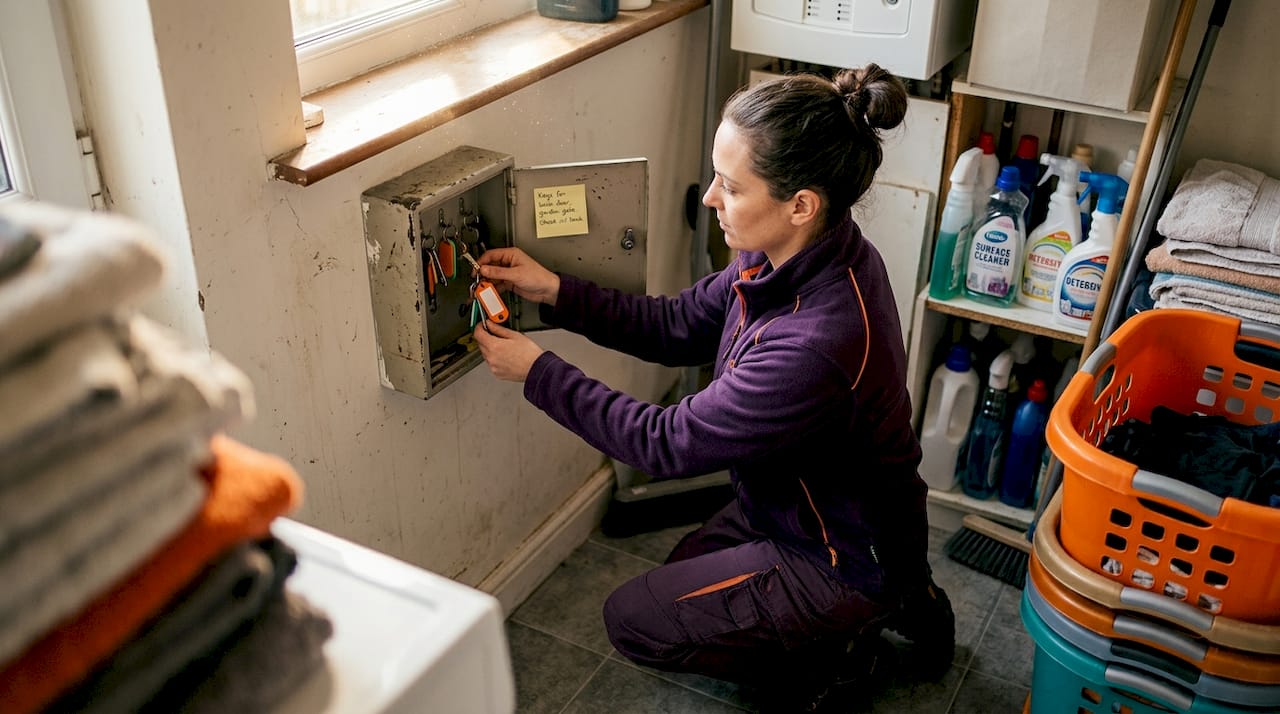
For businesses, a lockable key cabinet with individual hooks numbered for each key set is the appropriate solution. According to secure storage guidance, keys should be numbered rather than labelled with a description of the lock or property they open. A separate, password-protected index keeps the link between number and location confidential.
Here is what best practice storage looks like in action:
- Keys stored in a lockable cabinet or rated key safe, not in a drawer or on a hook by the door
- Each key assigned a unique number, with no identifying text on the key tag
- The key index stored separately, either in a secure digital system or a locked document
- Role-based access to the cabinet, so only authorised staff can retrieve keys
- The cabinet itself secured away from public or visitor areas
For businesses running master key systems or keyed alike systems, the master key deserves its own category in storage, with strictly limited access. Losing a master key in an unsecured environment is a major incident.
Emergency access arrangements, such as those needed by landlords, property managers, or family members for vulnerable residents, require extra diligence. A clear protocol for who can access the emergency key, under what circumstances, and with what documentation is essential. If a spare key is taken from the cabinet, that movement must be recorded.
Pro Tip: Conduct a quarterly check of your key cabinet or home key safe. Confirm all keys are present, no tags have become illegible, and the locking mechanism itself is functioning correctly. A five-minute check can prevent a significant security incident. If you are dealing with a lost key recovery situation, act immediately rather than waiting.
Best Practice 2: Keeping a Comprehensive Key Register
A key register is a formal record of every key in use across your property or organisation. It is the documentary backbone of key control, and without it, you are essentially operating on trust and memory alone.
Here is what every key register entry should contain:
- A unique key number or identifier
- A description of the lock or access point (kept in the separate, secured index)
- The name of the person the key was issued to
- The date of issue
- The expected return date or review date
- Confirmation of actual return and the date
For businesses, key registers are a legal and compliance requirement under certain insurance policies and ISO 27001. If your business holds certification or needs to demonstrate security governance, the register forms part of your evidence trail during audits.
| Register field | Why it matters |
|---|---|
| Unique key number | Prevents confusion and ensures traceability |
| Issue date | Establishes accountability from day one |
| Named holder | Creates clear responsibility for each key |
| Return date | Flags overdue or unaccounted keys |
| Audit date | Shows the register is actively maintained |
For homeowners, a simple written register kept in a secure place can tell you at a glance whether your neighbour still has the spare, or whether your cleaner returned all keys after their final visit. It removes reliance on memory entirely, which is where most problems begin.
Regular audits of the register are not optional. Audits are required as part of best practice for UK businesses, and for homeowners they should happen at least annually or after any significant change, such as a new tenant, a staff change, or a relationship breakdown.
Pro Tip: If you use digital key management software, always maintain a printed backup stored securely. Technology can fail at critical moments, and a paper record ensures continuity. Cross-reference both regularly to catch any discrepancies early. Pairing your register with insurance-approved locks gives you the strongest possible foundation for a valid claim if the worst happens.
Best Practice 3: Controlling Access with Role-Based Permissions
Role-based key control means assigning access only to people who genuinely need them to carry out their role, and reviewing that access regularly. It is a simple principle, but it is one of the most frequently ignored.
Think about a small business in Bristol. The owner, the manager, a cleaner, and a delivery driver might all have some level of access to the premises. But should all four have the same key? Almost certainly not. The delivery driver might only need access during certain hours. The cleaner may need access to common areas but not an office containing sensitive documents.
Role-based access prevents internal theft and significantly reduces the number of keys in circulation at any given time, which in turn reduces the risk that any one key will go unaccounted for.
| Access type | Risk level | Recommended approach |
|---|---|---|
| Unrestricted (same key for all) | High | Avoid wherever possible |
| Role-based (keys matched to duties) | Medium | Preferred for most businesses and shared homes |
| Time-limited (access only during hours needed) | Low | Ideal for contractors, cleaners, and delivery personnel |
| Managed master key system | Low to medium | Suited to multi-site businesses and landlords |
Key points for implementing role-based access effectively:
- Review access permissions every time a role changes or an employee leaves
- Never allow a key to be passed between colleagues informally. All transfers must go through the register
- Issue keys formally, with a signature from the recipient
- Master key systems offer a structured way to give layered access without issuing multiple keys, which is ideal for businesses with complex requirements
- Use secure access control solutions to strengthen the physical side of your permissions framework
Best Practice 4: Regular Audits and Lost Key Protocols
Audits bring your register, your keys, and your people back into alignment. Without them, even a well-designed system drifts over time.
For businesses, monthly audits are the benchmark. For homeowners and landlords, an annual check at minimum is advisable, with an additional review after any occupancy change. Here is a simple audit process to follow:
- Retrieve all keys from their designated storage
- Match each key against the register entry
- Confirm the current holder for any keys not in storage
- Check for any keys that may have been returned without being logged
- Identify any keys missing from the register entirely, which may indicate an unauthorised copy has been made
- Update the register with any corrections and record the audit date
Proper auditing and register maintenance is required for UK businesses operating under insurance and ISO 27001 conditions. Skipping audits is not just sloppy. It can have direct financial consequences if a claim arises.
When a key is reported lost or stolen, the protocol is clear:
“A missing key should never be ignored or hoped back into existence. Act immediately, trace its last known location, and assess the risk before deciding on next steps.”
Immediate reporting allows you to assess risk quickly. If the lost key has no identification attached and the location it was for is not obvious, the risk may be lower. But if any connection can be made between the key and a property, rekeying or replacing the affected lock is strongly advisable. Visit lost key steps to understand your options in full.
Comparing Key Control Strategies for Homes vs Businesses
Key control looks different depending on the scale and nature of your property. Here is how the key considerations compare:
| Feature | Home or landlord | Business or multi-site |
|---|---|---|
| Key register | Simple written log | Formal documented register, audited regularly |
| Storage method | Home key safe | Rated key cabinet with role-based access |
| Access permissions | Trusted individuals only | Role-based, formally issued |
| Audit frequency | Annually or after occupancy change | Monthly or per compliance requirement |
| Lost key response | Assess risk, consider lock change | Immediate reporting, rekeying, incident log |
| Compliance obligation | Insurance conditions | Insurance, ISO 27001, employer duty of care |
Specific scenarios worth considering include a buy-to-let landlord in South Gloucestershire who needs to track keys across multiple tenancies, a single-owner home where only one spare needs to be managed, a microbusiness with a small team and straightforward access needs, and a multi-site business that requires a master key system with layered permissions.
The deciding factors are always headcount, the value of assets at risk, and the specific terms of your insurance policy. Preventing home lockouts is much easier when your key control system reflects your actual situation rather than a one-size approach.
The Overlooked Truth: Why Most Key Control Plans Fail in Practice
Here is something we see regularly in our work across Bristol and South Gloucestershire. Most key control failures do not happen because the plan was wrong. They happen because the plan was never properly followed.
A business installs a key cabinet, sets up a register, and then six months later the register has three entries while twenty keys are in circulation. A homeowner buys a key safe, shares the code with four people, and forgets to change it when one of those people is no longer in their life. Good intentions, poor follow-through.
The critical mistake is trusting memory and convenience over process. People hand over keys informally because it is faster. They do not update the register because it feels like admin. They ignore a missing key because it will probably turn up. These small compromises accumulate into genuine vulnerabilities.
No software, no cabinet, and no safe is worth anything if the people using the system do not treat it consistently. The solution is making the process as easy as possible to follow. Set a calendar reminder for your next audit. Keep the register somewhere accessible. Make it clear to everyone involved that returning a key means logging it, not just dropping it on a desk.
Small teams and families are just as susceptible as large organisations. In fact, they are often more so because the informal atmosphere makes it easy to skip steps. Visit real lockout scenarios to understand how quickly inconvenience can escalate into a full security incident.
The properties and businesses we see managing key control best are not the ones with the most sophisticated systems. They are the ones where the process is simple, clearly understood by everyone involved, and reviewed without fail.
Take The Next Step: Trusted Key Control Solutions for Bristol and South Gloucestershire
At AHLP Locksmiths, we work with homeowners, landlords, and businesses across Bristol, South Gloucestershire and Gloucester to assess and modernise their physical security, including key control. Our local locksmith services cover everything from security consultations and master key installations to emergency callouts and lock upgrades. If you need key replacement services or want to understand the full benefits of upgrading your locks to British Standard or insurance-approved hardware, we are here to help. Call us on 07700 100146 or visit ahlp.co.uk to arrange a visit or get expert advice tailored to your property.
Frequently Asked Questions About Key Control
What should be included in a key register?
A key register should record each key’s unique number, who has it, when it was issued, and when it is returned. Every issuance, return, and holder must be documented to maintain an accurate trail.
Are there legal requirements for key control in the UK?
Businesses face legal and insurance obligations, including ISO 27001, to document and audit key control. These requirements apply to UK businesses under recognised compliance and security frameworks.
What is the safest way to store spare keys at home?
A secure, wall-mounted key safe with a code, positioned discreetly away from direct view, is the safest option. Secure key safes are recommended for storing master, access, and spare keys at home.
How often should keys and registers be audited?
Businesses should audit keys regularly, with monthly reviews considered best practice. Homeowners should audit at least once a year or after any change in occupancy or key register entries.
What action should I take if a key is lost or stolen?
Report the loss immediately and assess whether the key could be connected to your property by anyone who finds it. Unauthorised access risks make rekeying or replacing the affected lock the safest course of action.