

TL;DR:
- Security assessments are essential tools for homeowners and business owners, not just IT departments, as they identify and address genuine vulnerabilities. They involve physical, vulnerability, and penetration evaluations, with each serving specific purposes to create a comprehensive security plan. Regular reviews, professional evaluations, and linking controls to specific risks ensure ongoing protection and effective resource allocation.
Most people assume security assessments belong in the IT departments of large corporations. The reality is quite different. A security assessment is one of the most practical tools available to any homeowner or business owner who wants to understand where their property is genuinely vulnerable. Whether you are worried about a weak front door lock, inadequate lighting, or unsecured Wi-Fi, understanding what a security assessment is and how to conduct one gives you a clear picture of your actual risk rather than a vague sense of unease.
Table of Contents
- Key takeaways
- What is a security assessment, exactly?
- Types of security assessments
- How to conduct a security assessment
- Common pitfalls to avoid
- Your security assessment checklist
- My honest view on security assessments
- How Ahlp can help after your assessment
- FAQ
Key takeaways
| Point | Details |
|---|---|
| Definition of security assessment | A systematic process that identifies, evaluates, and helps mitigate security risks across your property. |
| Multiple assessment types exist | Physical, vulnerability, and penetration assessments serve different purposes and complement each other. |
| Follow a structured process | Preparation, risk identification, analysis, and a treatment plan are the four core steps. |
| Documentation matters | Recording findings and linking risks to specific controls is what turns an assessment into real protection. |
| Treat it as ongoing maintenance | Security assessments should be repeated after renovations, new technology, or any significant change to your property. |
What is a Security Assessment, Exactly?
A security assessment is a systematic process of identifying, evaluating, and addressing the security risks that affect a specific property, person, or organisation. The definition of security assessment goes beyond ticking boxes. Its real purpose is to align the protective measures you put in place with the actual threats you face, rather than applying random locks or alarms and hoping for the best.
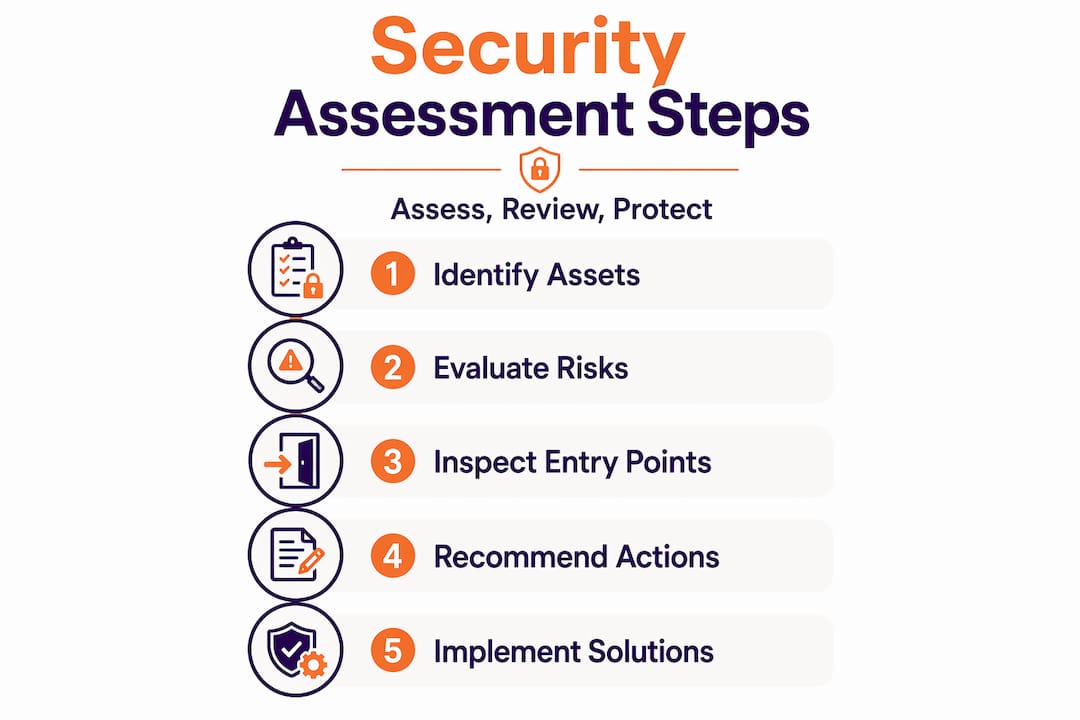
Think of it this way. A security assessment answers three questions in order: What do I have that needs protecting? What could go wrong? And what is the most sensible way to respond? The outcome is typically a risk register, which lists identified threats alongside their likelihood and potential impact, and a treatment plan that tells you what to do about each one.
Security assessments cover both physical and digital dimensions. For a homeowner, that might mean evaluating the quality of your door locks, the coverage of your outdoor lighting, and whether your home network is properly secured. For a business owner, it extends to access control systems, CCTV coverage, alarm monitoring, and the security of any digital devices connected to your network.
The key distinction worth understanding early is the difference between a security risk assessment and risk treatment. The assessment identifies and scores the risks. Treatment is the follow-up action, whether that means upgrading a lock, installing a new alarm, or simply accepting that a low-probability risk does not warrant immediate spending. These are two separate stages, and conflating them leads to poor decisions.
The risk assessment drives programme success in any security programme, focusing resources on real threats rather than creating a paper exercise that satisfies no one. This principle applies just as much to a three-bedroom house in Bristol as it does to a multinational firm.
Types of Security Assessments
Understanding the main types of security assessments helps you choose the right approach for your situation. Each type has a distinct focus, method, and output.
Vulnerability Assessment
A vulnerability assessment takes a broad view. It systematically scans for known weaknesses across a defined scope, whether that is a network, a building perimeter, or a set of access points. The goal is breadth: finding as many potential weaknesses as possible. Vulnerability assessments focus on breadth and automate discovery, making them well-suited to initial sweeps before deeper investigation begins.
Penetration Testing
Penetration testing goes a step further. A trained professional attempts to actively exploit the vulnerabilities found during a scan to see whether they are genuinely exploitable and what the real-world impact would be. Penetration tests prove exploitability and demonstrate business risk in a way a passive scan cannot. For most homeowners, this level of testing applies primarily to digital systems rather than physical ones.
Physical Security Assessment
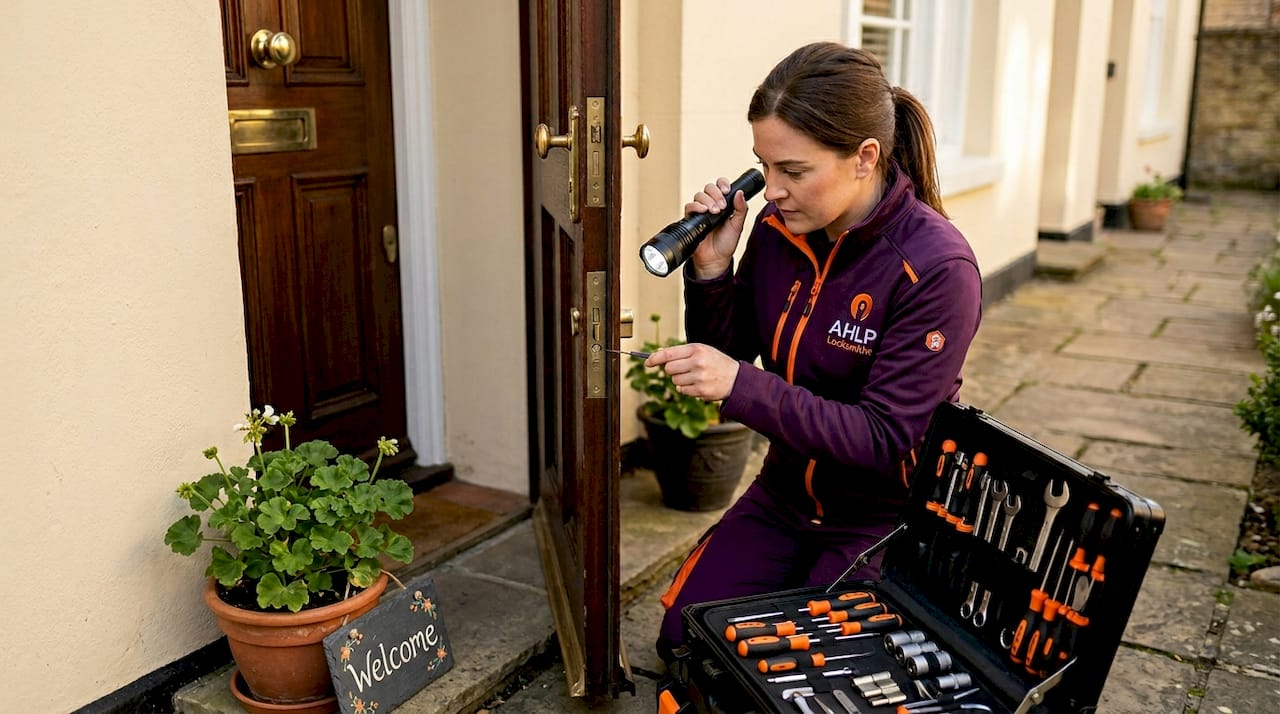
This is the type most relevant to property owners. A physical security assessment examines your locks, doors, windows, gates, lighting, alarm systems, and access control measures. A qualified assessor will walk your property, check whether locks meet British Standard ratings, test whether entry points are adequately reinforced, and note any surveillance blind spots. This is where a professional locksmith with assessment experience adds real value.
Here is a comparison of the three main types:
| Assessment type | Primary goal | Method | Key deliverable |
|---|---|---|---|
| Vulnerability assessment | Identify known weaknesses broadly | Automated scanning and manual review | List of vulnerabilities with severity ratings |
| Penetration testing | Prove weaknesses are exploitable | Simulated attack by trained professional | Exploitation report with business impact |
| Physical security assessment | Evaluate physical barriers and access control | On-site inspection by a qualified professional | Findings report with prioritised recommendations |
Pro Tip: Do not assume a vulnerability scan replaces a physical inspection, or vice versa. Confusing these two approaches leads to gaps in coverage. A thorough security programme uses both.
How to Conduct a Security Assessment
Knowing how to conduct a security assessment does not require specialist qualifications for a basic review. A structured approach produces useful results even at a beginner level. For high-value properties or complex business premises, commissioning a professional assessment is well worth the investment. A professional assessment can take from a few days to several weeks, depending on scope, and results in a detailed report with specific recommendations.
Here is a practical step-by-step process:
Identify your assets. List everything that needs protecting. For a home, this includes the building itself, valuables inside, vehicles, and digital devices. For a business, add stock, equipment, client data, and staff safety.
Identify threats and vulnerabilities. Walk the property and note potential entry points, weak locks, poor lighting, blind spots in camera coverage, and unsecured network equipment. Ask yourself how an opportunist burglar or targeted attacker might approach your property.
Analyse and score each risk. For each vulnerability, assess two factors: the likelihood of it being exploited and the impact if it were. A broken gate lock on a quiet residential street scores differently than the same defect on a commercial property with regular cash handling.
Develop a treatment plan. For each identified risk, decide on a response. Your options are to mitigate the risk (fit a better lock or add lighting), transfer it (take out adequate insurance), accept it (document that you have consciously decided the risk is low enough to leave), or avoid it (remove the asset or activity that creates the risk altogether).
Document your findings. Record everything in a risk register. This does not need to be complicated. A spreadsheet listing each risk, its score, your chosen response, and the action taken is sufficient for most residential and small business purposes.
Review and update regularly. A security assessment is not a one-time task. Revisit it after any renovation, significant change in occupancy, or new technology deployment.
Pro Tip: When commissioning a professional assessment, ask specifically whether the assessor uses a documented risk methodology. Auditors and insurers look for traceable links between the risks identified and the controls recommended. This matters when making insurance claims or demonstrating compliance.
Common Pitfalls to Avoid
Even well-intentioned assessments go wrong. Understanding the most common mistakes helps you get genuine value from the process rather than a false sense of security.
Confusing a vulnerability scan with a penetration test. These are not the same thing. One finds potential weaknesses. The other proves whether those weaknesses can actually be used against you. Using a scan report as a final word on your digital security overstates how protected you actually are.
Ignoring physical security entirely. Many property owners focus on alarms and cameras while overlooking the basic quality of their locks. A Euro cylinder lock without anti-snap protection is one of the most common points of entry for burglars in the UK. No digital alarm compensates for a door that takes seconds to compromise.
Applying controls without linking them to specific risks. Applying controls arbitrarily without connecting them to identified risks causes security failures and can invalidate insurance claims. Every measure you put in place should trace back to a specific risk in your register.
Treating assessment as a one-off event. A report that sits in a drawer and is never revisited provides no ongoing protection. Security conditions change. New vulnerabilities emerge. Tenants change. Technology is added. Your assessment should evolve with your property.
“The risk assessment is the heart of any security programme. Poor assessments become mere paperwork.”
- Relying solely on in-house judgment. Executing truly independent assessments is difficult when you are the person who set up the existing measures. External professionals bring objectivity and spot things familiarity causes you to overlook.
Your Security Assessment Checklist
Use this checklist to begin your own basic assessment or to prepare for a professional one. Work through each area and note findings as you go.
Exterior and perimeter
- Are all boundary fences, walls, and gates in good repair?
- Is exterior lighting adequate and motion-activated where appropriate?
- Are there clear sight lines, or do trees and shrubs create concealed access points?
Entry points and doors
- Do all external doors have British Standard or insurance-approved locks?
- Are UPVC and composite door mechanisms in good working order?
- Do ground-floor and accessible windows have key-operated locks fitted?
- Is the front door fitted with an anti-snap Euro cylinder?
Alarm and surveillance systems
- Is your alarm system regularly tested and professionally maintained?
- Does CCTV coverage include all entry points with no significant blind spots?
- Are alarm codes and access credentials known only to authorised individuals?
Cyber and digital devices
- Is your home or business Wi-Fi network secured with a strong, unique password?
- Are smart devices (doorbells, cameras, heating controls) on a separate guest network?
- Are software and firmware updates applied regularly to all connected devices?
Documentation and follow-up
- Are your findings recorded alongside a priority rating for each item?
- Have you set a date to revisit the checklist after completing initial remediation?
- Does your insurance policy reflect the security measures currently in place?
A home security checklist tailored to Bristol properties can also give you a useful regional reference point when working through your assessment.
My Honest Wiew on Security Assessments
I have spoken with hundreds of homeowners and business owners over the years, and the pattern is remarkably consistent. Most people only think seriously about a security assessment after something goes wrong. A break-in, a near miss, or a rejected insurance claim suddenly makes the process feel urgent. The honest truth is that by that point, the cost, both financial and emotional, has already been paid.
What I have found is that a properly conducted assessment almost always reveals at least one significant vulnerability the owner had no idea existed. Not because people are careless, but because familiarity breeds blindness. You stop seeing the worn lock you pass every day or the gap in your camera coverage you never checked from the outside.
The other thing worth saying is that assessments save money in the long run. Proper assessments justify security spend by directing resources toward genuine risks rather than expensive measures that address threats you do not actually face. Buying the most expensive alarm system on the market means nothing if your back door has a basic rim latch that any beginner can open in under a minute.
My advice: treat security assessments as scheduled maintenance, not emergency responses. A brief annual review, combined with a professional physical inspection every two to three years, gives you far more reliable protection than any single product ever could.
— Martyn
How AHLP Can Help After Your Assessment
Once you have completed your security assessment, the next step is acting on what you have found. At Ahlp, we offer professional security consultations across Bristol, South Gloucestershire, and Gloucester to help homeowners and business owners understand their physical security risks and address them with the right hardware.
Whether your assessment has flagged weak or outdated locks, unprotected Euro cylinders, or entry points that do not meet insurance requirements, our team can carry out upgrades using British Standard and insurance-approved products. We also handle lock upgrades to anti-snap cylinders, UPVC mechanism repairs, and full security reviews for both residential and commercial properties. Every job is completed without unnecessary damage to your property, and our transparent pricing means no surprises.
To book a consultation or arrange an urgent callout, visit our locksmith services page or call us on 07700 100146. We are ready to help you turn your assessment findings into genuine, lasting security.
FAQ
What is the basic definition of a security assessment?
A security assessment is a structured process of identifying, analysing, and addressing security risks across a property or organisation. The outcome is typically a risk register and a treatment plan outlining the steps needed to reduce identified vulnerabilities.
What are the main types of security assessments?
The three main types of security assessments are vulnerability assessments, penetration testing, and physical security assessments. Each serves a distinct purpose and the most thorough security programmes combine all three.
How long does a professional security assessment take?
A professional assessment typically takes from a few days to several weeks, depending on the size and complexity of the property or organisation being assessed.
Why do security assessments matter for insurance?
Insurers increasingly expect documented evidence that security risks have been identified and addressed. Applying controls without linking them to risks can undermine claims and leave gaps that invalidate your policy.
How often should I repeat a security assessment?
You should review your security assessment at least once a year and after any significant change such as a renovation, change in occupancy, or installation of new technology. Static assessments quickly become outdated as circumstances change.