
TL;DR:
- Many Bristol property owners mistake modern alarms for proper security advice, which requires an expert-led assessment. A security consultation evaluates specific risks, vulnerabilities, and insurer requirements to produce tailored, actionable recommendations. These assessments ensure insurance compliance, reduce premiums, and provide long-term security, unlike generic product suggestions from national companies.
Many Bristol property owners assume that buying a modern alarm system is the same as getting proper security advice. It is not. A genuine security consultation is a structured, expert-led review that assesses your specific risks, identifies vulnerabilities, and produces recommendations aligned with your insurer’s requirements. This guide explains exactly what a security consultation involves, how the process works in practice, and why it can make a meaningful difference to both your safety and your insurance premiums. Whether you own a family home or run a local business, understanding the distinction is the first step towards genuinely protecting what matters.
Table of Contents
- What is a security consultation?
- How security consultations work: process and frameworks
- Insurance and legal compliance: meeting insurer standards
- Physical vs. cyber security consultations: key differences
- Questions to ask before and after your consultation
- Outsmarting generic solutions: why local expertise matters more
- Ready for a professional security consultation?
- Frequently asked questions
Key Takeaways
| Point | Details |
|---|---|
| Site-specific expertise | A security consultation delivers tailored, unbiased recommendations rather than generic product pitches. |
| Insurance alignment | Following expert advice helps ensure your property meets insurer requirements and maximises your cover. |
| Layered defence approach | Using proven frameworks safeguards your property from neighbourhood to interior, covering all vulnerabilities. |
| Physical vs. cyber focus | Know whether your needs are mainly physical (locks, alarms) or digital (data protection) for the right consultation. |
| Local knowledge advantage | Opting for consultants with Bristol expertise brings personalised solutions and higher real-world protection. |
What is A Security Consultation?
A security consultation is not a sales visit. It is an independent, expert-led evaluation of your property’s vulnerabilities, your current security measures, and the specific risks you face. A qualified consultant reviews your site without being tied to a particular product brand or financial incentive to sell you a specific system. That independence is what makes it genuinely useful.
The goal is a tailored recommendation. Rather than a generic checklist of alarms and cameras, the consultant produces a plan that reflects your property’s layout, your neighbourhood’s risk profile, and your insurer’s requirements. That kind of specificity is difficult to achieve from a catalogue or a national call centre.
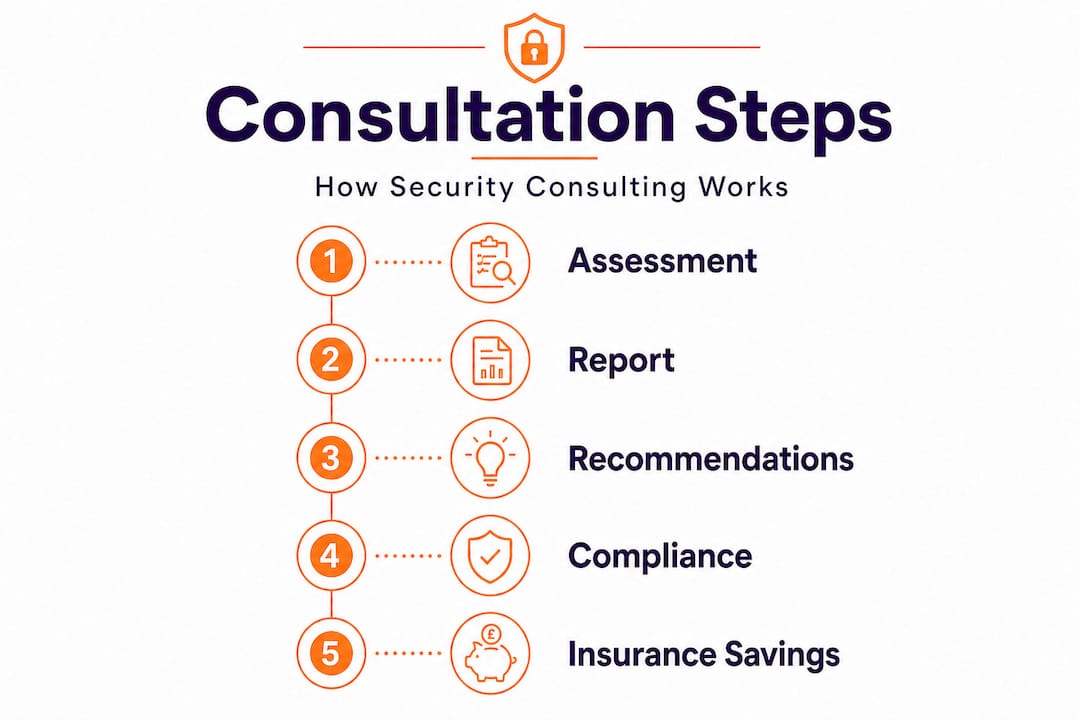
A typical consultation moves through four clear stages:
- Interview: The consultant discusses your concerns, past incidents, how you use the property, and any insurer conditions you are already aware of.
- Site walkthrough: A thorough inspection of entry points, perimeter features, lighting, existing locks, and any weak spots identified visually.
- Document review: Checking existing alarm certificates, lock grades, and insurance schedules to identify gaps between what you have and what your policy demands.
- Risk scoring: Assigning a priority level to each vulnerability so you know where to invest first.
“Consultations emphasise unbiased, site-specific advice over generic sales, using frameworks like layered defence or standards-aligned methodologies for practical, cost-effective outcomes.”
The output is a clear written report with actionable steps, not a brochure filled with upsells. Consultations also help you choose insurance-approved alarms and physical controls, which can directly reduce your premiums. For a thorough breakdown, our expert guide for Bristol covers everything you need to know before booking.
How Security Consultations Work: Process and Frameworks
With an understanding of what a consultation is, let us break down exactly how a typical assessment is conducted on-site, and what frameworks drive these evaluations.
A structured physical security assessment uses a layered defence model, working from the neighbourhood level inward to the interior and any designated safe room. This approach ensures nothing is overlooked and that every layer receives appropriate attention relative to your budget.
The typical on-site process follows these steps:
- Pre-visit briefing: The consultant confirms the scope, gathers any existing security documentation, and notes any insurer requirements you have received in writing.
- Perimeter review: Starting outside, the consultant assesses boundary fencing, garden gates, outbuildings, vehicle access points, and external lighting coverage.
- Shell assessment: This covers external doors, window locks, glazing quality, letterboxes, and any other openings in the building’s outer envelope. Weak Euro cylinders susceptible to snapping and inadequate multi-point locking mechanisms are commonly flagged here.
- Interior review: Checks include internal door strength, alarm positioning, keypad placement, sensor coverage gaps, and safe or valuables storage.
- Risk report compilation: Each vulnerability is categorised by severity and estimated cost to remediate, giving you a clear priority order.
The table below illustrates how different budget tiers translate into practical actions across key security layers:
| Security layer | Low-budget action | Mid-budget action | High-budget action |
|---|---|---|---|
| Perimeter | Improve external lighting | Install boundary fencing | CCTV with remote monitoring |
| Shell (doors) | Anti-snap Euro cylinder | Upgrade to BS3621 mortice lock | Composite door with multi-point lock |
| Shell (windows) | Window restrictors | Laminated glazing | Externally beaded double glazing |
| Interior | Door reinforcement plates | Grade 2 alarm system | Grade 3 alarm with 24/7 monitoring |
| Safe room | Secure filing cabinet | Internal deadbolt | Reinforced room with independent comms |
Pro Tip: Always ask your consultant to cross-reference their recommendations against your specific insurance policy schedule. Some insurers require a particular lock grade or alarm grade as a condition of your cover, and installing anything below that standard could invalidate a claim even if the system looks modern and capable.
Once the assessment is complete, a good consultant will walk you through the report, explain the reasoning behind each recommendation, and leave you with a document you can share with your insurer. Our team offers practical steps for Bristol homeowners and expert advice for South Gloucestershire properties too.
Insurance and Legal Compliance: Meeting Insurer Standards
Once the consultation process is underway, it is vital to recognise why these expert reviews matter not just for your safety, but for maintaining and even reducing your insurance costs.
Insurers are increasingly specific about what security measures they require. Many standard home and business policies demand features such as:
- Graded alarm systems: Grade 2 or Grade 3 alarms conforming to BS EN 50131 for higher-value properties.
- Certified locks: BS3621 five-lever mortice locks on final exit doors, or equivalent anti-snap Euro cylinder locks on UPVC doors.
- CCTV coverage: For commercial properties in particular, insurers may require monitored CCTV with recorded footage retained for a minimum period.
- Physical perimeter controls: Specified boundary heights, gate locks, and lighting standards.
Consultations ensure insurance compliance by verifying that your installed systems meet insurer standards for alarms and monitoring, which reduces both premium costs and the risk of claim denials. That last point deserves emphasis. A claim denial after a burglary, because your lock did not meet the standard listed in your policy schedule, is a costly and avoidable outcome. We have seen it happen to Bristol homeowners who genuinely believed their property was secure and insured, only to discover a technical non-compliance that the insurer used to decline the claim.
| Security feature | Without consultation | With consultation |
|---|---|---|
| Lock certification | Unknown compliance | Verified against insurer requirements |
| Alarm grading | May not meet policy grade | Matched to insurer grade demand |
| CCTV standards | Potentially inadequate resolution | Confirmed to meet insurer specification |
| Documentation | Absent or incomplete | Full written report for insurer submission |
| Premium impact | No reduction applied | Potential discount for verified controls |

Businesses face additional legal obligations. Commercial premises in certain sectors are subject to regulatory requirements around access control and data protection that overlap with physical security. A qualified consultant will flag these during the site review.
The financial case is clear. Verified compliance can reduce annual premiums and, more importantly, ensures your insurer cannot walk away from a claim on a technicality. For a full breakdown of what you stand to gain, explore the security consultation risk and insurance benefits on our website.
Physical vs. Cyber Security Consultations: Key Differences
Beyond traditional physical threats, security also has a digital face. Let us see where physical and cyber consultations diverge, and what that means for Bristol property owners.
For most homeowners and small business owners in Bristol, a physical security consultation will be the most immediately relevant. Physical consultations focus on:
- Theft and break-in prevention: Assessing door and window vulnerabilities, lock grades, anti-snap protections, and alarm coverage.
- Fire and environmental risks: Identifying fire door compliance gaps, poorly maintained escape routes, and sensor placement issues.
- Vandalism and access control: Reviewing intercom systems, keypad access, and perimeter deterrents.
- Insurance documentation: Producing the written evidence insurers require to confirm compliance.
Cybersecurity consultations serve a different purpose entirely. They use frameworks such as NIST and ISO 27001 to assess digital risks. For businesses handling customer data, processing payments, or relying on networked systems, cyber-focused assessments prioritise multi-factor authentication (MFA), endpoint detection and response (EDR) tools, and network segmentation rather than perimeter walkthroughs.
“Cyber-focused consultations prioritise frameworks like NIST/ISO, while physical consultations prioritise walkthroughs and layered perimeters. Insurers demand proven controls like MFA/EDR for cyber but alarms and CCTV for physical.”
The distinction matters because the proof of compliance required by insurers is completely different between the two domains. A cyber insurer wants penetration test results and access control logs. A property insurer wants lock certificates and alarm commissioning reports. Mixing up the two, or assuming one covers the other, is a common mistake that leaves real gaps in your protection.
Bristol businesses that handle sensitive customer information or process card payments should consider both types of consultation as separate exercises. For most residential clients, however, the physical review is the priority. Learn more about what each approach delivers on our security consultation benefits page.
Questions to Ask Before and After Your Consultation
To maximise your investment in a security consultation, it is all about asking the right questions and acting on the advice. Here are the best ways to do exactly that.
Before you hire a consultant, ask:
- Are you independent, or do you have sales targets tied to specific products or brands?
- What professional accreditations or qualifications do you hold?
- Do you have experience with properties in Bristol and with local insurer requirements?
- Will you produce a written report I can submit to my insurer?
- Does your fee include a follow-up review after I implement your recommendations?
After the consultation, ask:
- Which of these recommendations are mandatory for my current insurance policy, and which are optional enhancements?
- Are there any quick, low-cost changes I should implement immediately?
- Which certified products or lock grades meet the exact standards you have referenced?
- How do I document these improvements for my insurer?
- What common mistakes do property owners make when implementing these changes?
The most common mistake after a consultation is deprioritising the written report. Property owners often complete some improvements but never update their insurer, leaving the premium and compliance status unchanged. Always send the updated documentation to your insurer promptly.
Pro Tip: Ask your consultant to rank their recommendations into three groups: urgent, within three months, and long-term. This makes it far easier to budget and act, rather than feeling overwhelmed by a long list of changes with no clear starting point.
As layered defence frameworks demonstrate, even small improvements at each security layer compound into meaningful risk reduction. Do not wait until every item is implemented before informing your insurer. Partial compliance improvements, especially certified lock upgrades and alarm grading, are often recognised in premium calculations immediately. Find out more about the process on our why get a security consultation page.
Outsmarting Generic Solutions: Why Local Expertise Matters More
There is an uncomfortable truth in the security industry that does not get said often enough. National alarm companies and online security packages are primarily designed to be sold at scale. Their assessments, where they offer any at all, are structured to lead towards a pre-packaged product rather than an honest evaluation of your specific risk.
Bristol has its own risk profile. Certain areas see higher rates of vehicle theft, opportunistic residential burglary, or commercial premises targeting. A consultant who knows the local landscape, understands which property types are most frequently targeted in BS postcode areas, and has relationships with local insurers will produce advice that a national call centre simply cannot replicate.
Site-specific advice consistently outperforms generic checklists because real-world threats are never generic. A detached house on a quiet road in Yate has entirely different vulnerabilities to a commercial unit on an industrial estate near Avonmouth. One-size-fits-all solutions are designed to sell products, not to solve problems.
We have spoken with Bristol homeowners who installed nationally marketed smart alarm packages, believed they were covered, and later discovered their insurer did not recognise the product grade. The alarm looked impressive and worked technically, but it did not meet the policy requirement for a BS EN 50131 Grade 2 system. That is not a minor technicality. It is an uninsured property.
Local expertise also means accountability. When you work with a local locksmith or security consultant based in Bristol or South Gloucestershire, you are dealing with someone who will still be accessible when you need a follow-up, when you upgrade your property, or when your insurer asks a question three years down the line. That long-term relationship has real value that a national package deal cannot provide.
Our step-by-step guide for Bristol homes walks you through exactly how to upgrade your security with local knowledge and insurance compliance built into every recommendation.
Ready For a Professional Security Consultation?
Having explored the benefits and realities of security consultations, you can now take the next steps to secure expert advice for your Bristol property. At AHLP Locksmiths, we offer thorough security consultations for homeowners and businesses across Bristol, South Gloucestershire, and Gloucester. We assess your property with insurance compliance and genuine risk reduction in mind, using quality British Standard hardware and non-destructive methods throughout. See the risk reduction benefits of working with a local expert, and read our Bristol security consultation guide to understand exactly what to expect. Call us on 07700 100146 or visit ahlp.co.uk to book your consultation today.
Frequently Asked Questions
How long does a typical security consultation take?
Most on-site home or business security consultations are completed in one to two hours, depending on the size and complexity of the property.
What documents should I prepare for my consultant?
Have copies of your current insurance schedule, building layouts, and any existing alarm or lock certifications ready so the consultant can identify compliance gaps quickly.
Can a consultation really lower my insurance premium?
Yes. Consultations verify compliance with insurer standards for alarms and physical controls, which insurers often reward with premium reductions and which protects against claim denials.
Is a physical security consultation the same as cybersecurity advice?
No. Physical consultations cover locks, alarms, and perimeter defences, while cyber consultations prioritise digital controls such as multi-factor authentication and network protection. Each requires separate expertise and different insurer documentation.