
TL;DR:
- Securing your home involves a layered approach with strong locks, lighting, alarms, and cameras.
- Regularly check and update both physical security measures and connected smart devices.
- Building good routines and local awareness are crucial for long-term home security effectiveness.
How to secure your home: practical steps for Bristol homeowners
Bristol’s burglary rates remain a genuine concern for homeowners across the city and surrounding areas. Break-ins are common and investigations often have low positive outcomes, which means relying solely on a police response is not a realistic strategy. The most effective protection is prevention: making your home a harder, less attractive target before any attempt is made. This guide covers the practical steps you can take right now, from assessing your vulnerabilities and upgrading your physical locks, to adding layered deterrents and securing the digital systems that modern homes depend on.
Table of Contents
- Assessing your home’s vulnerabilities
- Physical security: locks, doors, and windows
- Layered deterrence: lighting, alarms, and cameras
- Securing your home’s digital edge: Wi-Fi and smart devices
- Why local context and regular habits matter more than gadgets
- Professional support for secure Bristol homes
- Frequently asked questions
Key Takeaways
| Point | Details |
|---|---|
| Layered security works | Combining deterrence, physical barriers, and digital protection is the most effective way to keep Bristol homes safe. |
| Prevention trumps investigation | With low burglary conviction rates locally, it’s critical to invest in preventing crime instead of relying on response. |
| Regular routines matter | Daily habits like locking windows and updating device security make as much impact as expensive gadgets. |
| Update with your neighbourhood | Adjust your security methods as local risks or technologies change so your home stays one step ahead. |
Assessing your home’s vulnerabilities
The first step in protecting your home is understanding exactly where it falls short. Burglars are opportunistic. They scan neighbourhoods looking for properties that offer easy access, low visibility, and little risk of detection. Most break-ins are not elaborate affairs — they are fast, opportunistic entries through unlocked doors, poorly fitted windows, or unlit rear access points.
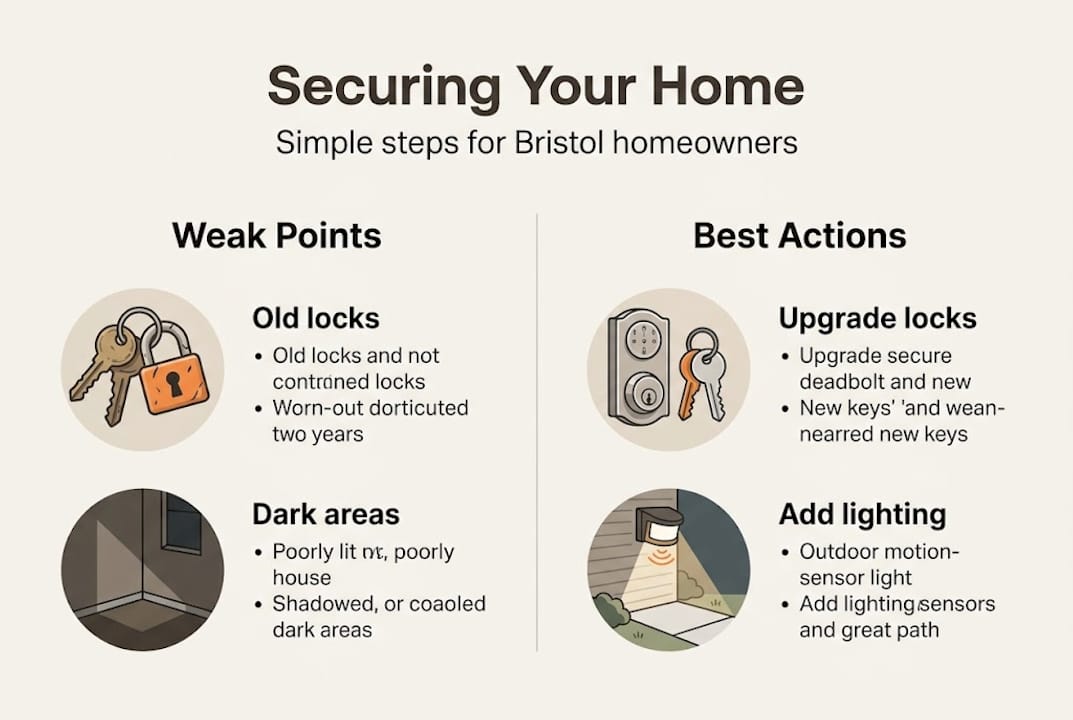
Start by walking around your property as a stranger would, looking at it critically. Ask yourself: which entry points are hidden from the road or from neighbours? Where is lighting poor or absent? Are there overgrown hedges or fences that would provide cover for someone trying to force a door?
Here is a checklist of the most commonly overlooked vulnerabilities:
- Front and rear doors: Check that they fit tightly in their frames with no excessive movement. A door that rattles or has a weak frame is far easier to force than one with a reinforced steel frame plate.
- Windows: Ground-floor windows, especially those at the side or rear of a property, are frequent entry points. Any window with a basic latch rather than a key-operated lock is a risk.
- Garage doors: These are frequently underestimated. An unlocked garage door gives access not only to tools and vehicles but, in many homes, to an internal door leading directly into the house.
- Gates and side passages: If your side gate is unlocked or easy to climb, a burglar can reach your rear garden undetected. A good bolt or padlock here makes a significant difference.
- Signage and lighting: Visible security signage, combined with well-placed exterior lighting, signals that your property is actively protected. Shutters also contribute to visible deterrence and can slow a would-be intruder considerably.
For UK homeowners, a layered approach works best: deter with lighting, detect with alarms, and delay with proper locks and window security. Thinking about each of these layers as you assess your home helps you prioritise where to spend your time and money most effectively. Our break-in prevention tips offer further practical guidance on which vulnerabilities to tackle first. Understanding the full range of window lock types available can also help you match the right solution to each window in your home.
Pro Tip: Do not neglect rear entryways and garage doors. Statistics consistently show that the rear of a property is the most common point of entry, precisely because it offers concealment. Even simple, inexpensive measures like a padlocked gate, a well-fitted mortice lock on the garage door, and a motion-activated light can significantly reduce the appeal of your property to a would-be intruder.
Physical security: locks, doors, and windows
Once you know where your home is vulnerable, it is time to tackle the physical entry points that matter most. Choosing the right lock for the right door is not just about security — it can also affect whether your home insurance is valid in the event of a claim.
Doors and deadlocks
For front and rear doors, a five-lever mortice deadlock that meets the British Standard BS3621 is the recognised benchmark in the UK. Many insurance policies specifically require a BS3621-compliant lock on all final exit doors. A night latch (sometimes called a Yale lock) alone is not sufficient — these can often be slipped open and provide minimal resistance to a determined push. Pairing a night latch with a mortice deadlock gives you both convenience and genuine strength.
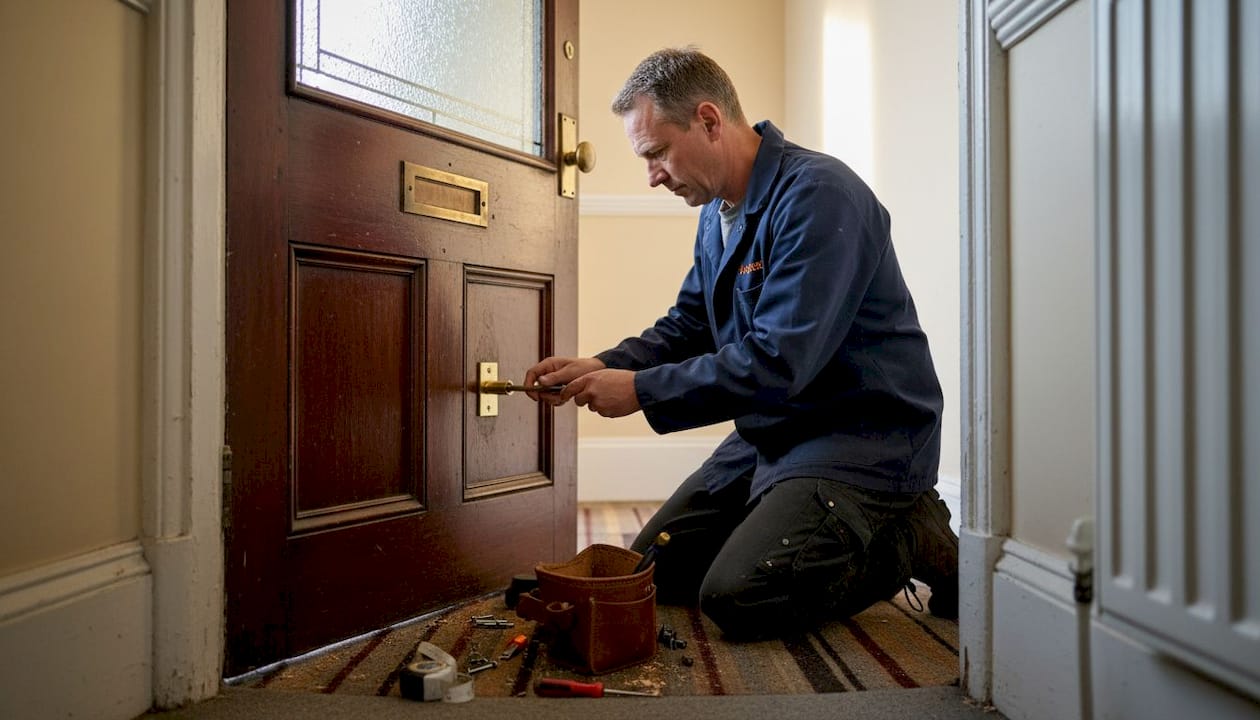
For uPVC and composite doors, the lock mechanism is built into a multipoint locking system. These are generally very strong when functioning correctly, but the Euro cylinder at the centre of the lock is often the weak point. Cylinders that protrude from the door face by more than 3mm can be snapped using nothing more than a pair of pliers. Upgrading to an anti-snap Euro cylinder is one of the single most impactful changes you can make to a modern uPVC or composite door.
Windows and glazing
Window security is frequently underestimated. Many older homes still have single-point catches or basic latches on ground-floor and first-floor windows that a burglar can defeat in seconds. Key-operated window locks are far superior and are often required by insurers. For detailed guidance on fitting them correctly, our window lock installation steps walk you through the process room by room. You can also explore the full range of door lock upgrades we recommend for Bristol properties.
For patio and French doors, fitting additional bolts at the top and bottom of the door provides extra resistance against forced entry. Shutters fitted professionally offer an additional physical barrier that can deter even persistent intruders.
Comparison of common lock types
| Lock type | Typical use | Strengths | Weaknesses |
|---|---|---|---|
| Five-lever mortice deadlock | Timber front/rear doors | High resistance, BS3621 rated | Needs correct installation |
| Night latch (Yale) | Front doors | Convenient self-locking | Weak alone, can be slipped |
| Multipoint locking (uPVC) | uPVC and composite doors | Strong overall system | Euro cylinder can be snapped |
| Anti-snap Euro cylinder | uPVC and composite doors | Resists snap attacks | Must meet TS007 3-star rating |
| Key-operated window lock | All window types | Insurer-approved, reliable | Key must be kept accessible |
Key storage habits are just as important as the locks themselves. Door and key choices are critical for preventing both forced and opportunistic entry. Never store spare keys in obvious places like under a doormat, inside a letterbox, or on a hook visible through a window.
Pro Tip: Store key copies somewhere secure and discreet, and never label them with your address. If you ever lose a set of keys, consider changing your locks promptly rather than waiting to see if they turn up.
Layered deterrence: lighting, alarms, and cameras
Physical barriers are your foundation. Now let us add the deterrents that drive opportunistic burglars away before they even try your door.
A strong security system works in overlapping layers. No single device will guarantee protection, but each layer makes your home harder and riskier to target. Research confirms that a layered home security approach combining lighting, alarms, and cameras reduces vulnerability more effectively than any single measure alone.
Lighting
Motion-activated lights fitted at the front, rear, and side of your property are among the most cost-effective deterrents available. A burglar relying on darkness for cover will think twice when a bright light switches on suddenly. Timer-controlled interior lighting creates the impression that the property is occupied, which is particularly useful when you are away. Position lights so they cover all access points including gates, garage doors, and any recessed doorways.
Alarm systems
You have two main options: audible alarms and monitored alarm systems. An audible alarm makes enough noise to attract attention and often sends a burglar running. A monitored system notifies a response centre or directly contacts the police, which offers a more active layer of protection. For most Bristol homes, a professionally installed alarm with a highly visible external siren box provides both deterrence and detection.
Cameras
Visible CCTV cameras are a strong deterrent in themselves. Burglar deterrence data shows that visible security measures significantly reduce the likelihood of a property being targeted. Position cameras to cover your main entry points and ensure footage is stored either locally on a secure device or in the cloud, so it cannot be destroyed along with any stolen equipment. Understanding how window locks and insurance interact is equally important when setting up your overall security plan.
Comparative impact of security measures
| Security measure | Deterrence impact | Detection capability | Cost range |
|---|---|---|---|
| Motion-activated lighting | High | Low | Low |
| Audible alarm system | High | Medium | Medium |
| Monitored alarm system | High | High | Medium to high |
| Visible CCTV cameras | High | High | Medium |
| Smart video doorbell | Medium | Medium | Low to medium |
Statistic to note: only 3.7% of reported burglaries in Bristol ended in a suspect being charged, which underlines why active prevention rather than post-incident investigation is your most reliable defence. Here are the steps we recommend to layer your deterrence effectively:
- Install motion-activated lights at all external access points.
- Add a visible alarm box even before fitting an internal system.
- Place cameras at the front door, rear garden access, and any side passage.
- Use timer plugs on lamps inside to simulate occupancy.
- Register your valuables with a free national property register service to aid recovery if anything is taken.
Securing your home’s digital edge: Wi-Fi and smart devices
With your visible defences in place, it is time to address risks that most homeowners overlook entirely: the vulnerabilities of your home’s connected systems. Smart locks, video doorbells, alarm apps, and Wi-Fi networks can all become entry points for a different kind of attacker if they are not properly secured.
Weak passwords and default settings on routers and smart devices are a genuine, real-world risk. Many households buy and install a smart lock or alarm system and never change the manufacturer’s default login. This is the digital equivalent of fitting a strong door and leaving a key in the lock. Securing smart home devices starts with changing defaults and using modern encryption standards, specifically WPA3 on your router where available.
Here are the most important steps to secure your home’s connected systems:
- Change your router password from the default immediately, using a password of at least 16 characters with a mix of letters, numbers, and symbols.
- Enable WPA3 encryption on your Wi-Fi network. If your router does not support WPA3, use WPA2 at a minimum and consider upgrading your hardware.
- Create a separate guest network for smart devices so that any breach of a smart device does not expose your main network.
- Enable two-factor authentication on all alarm and smart lock apps. This means a stolen password alone is not enough to access your system.
- Keep firmware updated on every connected device including your router, smart lock, doorbell, and alarm hub.
Even the most robust physical security will not protect you if your smart home system remains open to remote access by an unauthorised user. Digital and physical security must be treated as one integrated strategy, not two separate concerns.
For broader guidance tailored to Bristol homeowners, our home security advice covers both physical and digital considerations in one place.
Pro Tip: Set a monthly calendar reminder to check for firmware updates on all your connected devices. Manufacturers release security patches regularly, and ignoring them leaves known vulnerabilities open for anyone to exploit.
Why local context and regular habits matter more than gadgets
After years of working with Bristol and South Gloucestershire homeowners, we have come to a clear conclusion: the single biggest gap in most people’s security is not their lock specification or their alarm brand. It is their habits.
We see this consistently. A homeowner invests in a quality five-lever mortice lock and a monitored alarm, then leaves the back gate unlatched every morning because it is quicker than fumbling with a bolt. The alarm is set half the time. The exterior light bulb has been out for six weeks. The technology is sound, but the routine has failed it.
This is where local awareness truly matters. Bristol’s crime patterns shift between neighbourhoods and across seasons. A street that felt low-risk twelve months ago may be seeing a spike in opportunistic entries this winter. Checking local police ward reports and community groups keeps you informed in a way that no gadget can replicate.
Our view is straightforward: technology and hardware are only as effective as the habits built around them. Review your routines each season. After any local crime alert, revisit your vulnerabilities with fresh eyes. Check that your lighting is working, your gates are secured each evening, and your windows are locked before bed. These small, consistent actions are what genuinely keep Bristol homes safe in the real world.
Pro Tip: Revisit your home’s vulnerabilities at the start of each season or after any reported crime spike in your area. Small changes in the environment, such as longer nights or new construction nearby that blocks sightlines, can open new vulnerabilities that did not exist before.
Professional support for secure Bristol homes
If you are ready to move from planning to action, our team at AHLP Locksmiths is here to help. We carry out professional security assessments across Bristol, South Gloucestershire, and Gloucester, identifying vulnerabilities you might not spot yourself and recommending practical, cost-effective solutions. Explore our full range of locksmith services or use our lock replacement guide to understand which upgrades suit your property best. If you are looking specifically for anti-snap locks in Bristol, we supply and fit insurance-approved cylinders with no call-out fee. Whether it is an emergency lockout, a burglary repair, or a planned upgrade, call us on 07700 100146 or visit ahlp.co.uk and we will respond quickly and professionally.
Frequently asked questions
What is the single most effective step to secure my home?
No single step is sufficient on its own, but a layered approach combining strong locks, visible deterrents such as lighting and cameras, and consistent daily routines provides the highest protection for homes in the Bristol area.
Are smart locks and security cameras really worth it?
Smart devices are effective when paired with traditional physical security measures. Visible cameras and smart doorbells are particularly useful for deterrence and remote monitoring, and research confirms that visible security signals such as lighting and cameras reduce the likelihood of a property being targeted.
How often should I update or check my home’s security?
Review your home’s defences at least once a year or after any local crime alerts, checking that locks are functioning, alarms are tested, exterior lighting is working, and connected devices have the latest firmware installed.
What should I do if there’s a recent rise in burglaries locally?
Enhance your visible deterrence immediately by checking lighting, securing gates, and ensuring all locks are engaged. Bristol burglary patterns shift over time, so a professional security assessment is a sound investment whenever local risk increases.