

TL;DR:
- Master key systems create hierarchical access, reducing the number of keys needed and enhancing security.
- They are ideal for larger properties or businesses with multiple access levels, not small homes.
- Proper management, like logging keys and quick rekeying after loss, is essential for system security.
Many property owners assume that handing out more keys gives them better control. In practice, the opposite is often true. A growing number of homeowners, landlords, and business operators across Bristol and South Gloucestershire are discovering that a master key system brings far greater clarity, fewer headaches, and stronger security than a drawer full of individual keys ever could. This article explains exactly how master key systems work, who they suit best, and how to decide whether one is right for your property. By the end, you will have a clear picture of what to expect and how to take the next step.
Table of Contents
- What is a master key system?
- How do master key systems improve security and convenience?
- Comparing master key systems with traditional locks
- Is a master key system right for your property?
- A locksmith’s perspective: the real value and overlooked risks of master key systems
- Expert support for your master key system upgrade
- Frequently asked questions
Key Takeaways
| Point | Details |
|---|---|
| Streamlined key control | A master key system lets you access all areas with just one key, reducing clutter and confusion. |
| Enhanced security | Fewer keys mean less risk of unauthorised copies or lost access points for intruders. |
| Great for complex properties | Multi-user or multi-unit sites benefit most from the flexibility and control of a master key setup. |
| Professional advice matters | Consulting a qualified locksmith ensures a system that fits your property’s unique needs. |
What is a Master Key System?
A master key system is a structured locking arrangement where individual keys open only specific doors, while a single master key opens all of them. As master key systems explained on our site describes, multiple unique keys open specific doors, while one master key opens all. This is not a simple duplicate key arrangement. It is a precisely engineered hierarchy of access, built into the cylinders themselves.
The core components of any master key system are the cylinders (the locking mechanisms inside each door), the individual sub-keys (which open only assigned doors), and the master key itself. More complex properties may also include a grand master key, which sits above the master and controls an even wider range of locks. Each level of the hierarchy is cut and coded to interact only with its designated cylinders.
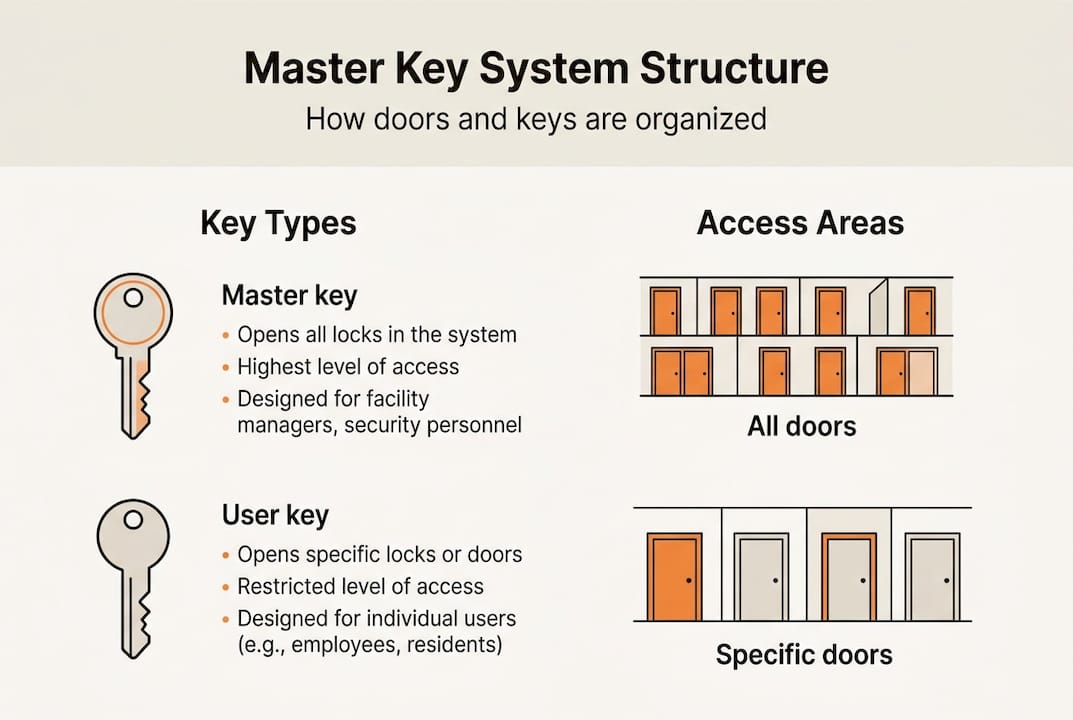
To make this concrete, here is an example of how access levels might be structured across a typical property:
| Role | Doors accessible | Key type |
|---|---|---|
| Property owner | All doors | Master key |
| Cleaner | Ground floor only | Sub-key A |
| Tenant (Flat 1) | Flat 1 and main entrance | Sub-key B |
| Tenant (Flat 2) | Flat 2 and main entrance | Sub-key C |
| Maintenance staff | Utility rooms and entrance | Sub-key D |
This kind of structured access is what makes secure access control so valuable for properties with multiple users.
Master key systems are used across a wide range of settings, including:
- Residential blocks and HMOs where landlords need access to all flats
- Office buildings with departments requiring different access levels
- Schools and colleges where staff, cleaners, and management have separate needs
- Small hotels and B&Bs managing guest and staff access
- Retail units in shared commercial premises
According to the Master Locksmith Association, more than 60% of commercial premises now use master key solutions, and it is easy to see why. The system gives you control without complexity.
How Do Master Key Systems Improve Security and Convenience?
Now that the system’s basics are clear, we can explore how these systems translate into tangible everyday benefits.
One of the most significant advantages is that master key systems reduce the number of keys required while maintaining access control. Fewer keys in circulation means fewer opportunities for a key to go missing or fall into the wrong hands. For a landlord managing six flats, that difference is substantial.
Here is a direct comparison between the two approaches:
| Feature | Master key system | Separate key system |
|---|---|---|
| Keys per manager | 1 master key | 1 key per door |
| Risk if one key is lost | Contained to sub-key level | Potentially affects all doors |
| Access control | Structured by design | Relies on manual tracking |
| Rekeying cost if key lost | Targeted and efficient | Potentially whole property |
| Ease of use | High | Low for multi-door properties |
The benefits of using master key systems extend beyond convenience. When a staff member leaves a job or a tenant moves out, you can revoke access quickly by replacing a single sub-key cylinder rather than changing locks across the entire property.
Using a master key system day to day is straightforward:
- Identify which doors each person needs to access.
- Issue the appropriate sub-key for those specific doors only.
- Retain the master key for your own use or that of a trusted manager.
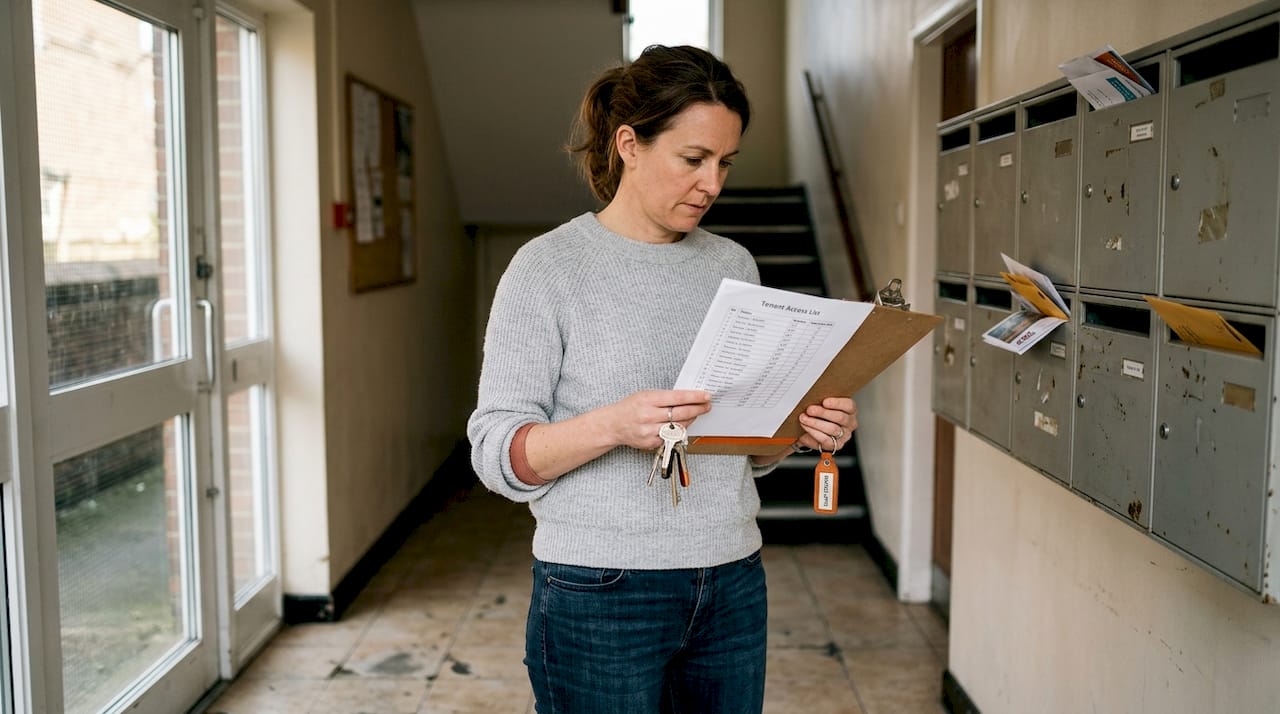
- Log who holds which key and when it was issued.
- Review the keyholder list at regular intervals, particularly after staff changes.
For landlords and site managers, this structure removes a great deal of daily friction. You are not searching through a bundle of identical-looking keys to find the right one. One key, one purpose.
For families in larger homes, the keyed alike vs master key systems comparison is worth considering too, as each approach suits different household sizes and routines.
The security benefits of master key systems are well documented, particularly for properties where multiple people need varying levels of access.
Pro Tip: Carry out a keyholder audit at least twice a year. Write down every person who holds a key, what level of access it grants, and when it was issued. This simple habit prevents access creep, where keys accumulate with people who no longer need them.
Comparing Master Key Systems with Traditional Locks
Understanding these advantages allows for an informed comparison between master key systems and more traditional approaches.
Traditional locks are straightforward: one key, one lock. They are reliable, widely available, and inexpensive to replace. For a single-occupancy home with one or two doors, they are often perfectly adequate. However, as keyed alike systems and master key arrangements show, the moment a property grows in complexity, traditional individual locks start to create problems.
As noted in master key systems for buildings, traditional locks often require many keys to cover various access needs, while master key systems consolidate control. Here is how the two approaches compare across key factors:
- Cost: Traditional locks are cheaper upfront, but master key systems save money over time by reducing rekeying and replacement costs.
- Adaptability: Master key systems can be expanded to include new doors. Traditional setups require starting from scratch.
- Security implications: A lost sub-key in a master key system is a contained problem. A lost key in a traditional setup may compromise the whole property.
- Replacement scenarios: Replacing a cylinder in a master key system is targeted and fast. Replacing traditional locks across multiple doors is time-consuming and expensive.
“Good security does not have to be complicated. The best systems are the ones people actually use correctly, every single day.” This is a principle we return to with every installation we carry out.
Knowing the difference between lock types helps you choose the right solution for your specific situation rather than defaulting to what is most familiar.
If a master key is ever lost, the response should be immediate. All locks accessible by that key should be assessed, and a professional locksmith should rekey or replace the affected cylinders without delay. This is not an overreaction. It is standard practice and the responsible course of action.
Is a Master Key System Right for Your Property?
By clarifying the differences, you can now think about your own property’s suitability for a master key system.
The honest answer is that not every property needs one. As master key systems guidance makes clear, suitability depends on property size, number of users, frequency of access changes, and security requirements. A small terraced house with two occupants probably does not need a master key hierarchy. A six-bedroom HMO, a small office, or a B&B almost certainly does.
Work through this checklist to help you decide:
- How many doors need to be managed? If it is more than four or five, a master key system starts to make practical sense.
- How many people need different levels of access? More than two or three distinct access roles is a strong indicator.
- How often does access need to change? High staff turnover or frequent tenant changes make master key systems especially valuable.
- What is the cost versus benefit over three to five years? Factor in the time saved, the rekeying costs avoided, and the security improvement.
- Are you planning renovations or extensions? Installing a master key system during building work is far more cost-effective than retrofitting later.
For homes, a master key system suits larger households, rental properties, and holiday lets particularly well. For businesses, any site with departments, shift workers, or contracted staff will benefit. You can learn more about master key systems and compare your options before committing.
Also worth reviewing is a top locksmith services comparison to understand the full range of security upgrades available alongside master key installation. If you are also concerned about day-to-day access management, our guide on preventing lockouts covers practical habits that complement any locking system.
The Yale overview of master key systems also provides useful context on how these systems can be expanded as your property or business grows.
Pro Tip: For any property with more than five doors or three distinct user groups, we strongly recommend consulting an accredited locksmith before purchasing any hardware. A professional assessment ensures the system is designed correctly from the outset, saving you significant cost and disruption later.
A Locksmith’s Perspective: The Real Value and Overlooked Risks of Master Key Systems
We have installed master key systems across Bristol and South Gloucestershire for many years, and the pattern we see most often is this: people invest in the system but underestimate the ongoing management it requires. The hardware is only half the story.
The most common pitfall is over-reliance on a single master key held by one person. If that person is unavailable or that key goes missing, the entire property is affected. We always advise clients to designate a trusted backup keyholder and to store a record of the system’s configuration securely.
Another overlooked risk is poor access tracking. Issuing sub-keys without logging them is the equivalent of leaving a spare key under the doormat. It feels convenient until something goes wrong.
Our contrarian view is this: for a small two-bedroom home with one or two occupants, a master key system is often unnecessary and can create a false sense of security. Simpler, well-maintained locks with good habits achieve the same result at lower cost. The advantages of professional locksmiths include helping you make this distinction clearly, so you invest in the right solution rather than the most elaborate one.
Security and convenience are always a balance. The right system is the one that fits your property, your habits, and your budget.
Expert Support For Your Master Key System Upgrade
If you are considering a master key system for your home or business in Bristol or South Gloucestershire, we are here to help you get it right. At AHLP Locksmiths, our trusted locksmith services cover everything from initial consultation through to full installation and aftercare. We assess your property, recommend the most suitable system, and fit it using quality, insurance-approved hardware. Our guide to locksmith services is a useful starting point if you want to understand all your options. We also support schools, nurseries, and colleges through our dedicated locksmith services for schools and colleges. Call us on 07700 100146 or visit ahlp.co.uk to arrange a free assessment.
Frequently Asked Questions
Can a master key open any lock?
A master key only works with locks designed to be part of its specific system. As confirmed by the MLA, master keys only open locks designed within their system, so it will not work on unrelated locks elsewhere.
What happens if a master key is lost?
Losing a master key is serious and requires immediate action. The Building Centre advises that rekeying is strongly recommended whenever a master key goes missing, and a professional locksmith should carry this out promptly.
Are master key systems suitable for homes?
They work very well for larger households, HMOs, and rental properties, but are generally unnecessary for small single-occupancy homes. As our master key systems page notes, master key systems suit larger residences and multi-tenant properties most effectively.
Can I add more doors to my master key system later?
Yes, most systems are modular by design and can be expanded as your property grows. Yale confirms that systems can be expanded with future needs, though planning this with your locksmith from the start will save time and cost.
Recommended
- Master Key Systems: Enhanced Security and Convenience
- Why Use Master Key Systems for Secure Access Control
- Keyed alike systems explained: enhance security with one key
- Key advantages of insurance-approved locks in 2026