

Window locks vary considerably depending on whether you have uPVC, timber, aluminium or traditional sash windows. Some windows use a simple key-locking handle, while others have an espagnolette or multipoint mechanism hidden inside the frame with several locking points around the opening.
Knowing which type you have is useful when a window will not lock, a handle has broken, a key has been lost or you are reviewing the security of accessible windows.
This guide explains the main window lock types found in UK homes, how to identify them and which windows they are normally used with. It also explains what home insurers may ask for and where standards such as PAS 24 fit into window security.
Window Lock Types at a Glance
| Window lock type | Commonly found on | How it works |
|---|---|---|
| Key-locking window handle | uPVC, aluminium and some timber windows | Key secures the handle in the closed position |
| Espagnolette window lock | uPVC and modern casement windows | Handle operates locking points along the window edge |
| Multipoint window lock | uPVC, composite and some aluminium windows | Secures the window at several points around the frame |
| Cockspur handle | Older uPVC and aluminium windows | Handle nose closes over a wedge on the frame |
| Sash window lock or fastener | Traditional sliding sash windows | Secures the upper and lower sashes together |
| Sash stop | Sliding sash windows | Restricts how far the sash can move |
| Casement window lock | Timber casement windows | Key-operated lock secures the opening section to the frame |
| Window stay lock | Timber casement windows | Secures or restricts the window stay |
| Window restrictor | Various window types | Limits how far the window can open |
The right replacement depends on the window itself. A locking handle on a uPVC window, for example, may operate a separate espagnolette mechanism inside the frame, so replacing the handle will not repair a failed internal mechanism.
1. Key-Locking Window Handles
Key-locking handles are among the most recognisable window security fittings in UK homes.
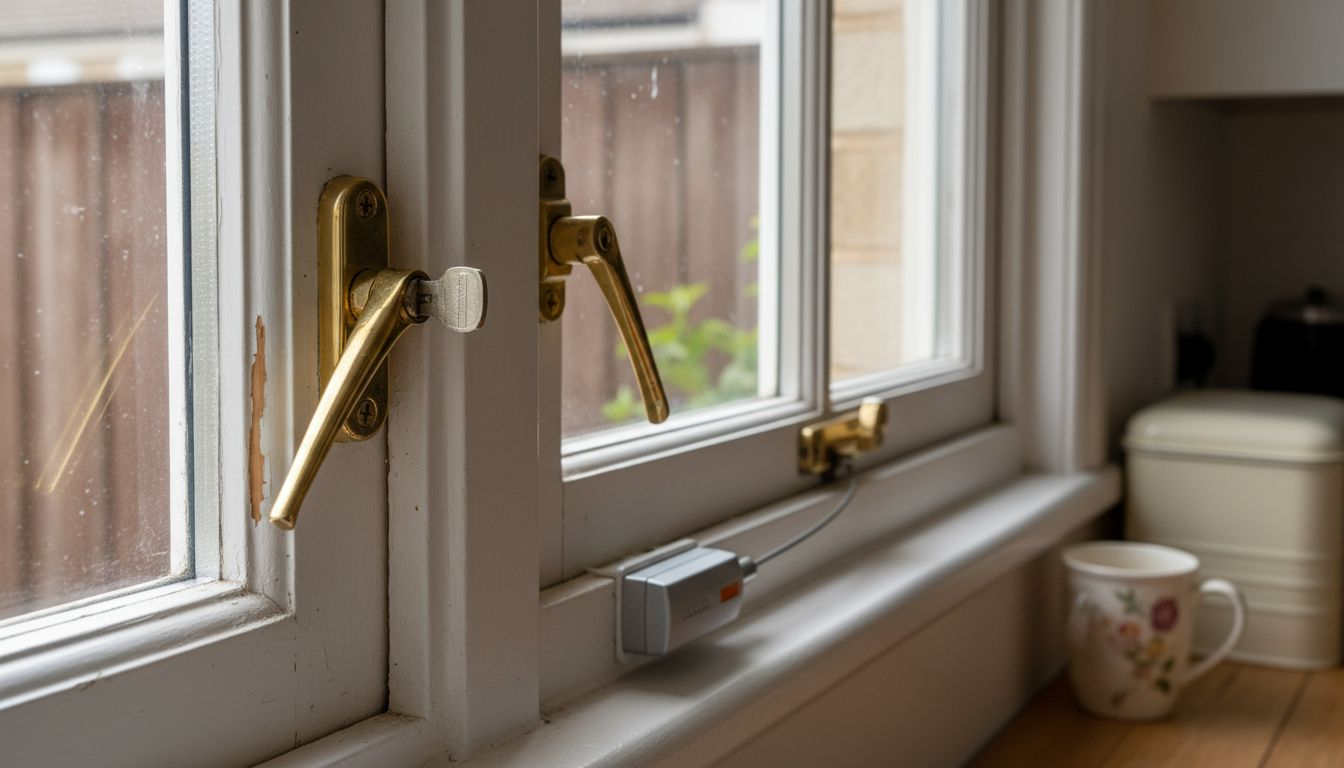
They are commonly fitted to uPVC casement windows, although similar designs can also be found on aluminium and some timber windows. Turning the key locks the handle so that it cannot simply be operated to open the window.
On many modern windows, however, the handle is only the part you can see. Moving it also operates a separate locking mechanism hidden inside the window.
If a handle becomes loose, spins without operating the window or no longer moves the locking points correctly, the problem may therefore be deeper than the handle itself.
Commonly fitted to: uPVC, aluminium and some timber casement windows.
Typical problems: lost keys, broken handles, worn spindles and handles that no longer operate the internal mechanism.
2. Espagnolette Window Locks
An espagnolette, often shortened to espag, is an internal locking mechanism commonly found in modern uPVC casement windows.
The mechanism runs along the edge of the opening part of the window. When you turn the handle, locking points move into corresponding keeps around the frame.
Depending on the design, these locking points may include rollers, mushroom cams or similar components.
This creates an important distinction when diagnosing a fault:
The handle and espagnolette mechanism are separate parts.
A broken handle can sometimes be replaced without changing the espag. If the handle moves but the locking points do not engage correctly, the internal mechanism may instead need attention.
Commonly fitted to: uPVC casement windows and some modern aluminium or timber systems.
Typical problems: failed gearboxes, worn locking points, stiff operation and poor engagement caused by window alignment.
3. Multipoint Window Locks
A multipoint window lock secures the opening section at several positions rather than relying on one central locking point.
The principle is similar to the multipoint mechanisms commonly used on modern uPVC doors, although window hardware is designed specifically for the window system.
Multiple locking points help hold the opening section against the frame around more than one part of its perimeter. The exact mechanism varies between manufacturers and window designs.
If a multipoint window suddenly becomes difficult to lock, do not force the handle. Poor alignment can place additional pressure on the mechanism, while forcing a stiff system can damage the gearbox or handle.
Commonly fitted to: modern uPVC, aluminium and some other casement window systems.
Typical problems: failed mechanisms, damaged keeps, poor alignment and locking points no longer engaging correctly.
For examples of faults that can lead to replacement, see our guide to lock replacement for local homes.
4. Cockspur Window Handles
Cockspur handles are particularly common on older uPVC and aluminium windows.
Instead of operating a long espagnolette mechanism, the handle has a projecting nose or spur that closes over a wedge mounted on the window frame. Lockable versions normally include a key cylinder in the handle.
They are relatively easy to recognise once the window is open because you can see the spur extending from the handle.
Replacing a cockspur handle requires more than simply finding one that looks similar. The fixing positions and the height of the spur relative to the frame need to match the existing window.
Commonly fitted to: older uPVC and aluminium windows.
Typical problems: broken handles, lost keys, worn locking cylinders and difficulty finding correctly sized replacement handles.
5. Sash Window Locks and Fasteners
Traditional sash windows slide vertically, so they need different security hardware from outward-opening casement windows.
A sash fastener is normally fitted where the meeting rails of the upper and lower sash come together. Closing the fastener helps secure the two sections together.
Key-locking versions provide additional control by preventing the fastener from simply being released without the key.
Older sash windows should be assessed as a complete unit because worn timber, movement in the frame or loose hardware can affect how securely the fastener engages.
Commonly fitted to: traditional timber sliding sash windows.
Typical problems: loose fasteners, worn fixings, poor alignment and locks that no longer engage correctly.
6. Sash Stops
Sash stops provide another way to secure traditional sliding sash windows.
Rather than simply fastening the two sashes together, stops restrict how far the window can slide. Depending on their position and design, they can prevent the sash from being opened beyond a predetermined point.
This can provide additional security while retaining some flexibility in how the window is used.
They are particularly useful where the existing sash fastener is not the only security measure required.
Commonly fitted to: timber sliding sash windows.
Typical problems: damaged stops, missing keys and poorly positioned fittings.
7. Casement Window Locks
Traditional timber casement windows may use separate key-operated locks rather than an integrated multipoint mechanism.
These locks secure the opening casement to the frame and are available in different designs to suit the way the window opens and closes.
They are particularly relevant on older timber windows where replacing the complete window purely to improve security would be unnecessary.
The condition of the timber matters as much as the lock itself. A strong replacement lock fitted into badly weakened or damaged timber will not solve the underlying problem.
Commonly fitted to: timber casement windows.
Typical problems: loose fixings, worn locks, missing keys and damaged timber around the lock.
8. Window Stay Locks
Traditional casement windows often use a metal stay to hold the window open at different positions.
A stay lock adds security to this arrangement by preventing the stay from simply being lifted or released. Designs vary, with some incorporating key operation.
This is different from an espagnolette or multipoint system and is normally associated with more traditional window hardware.
Commonly fitted to: timber casement windows.
Typical problems: missing keys, worn stays, loose fittings and damage around the fixing points.
9. Window Restrictors
A window restrictor limits how far a window can open.
Restrictors can be useful where controlled opening is needed, including upper floors or households where there is a risk of children opening windows too far. Different designs are available for different frames and applications.
A restrictor should not automatically be treated as a replacement for the window’s main security lock. Its primary purpose may be controlling the opening distance rather than providing the complete locking function.
Commonly fitted to: uPVC, timber and aluminium windows depending on the restrictor design.
Typical problems: damaged cables or mechanisms, unsuitable fitting positions and restrictors that no longer engage correctly.
l strip, you probably have an espagnolette or multipoint mechanism.
Look for rollers, cams or other moving locking points along the edge.
If the window has an older handle with a projecting spur that closes over a wedge, it is likely to be a cockspur arrangement.
On a timber casement window
Look for a separate lock securing the opening section to the frame and check whether the window stay has its own locking device.
Traditional timber windows often use individual pieces of hardware rather than one concealed multipoint mechanism.
On a sash window
Look at the meeting rails where the upper and lower sections overlap.
You may find a central sash fastener, one or more additional locks, or sash stops positioned to restrict movement.
If you are trying to identify a failed part, photographs of the handle, window edge and locking points are often more useful than a photograph of the closed window.
What Window Locks Do Home Insurers Require?
There is no single window lock required by every UK home insurer.
The correct answer comes from your individual policy wording. Insurers may specify additional security for ground-floor windows and other accessible windows, particularly where those windows can be opened.
Policy wording may refer to requirements such as:
- Key-operated window locks
- Locks on ground-floor windows
- Locks on other accessible windows
- Security on windows that can be reached from extensions, flat roofs or other structures
- Exceptions for designated escape windows
- Security conditions that apply when the property is left unoccupied
Check the security conditions and endorsements in your own policy rather than assuming that every window needs the same lock.
If the wording is unclear, ask your insurer or broker exactly which windows they class as accessible and what locking arrangement they require.
Does BS3621 Apply to Window Locks?
BS3621 should not normally be used as the standard for identifying a window lock.
BS3621 concerns thief-resistant lock assemblies for doors and is commonly encountered when assessing locks on timber entrance doors.
It is therefore misleading to say that a ground-floor window needs a “BS3621 window lock”.
If your insurer specifically mentions BS3621, check whether that requirement actually relates to your external doors rather than your windows.
For a full explanation of BS3621 and other lock standards, see our guide to British Standard and insurance-approved locks.
What Does PAS 24 Mean for Windows?
PAS 24 relates to the security performance of complete doorsets and windows rather than being a grading system for an individual replacement window lock.
Products tested to PAS 24 are assessed as complete assemblies. For a window, that means security depends on the interaction between components such as the frame, glazing, hardware and locking system rather than one lock carrying all of the responsibility.
This distinction matters when repairing an existing window.
Fitting a new handle or lock to an older window does not automatically make the complete window PAS 24 compliant. PAS 24 applies to the tested product or assembly, so it should not be used as a generic label for an individual aftermarket lock.
If you are replacing a lock because of an insurance requirement, check whether the insurer is asking for a specific window lock or referring to the security specification of the complete window.
Which Window Locks Are Best for Ground-Floor Windows?
The appropriate lock depends on the window design.
For a modern uPVC casement window, the existing espagnolette or multipoint mechanism should engage correctly around the frame and any key-locking handle should operate properly.
For timber casement windows, a suitable key-operated casement lock may be appropriate.
Traditional sash windows can use suitable locking fasteners and additional sash stops depending on the design and security requirement.
The important point is that an accessible window should close securely and its locking system should match the window construction. Adding a generic aftermarket lock without considering the frame and existing mechanism can create inconvenience without addressing the actual weak point.
If insurance is the reason for the upgrade, check the policy wording before choosing the hardware.
When Does a Window Lock Need Replacing?
A window lock does not need replacing simply because it is old.
Replacement or repair is worth investigating when:
- The key no longer turns correctly
- The handle is loose or broken
- The handle moves but the locking points do not
- The window will not close securely
- Locking points no longer engage with their keeps
- The mechanism is visibly damaged or corroded
- Keys have been lost
- Existing hardware does not satisfy a requirement you need to meet
- There are signs of attempted forced entry
With uPVC windows, poor alignment can sometimes make a working mechanism difficult to operate. Diagnosing that first can prevent unnecessary replacement.
Can You Replace a Window Lock Without Replacing the Window?
In many cases, yes.
Handles, espagnolette mechanisms, cockspur handles and various locks fitted to timber or sash windows can often be replaced individually where compatible parts are available.
The main challenge with older windows is identifying the correct replacement. Manufacturers change hardware over time, and obsolete mechanisms may require a compatible alternative rather than an identical part.
The condition of the window also matters. Replacing a lock may not be worthwhile if the frame, opening section or surrounding material is severely damaged.
A locksmith can identify whether the fault is limited to the locking hardware or whether the window itself needs further repair.
Window Lock Repairs and Replacements in Bristol
If a window no longer locks properly, avoid forcing the handle repeatedly. Excess pressure can turn a minor alignment problem into a damaged handle or failed internal mechanism.
Take clear photographs of the handle, the edge of the open window and any visible locking points where possible. These can help identify the existing system and the parts that may be required.
AHLP Locksmiths provides locksmith services across Bristol, South Gloucestershire and Gloucester, including lock repairs, replacements and home security upgrades.
For a wider property review covering doors, windows and other entry points, see our home security guide for Bristol and South Gloucestershire.
Frequently Asked Questions
What are the main types of window locks in UK homes?
Common UK window locks include key-locking handles, espagnolette mechanisms, multipoint locks, cockspur handles, sash fasteners, sash stops, casement locks and window stay locks. Window restrictors are also widely used, although their main function may be controlling how far a window opens rather than acting as its primary security lock. The appropriate mechanism depends on whether the window is uPVC, timber, aluminium, casement or sliding sash. Identifying the window construction first makes choosing or replacing the lock much easier.
What type of lock is fitted to a uPVC window?
Many modern uPVC casement windows use an espagnolette or multipoint mechanism hidden along the edge of the opening section. Turning the handle moves locking points into keeps positioned around the frame, while the handle itself may also be key lockable. Older uPVC windows can instead use cockspur handles that close over wedges fixed to the frame. If a uPVC window will not lock, identify whether the fault is in the handle, internal mechanism or window alignment before replacing parts.
Do ground-floor windows need key-operated locks for home insurance?
Some home insurance policies require key-operated locks on ground-floor or otherwise accessible windows, but requirements vary between insurers and policies. Check the security conditions or endorsements in your own policy to see which windows are covered and whether any exceptions apply. Windows accessible from a flat roof, extension or similar structure may also be relevant even when they are above ground level. If the wording is unclear, ask your insurer to confirm the requirement before changing the existing hardware.
Does PAS 24 apply to individual window locks?
PAS 24 assesses the security performance of complete doorsets and windows rather than acting as a standalone grade for an individual replacement window lock. A PAS 24 window is tested as an assembly, with the frame, glazing, hardware and locking system contributing to its performance. Replacing one component on an existing window therefore does not automatically make that window PAS 24 compliant. When buying a replacement window, check the certification for the complete product rather than looking for a PAS 24 mark on an individual handle or lock.
Can a locksmith replace a broken window lock without replacing the whole window?
Many window-lock faults can be repaired without replacing the complete window. Depending on the system, a locksmith may be able to replace a handle, espagnolette mechanism, cockspur handle, casement lock or other individual component. Older or obsolete mechanisms can be more difficult because an identical replacement may no longer be manufactured, although compatible alternatives are sometimes available. The window and frame should also be checked for alignment or damage so that a new lock is not fitted without addressing the reason the original mechanism failed.