Terms such as British Standard lock, insurance approved lock, TS007, Sold Secure and security grade are often used as though they mean the same thing. They do not.
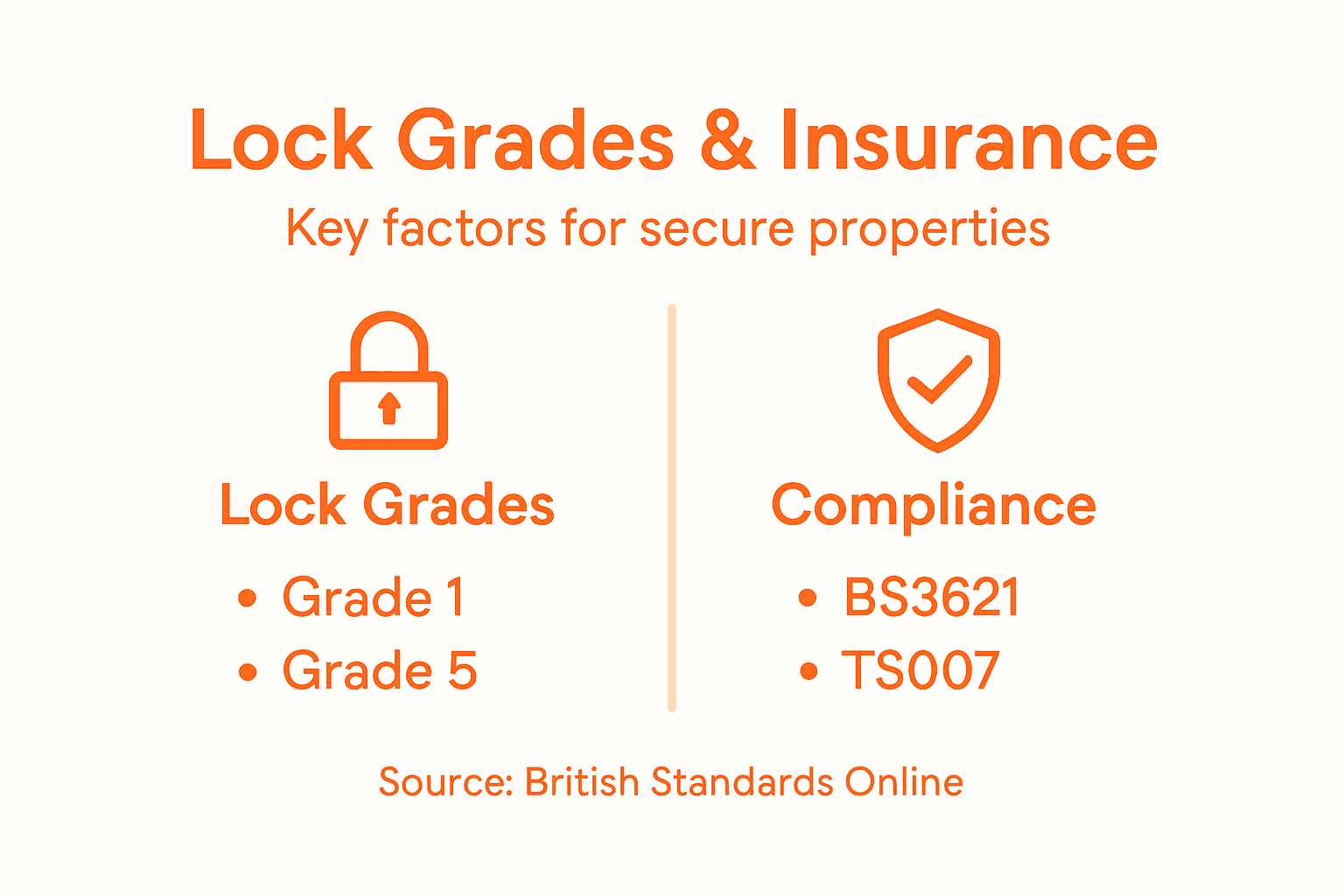
Different standards apply to different products. BS3621 is commonly associated with thief-resistant locks on timber doors, TS007 deals with replacement cylinders and associated security hardware, Sold Secure independently tests a much wider range of security products, and European standards such as EN 1627 and EN 1143-1 cover different types of physical security.
For homeowners, the important question is usually much simpler: does the lock fitted to my door meet the standard required by my home insurance policy?
This guide explains the main UK lock and security standards in plain English, what their ratings mean and what to look for on the lock itself.
What Is a British Standard Lock?
A British Standard lock is a lock that meets the requirements of a specific British Standard. It is not one universal grade covering every type of lock.
For domestic doors, one of the standards homeowners are most likely to encounter is BS3621. For replacement cylinders and protective hardware on many uPVC and composite doors, TS007 is more relevant.
The important point is to match the standard to the type of door and locking system you have rather than simply looking for the words “British Standard”.
BS3621: Thief-Resistant Locks for Doors
BS3621 is a British Standard covering thief-resistant lock assemblies with key operation on both sides.
You are most likely to encounter it on locks fitted to timber entrance doors, including qualifying mortice locks and certain night latches. Locks certified to BS3621 are tested against specified forms of attack and must satisfy the requirements of the standard before they can be certified.
BSI’s certification directory includes BS3621-certified five-lever mortice deadlocks, sashlocks, cylinder mortice deadlocks and qualifying night latches. This is why describing BS3621 simply as a “five-lever lock standard” can be misleading.
How do I know if my lock is BS3621?
Open the door and look at the metal forend or faceplate on the edge of the door, where the lock bolt and latch emerge.
On a BSI-certified lock, look for:
The BSI Kitemark
The number BS3621
Often the relevant version or year of the standard
Manufacturer or product identification
The Kitemark is important because it indicates independent BSI certification rather than simply a manufacturer’s claim about the product.
If the markings have been painted over or are difficult to read, do not assume that the lock either does or does not comply. Identify the model or ask a locksmith to check it before replacing an otherwise suitable lock.
TS007: What Do the Star Ratings Mean?
TS007 deals with enhanced security requirements for replacement cylinders and the security hardware surrounding them.
This is particularly relevant to Euro cylinder locks used with multipoint locking systems on many uPVC and composite doors. The purpose of the rating system is to show how the cylinder and associated protective hardware perform against specified forms of attack.
The stars need a little explanation because a two-star rating is not simply a middle-grade cylinder.
TS007 1 star
A one-star rating can apply to a cylinder that meets the relevant requirements of the standard, but a one-star cylinder alone does not provide the complete three-star security combination.
It can be combined with suitable two-star protective hardware.
TS007 2 star
A two-star rating applies to security hardware, such as a security handle or escutcheon designed to protect the cylinder.
It is not a two-star cylinder grade.
A one-star cylinder combined with two-star protective hardware can provide the cumulative three-star arrangement recognised by TS007.
TS007 3 star
A three-star cylinder is designed to achieve the required three-star level without relying on separate two-star protective hardware.
For homeowners wanting a straightforward cylinder upgrade, this is why TS007 three-star cylinders are commonly discussed in connection with anti-snap security.
In simple terms, the recognised combinations are:
1-star cylinder + 2-star security hardware = 3 stars
3-star cylinder = 3 stars without additional two-star hardware being required for that rating
Look for the BSI Kitemark and star rating on certified cylinders or associated hardware. For more detail on cylinder security, see our guide to the advantages of anti-snap locks.
Sold Secure: Independent Security Product Testing
Sold Secure is an independent testing and certification organisation for security products.
It was established in 1992 by Northumbria and Essex Police with Home Office backing. Products submitted for approval undergo security testing, and products that successfully meet the relevant specification can carry the Sold Secure Approved mark.
Sold Secure covers much more than front-door locks. Its current product categories include:
Lock cylinders
Domestic building security
Garage door security
Padlocks and fittings
Key safes
Multipoint locks
Gate security
Ground anchors
Smart locks
Safes and security cabinets
Sold Secure uses different grading systems depending on the product category. You may therefore see terms such as Bronze, Silver, Gold or Diamond, but they should always be read in the context of the particular product and specification.
For example, Sold Secure currently lists SS312 Diamond among its lock-cylinder approvals, while its domestic-building and other security categories use their own relevant grades.
This is different from BS3621 or TS007. A Sold Secure rating tells you that a product has been independently assessed under the relevant Sold Secure specification; it does not automatically mean that it satisfies whatever lock wording appears in your home insurance policy.
EN 1627: Security for Complete Doors and Windows
BS EN 1627 looks beyond an individual lock.
It sets requirements and classifications for the burglar resistance of products including pedestrian doorsets, windows, shutters, grilles and curtain walling. In other words, it considers the security performance of the construction product rather than treating the lock as the only component that matters.
This distinction is useful because a strong cylinder fitted into a weak door does not make the complete doorset equally resistant to attack.
EN 1627 is therefore more relevant when comparing the tested burglar resistance of a complete door, window or similar building element than when simply checking whether an existing mortice lock is BS3621 certified.
If you are reviewing different door types and their locking systems, our guide to uPVC vs wooden door locks explains how the mechanisms differ in typical UK homes.
EN 1143-1: Safes and Strongrooms
EN 1143-1 is different again because it concerns secure storage rather than ordinary domestic door locks.
The standard establishes requirements, classifications and test methods for the burglary resistance of products including:
Freestanding safes
Built-in safes
ATM safes
Strongroom doors
Strongrooms
This means an EN 1143-1 grade should not be compared directly with a TS007 star rating or BS3621 certification. They measure different products for different purposes.
If an insurer specifies a particular safe standard or security grade for jewellery, cash or other high-value items, check the exact wording of the policy and the certification of the safe rather than assuming that any product marketed as a “security safe” will qualify.
What Does “Insurance Approved Lock” Actually Mean?
There is no single lock that every UK home insurer requires.
Your insurance policy is the document that matters. Depending on the property, door type and insurer, the policy or schedule may specify a particular standard, lock type or security condition.
For example, you may encounter wording referring to:
BS3621 locks
A five-lever mortice deadlock conforming to BS3621
Multipoint locking on uPVC or composite doors
Key-operated window locks
A particular cylinder or security specification
Specific security requirements applying when the property is unoccupied
Do not replace a lock solely because somebody describes another product as “insurance approved”. First check the security or minimum-security section of your policy schedule and identify exactly what your insurer requires.
If the wording is unclear, ask the insurer or broker to confirm the requirement for your particular door type.
How Do I Check Whether My Existing Lock Meets My Insurance Requirements?
Start with the policy rather than the lock.
1. Read your policy schedule
Look for headings such as:
Security
Minimum security
Door and window locks
Endorsements
Conditions of cover
Protections
Write down the exact standard or type of lock specified.
2. Identify the type of door
A timber entrance door with a mortice lock requires a different assessment from a uPVC or composite door with a multipoint mechanism and Euro cylinder.
Knowing the door and lock type prevents you from looking for the wrong certification.
3. Look for the certification mark
For a BS3621 lock, open the door and inspect the metal faceplate or forend on the door edge.
Look for the BSI Kitemark and BS3621 marking.
For a TS007 cylinder or security component, look for the Kitemark and star rating on the cylinder or associated hardware.
4. Check the complete locking arrangement
Do not assume that a multipoint mechanism automatically means the cylinder itself has an enhanced security rating.
Likewise, finding a high-security cylinder does not tell you whether the surrounding door, handles, frame and multipoint mechanism are in good condition.
5. Ask before replacing anything
If you cannot identify the lock or your policy wording is ambiguous, confirm the requirement before purchasing a replacement.
A locksmith can identify what is fitted, but your insurer ultimately determines what satisfies the conditions of your individual policy.
Where Is the British Standard Kitemark on a Lock?
On many BS3621 mortice locks, the easiest place to check is the metal strip visible on the edge of the door when the door is open.
You are looking for the distinctive BSI Kitemark together with the relevant standard number. The markings are normally stamped or engraved into the lock hardware rather than printed on a removable sticker.
For cylinders and security hardware certified under TS007, look for the Kitemark together with the star symbols indicating the product’s rating.
If you cannot find a visible marking, identify the manufacturer and model before assuming that the lock complies. Certification can also be checked against BSI’s product directory where the product details are available.
British Standard Locks vs TS007 vs Sold Secure
These terms become much easier to understand once you stop treating them as competing grades.
| Standard or scheme | Mainly applies to | What to look for |
|---|---|---|
| BS3621 | Thief-resistant lock assemblies commonly found on timber doors | BSI Kitemark and BS3621 marking |
| TS007 | Replacement cylinders and associated security hardware | Kitemark and 1, 2 or 3-star marking |
| Sold Secure | Independently tested security products across many categories | Sold Secure approval and relevant product grade |
| EN 1627 | Complete doorsets, windows, shutters, grilles and similar products | Product’s declared EN 1627 classification |
| EN 1143-1 | Safes, strongroom doors and strongrooms | Certified burglary-resistance classification |
The best standard therefore depends on what you are assessing.

Do You Need to Upgrade Your Locks?
Do not replace a working lock simply because it lacks a marketing term such as “high security”.
An upgrade is worth investigating when:
Your insurance policy specifies a standard your existing lock does not meet
You cannot verify the certification required by your policy
A Euro cylinder lacks the level of protection you want against cylinder attacks
The lock is damaged, corroded or unreliable
The door or locking mechanism is poorly aligned
Keys have been lost or cannot be accounted for
You have recently moved into the property
There are signs of attempted forced entry
The condition of the whole door matters as well. A certified lock cannot compensate for a badly damaged frame or a multipoint mechanism that no longer engages correctly.
For practical examples of when replacement is appropriate, see our guide to lock replacement for local homes.
Need Help Identifying Your Locks?
If you cannot tell which standard your current locks meet, start with your insurance policy and take note of the exact wording.
AHLP Locksmiths can then inspect the lock and door, identify the existing hardware and explain the relevant replacement options. This avoids changing a perfectly suitable lock unnecessarily or fitting a product that does not address the requirement you are trying to meet.
You can view our locksmith services or contact AHLP Locksmiths if you need a lock checked or replaced.
Frequently Asked Questions
What is a British Standard lock?
A British Standard lock is a lock that has been designed and tested against the requirements of a particular British Standard. For household entrance doors, BS3621 is one of the standards homeowners encounter most frequently, particularly with qualifying locks on timber doors. Other locking products are covered by different standards, so “British Standard” should not be treated as one universal security grade. Check the actual standard number and certification rather than relying only on a product description.
What is a BS3621 lock?
BS3621 covers thief-resistant lock assemblies with key operation on both sides and is commonly encountered on timber entrance doors. Certified products can include qualifying mortice deadlocks, sashlocks and certain night latches rather than just one specific lock design. A BSI-certified product should carry the Kitemark and BS3621 identification. Open the door and check the metal faceplate or forend on the door edge for these markings.
What does a three-star lock mean?
When people refer to a three-star door lock, they are usually talking about a cylinder certified to TS007. A three-star cylinder achieves the relevant three-star security level without needing separate two-star protective hardware to reach that rating. Another recognised arrangement uses a one-star cylinder with two-star security hardware, such as an appropriate handle or escutcheon. This is why the individual star markings need to be understood as parts of the complete locking arrangement rather than simple grades from bad to good.
Does my home insurance require BS3621 locks?
That depends on the wording of your individual insurance policy rather than a universal rule applying to every UK home. Some policies specifically refer to BS3621 on relevant external doors, while others describe the required locking arrangement differently. Check the security conditions and endorsements in your policy schedule before replacing anything. If the requirement is unclear or does not seem to match your door type, ask your insurer or broker to confirm it in writing.
How can I tell whether my lock is insurance approved?
First establish what your insurer actually requires because “insurance approved” is not one universal lock specification. If the policy specifies BS3621, open the door and check the lock faceplate or forend for the BSI Kitemark and BS3621 marking. For a Euro cylinder, check for any TS007 Kitemark and star rating and compare that with the wording of your policy. If the markings cannot be identified, have the lock checked before assuming that it either complies or needs replacing.