

Struggling with a stubborn lock on your Bristol home? Accurate lock repairs can make all the difference to your property’s safety and help save on costly locksmith visits. Knowing how to assess your specific lock and gather the right tools means you can tackle repairs with confidence and protect your home from unwanted risks. This guide will walk you through key inspection steps so you can address lock problems efficiently and keep your security strong.
Table of Contents
- Step 1: Assess Lock Type And Gather Tools
- Step 2: Dismantle The Lock Carefully
- Step 3: Inspect Components For Damage
- Step 4: Replace Or Repair Faulty Parts
- Step 5: Reassemble And Test The Lock
Lock Repair Quick Summary
| Key Point | Explanation |
|---|---|
| 1. Identify Your Lock Type | Correctly identifying your lock type guides your repair strategy and necessary tools. |
| 2. Document Dismantling Steps | Taking photographs during lock disassembly helps prevent confusion during reassembly. |
| 3. Inspect for Hidden Damage | Thoroughly examine each component for signs of wear or damage before deciding on repairs. |
| 4. Prioritise Replacement | Replace parts with significant wear or corrosion to ensure lock reliability and security. |
| 5. Test After Reassembly | Conduct multiple functionality tests post-reassembly to confirm the lock operates smoothly. |
Step 1: Assess Lock Type and Gather Tools
Lock repairs start with accurate identification of your specific lock mechanism. Understanding whether you have a Euro cylinder, mortice lock, or a UPVC mechanism will determine your repair strategy and tool requirements.
Begin by carefully examining your lock’s characteristics. Key factors include:
Here’s a comparison of common lock types and their distinguishing features:
| Lock Type | Typical Door Material | Security Level | Common Issues |
|---|---|---|---|
| Euro Cylinder | UPVC, Composite | Moderate-High | Snapping, misalignment |
| Mortice Lock | Wooden | High | Wear, jamming, rust |
| UPVC Mechanism | UPVC | Moderate | Stiffness, broken gears |
- Lock material (brass, steel, aluminium)
- Door type (wooden, composite, UPVC)
- Mechanism complexity (single or double cylinder)
To assess your lock accurately, you’ll need some basic tools. Understanding lock variations helps ensure you select the right equipment. Essential tools for your lock repair kit should include:
- Screwdriver set (flathead and Phillips head)
- Adjustable wrench
- Allen key set
- Measuring tape
- Needle-nose pliers
Before disassembling anything, take clear photographs of your current lock configuration. These will serve as a reference point if reassembly becomes challenging.
Professional locksmiths always document the original lock setup before starting repairs.
Carefully inspect the lock mechanism for signs of wear, rust, or damage. Look for misaligned parts, sticky keyholes, or difficulty turning the key – these indicate specific repair needs.
Pro tip: Always test your replacement tools and parts before beginning a complete lock repair to prevent unexpected complications.
Step 2: Dismantle the Lock Carefully
Dismantling a lock requires precision, patience, and a methodical approach to prevent damage to delicate internal components. Safety protocols for lock dismantling emphasise the importance of careful preparation and systematic removal.
Begin by clearing your workspace and laying out a clean, well-lit area with the following essential items:
- Soft cloth or towel
- Small parts tray
- Magnifying glass
- A camera or smartphone for documentation
Remove the lock’s external screws carefully, keeping them organised in your parts tray. Pay close attention to:
- Number and position of screws
- Orientation of each component
- Order of removal
Careful documentation prevents confusion during reassembly.
As you dismantle the mechanism, take photographs at each stage. This visual record will prove invaluable if you encounter difficulties during repair or need to return the lock to its original configuration.
Inspect each component for signs of wear, corrosion, or damage. Look for:
- Rust on metal parts
- Worn spring mechanisms
- Damaged pins or tumblers
- Evidence of previous amateur repairs
Pro tip: Place removed components in order on your cloth, arranging them exactly as they were extracted to ensure perfect reassembly.
Step 3: Inspect Components for Damage
Careful component inspection is crucial to ensuring your lock’s long-term reliability and performance. Comprehensive lock component assessment requires a systematic and detailed approach to identifying potential weaknesses.
Begin your detailed inspection by examining each individual component under good lighting, using a magnifying glass to reveal subtle signs of wear or damage. Focus on these critical areas:
- Spring mechanisms: Check for metal fatigue or compression
- Pins and tumblers: Look for uneven wear or deformation
- Metal surfaces: Inspect for corrosion, pitting, or rust
- Screw threads: Verify integrity and smooth engagement
Pay special attention to these key structural elements:
- Check pin alignment and smoothness
- Test spring tension and responsiveness
- Examine metal surfaces for structural integrity
- Verify no microscopic cracks exist
Microscopic damage can compromise your entire lock mechanism.
During your inspection, document any irregularities with close-up photographs. Note the location and extent of potential issues, which will help you determine whether repair or replacement is necessary.

Some damage might not be immediately visible, so manipulate each component carefully to test its functionality. Listen for unusual sounds, feel for unexpected resistance, and observe any slight irregularities in movement.
Pro tip: Use a white sheet of paper underneath components during inspection to highlight even the smallest particles of metal wear or corrosion.
Step 4: Replace or Repair Faulty Parts
After careful inspection, you’ll need to make critical decisions about whether to repair existing components or invest in replacement parts. Consumer rights for faulty components provide important guidance for addressing lock mechanism issues.
Evaluate each damaged component using these decisive criteria:
- Structural integrity: Can the part be safely repaired?
- Wear level: Has the component exceeded its functional lifespan?
- Cost comparison: Is replacement more economical than repair?
- Safety implications: Will the repair compromise lock security?
Prioritise replacement in these specific scenarios:
- Significant metal corrosion
- Irreparable spring mechanism damage
- Bent or permanently deformed pins
- Compromised locking mechanism alignment
Compromised lock components can render your entire security system vulnerable.
When sourcing replacement parts, ensure you match the exact specifications of your original lock. This means measuring dimensions precisely and identifying manufacturer details.
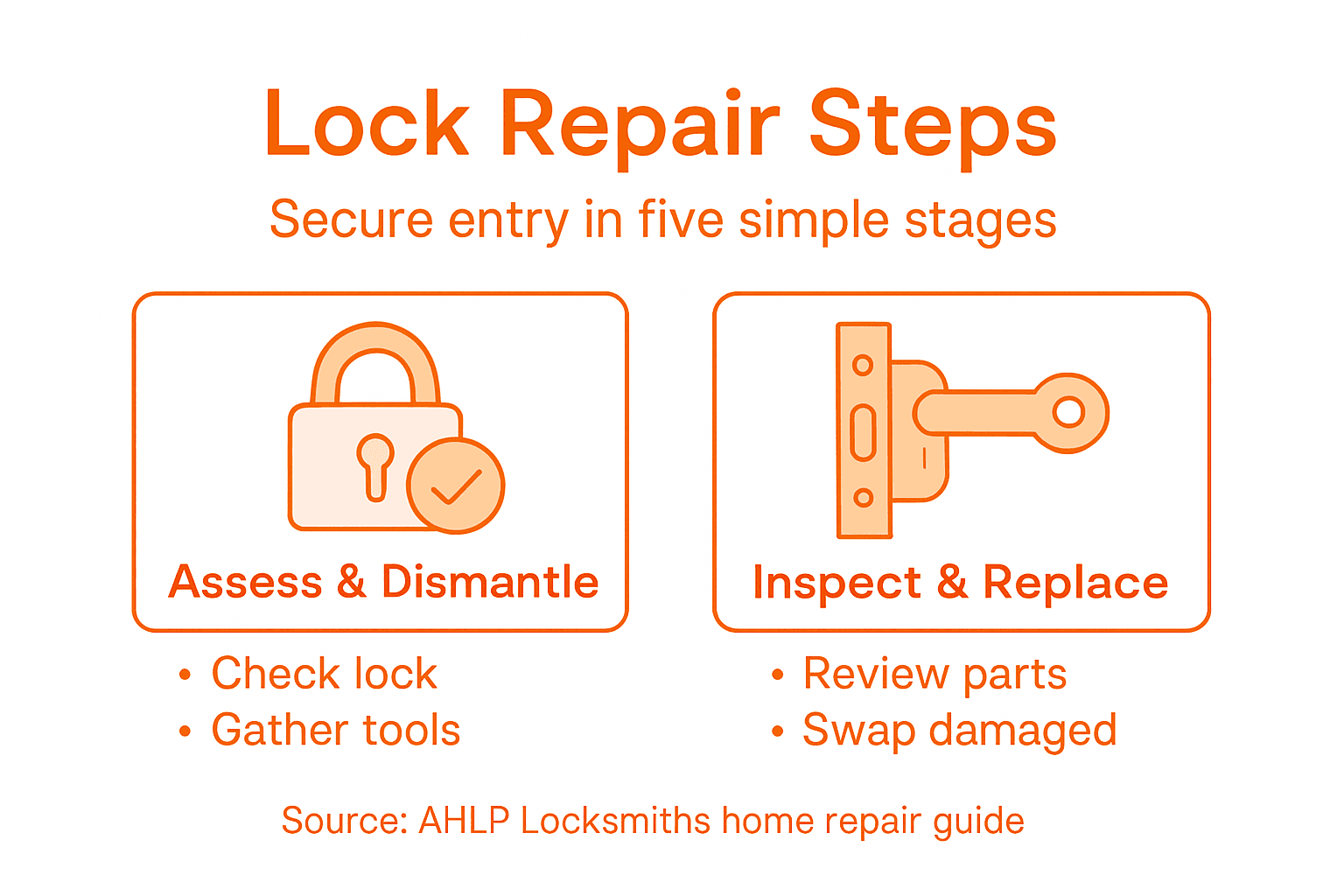
Be prepared to invest in quality replacement components. Cheap, inferior parts might save money initially but could compromise your lock’s long-term reliability and security performance.
The following table outlines when to repair versus replace lock components:
| Situation | Recommended Action | Rationale |
|---|---|---|
| Minor surface corrosion | Repair | Maintains function with simple fixes |
| Severely worn or bent internal mechanisms | Replace | Ensures long-term security |
| Spring tension slightly reduced | Repair | Minor adjustment restores performance |
| Major crack or deformation in metal parts | Replace | Prevents total lock failure |
Pro tip: Photograph the original part alongside the replacement to verify absolute compatibility before final installation.
Step 5: Reassemble and Test the Lock
The final stage of lock repair involves methodically reconstructing the mechanism and rigorously testing its functional integrity. Precision during reassembly will determine the lock’s reliability and security performance.
Begin the reassembly process by carefully replacing components in the exact reverse order of disassembly. Key steps include:
- Align pins and tumblers precisely
- Ensure spring mechanisms are correctly tensioned
- Check screw alignment before final tightening
- Verify component orientation matches original configuration
Follow these systematic reassembly steps:
- Replace internal mechanism components
- Secure each part with appropriate torque
- Gradually rebuild the lock structure
- Test movement at each stage
Precision during reassembly prevents future mechanical failures.
Once reassembled, conduct comprehensive functionality tests. Insert the key and perform multiple lock and unlock cycles, checking for:
- Smooth key insertion
- Consistent rotation
- Secure locking mechanism
- No unexpected resistance
- Complete key rotation
If any irregularities emerge, disassemble and review your work carefully. Minor misalignments can significantly impact lock performance and security.
Pro tip: Apply a small amount of graphite lubricant during reassembly to ensure smooth mechanical operation and reduce future wear.
Secure Your Home Entry with Trusted Professional Lock Repairs
The detailed step-by-step lock repair guide highlights common challenges such as identifying the correct lock type, inspecting components for damage, and carefully reassembling mechanisms to restore smooth operation. If you are struggling with issues like stiff keys, worn pins, or malfunctioning UPVC mechanisms, these problems can leave your home vulnerable and cause frustrating delays.
At AHLP Locksmiths, we understand the importance of precision and quality when it comes to your security. Our experienced team offers comprehensive Locksmith Services – Auto Home Lock Pro that cover everything from lock repairs to full security upgrades across Bristol, South Gloucestershire and Gloucester. Using high-grade British Standard and insurance-approved hardware, we ensure your locks function flawlessly, giving you peace of mind.
Don’t leave your home’s safety to chance. Act now and benefit from fast, reliable repairs or upgrades by contacting our friendly local experts at AHLP Locksmiths. For urgent lock issues, explore our emergency locksmith service to get immediate professional assistance that restores security without delay.
Frequently Asked Questions About Lock Repair Needs
How do I identify the type of lock I have for repair?
Begin by examining the lock’s characteristics, such as the material, door type, and mechanism complexity. Look for indicators like whether it is a Euro cylinder, mortice lock, or UPVC mechanism, as this will guide you in planning your repair strategy and tool requirements.
What tools do I need for DIY lock repairs?
Essential tools for your lock repair kit include a screwdriver set, adjustable wrench, Allen key set, measuring tape, and needle-nose pliers. Gather these tools before you start to ensure you are prepared for the repair process.
How do I safely dismantle a lock for repair?
Carefully remove the lock’s external screws in a systematic order, documenting each step with photographs. Ensure your workspace is well-lit and organised, placing removed components in a specific order to facilitate easy reassembly later.
What should I look for when inspecting lock components?
Inspect components for signs of wear, corrosion, or damage, focusing on spring mechanisms, pins, tumblers, and metal surfaces. Use a magnifying glass to detect subtle flaws that could affect the lock’s function and reliability.
When should I replace rather than repair a lock component?
Consider replacing a component if it shows significant corrosion, irreparable damage, or severe deformation. In such cases, prioritise the replacement to maintain the lock’s security and functionality, which can save you effort in the long run.
How can I test my lock after reassembly?
After reassembling the lock, insert the key and perform multiple lock and unlock cycles. Ensure there is smooth key insertion, consistent rotation, and secure engagement without unexpected resistance to confirm that the lock is functioning properly.