
TL;DR:
- Upgrading locks and alarms to British Standard standards is essential for insurance compliance.
- Professional installation and certification increase security effectiveness and claim approval chances.
- Regular maintenance and proper documentation ensure ongoing compliance and maximise insurance discounts.
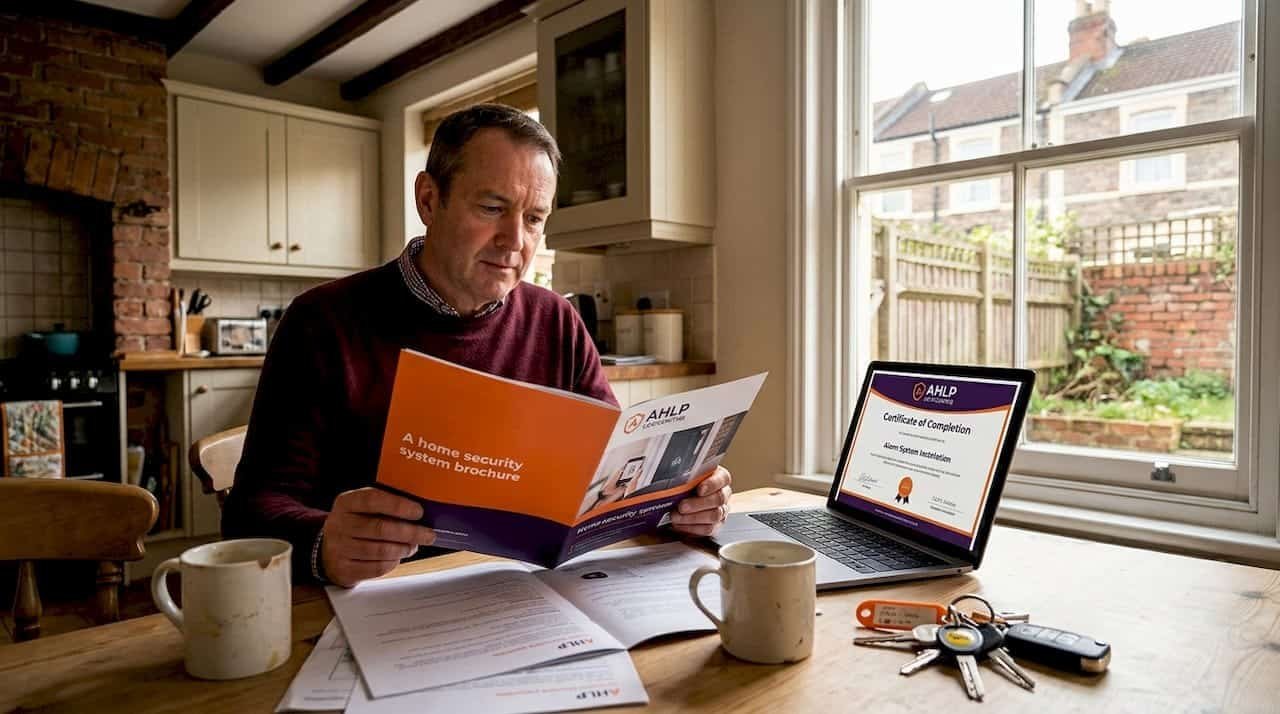
Your home insurance renewal arrives and, buried in the small print, there’s a requirement for a Grade 2 intruder alarm or British Standard locks you don’t currently have. It’s a situation many Bristol homeowners face, and it creates an uncomfortable realisation: your home may be less protected than you assumed. Outdated locks, unmonitored alarms, and non-compliant systems leave you exposed not just to break-ins, but to rejected insurance claims when you need them most. This guide walks you through every stage of a compliant, cost-effective home security upgrade so you can protect your property, satisfy your insurer, and enjoy genuine peace of mind.
Table of Contents
- Assessing your current security and compliance
- Planning your home security upgrade: what to consider
- Step-by-step: upgrading your home security system
- Verifying, maintaining, and maximising your upgraded system
- Our take: the overlooked truths about home security upgrades
- Get expert help with your home security upgrade
- Frequently asked questions
Key Takeaways
| Point | Details |
|---|---|
| Compliance is essential | Your system must meet current British and insurance standards to keep your policy valid. |
| Professional installation pays off | Expert fittings optimise safety, maximise insurance discounts, and ensure reliable claims. |
| Documentation is powerful | Stored certificates and proof of compliance can protect you in the event of a claim. |
| Plan for savings | Smart upgrades can lower annual insurance costs by 5–15% with proper paperwork. |
Assessing Your Current Security and Compliance
Now that you understand why upgrades are crucial, here’s how to evaluate your system. Before spending a penny on new equipment, you need an honest picture of what you already have and where the gaps are.
Start by looking at the visible signs that your current setup may not meet modern standards:
- Locks that are more than ten years old, particularly basic Euro cylinders without anti-snap protection
- An alarm system with no monitoring contract, no NSI or SSAIB certification, and no documentation
- Window locks that are simple push-button latches rather than key-operated mechanisms
- No evidence of a security survey or written risk assessment from a qualified professional
- Missing paperwork, such as installation certificates or service records
These aren’t cosmetic concerns. Insurers increasingly ask for proof that your security meets recognised British standards, and without it, you may find your policy is void at the point of claim.
On the alarm side, UK insurance-compliant intruder alarms must be designed under PD 6662 and BS EN 50131 standards, installed by SSAIB or NSI certified companies, with appropriate grading: Grade 2 for low to medium risk homes, Grade 3 for higher risk properties. Some insurers also require specific signalling, such as DP3 or DP4, for police response via a Unique Reference Number (URN). These aren’t optional extras. They are the baseline for a fully compliant system.
The table below summarises the key features to check during your assessment:
| Feature | Standard required | Compliance check |
|---|---|---|
| Intruder alarm design | PD 6662 / BS EN 50131 | Check installer’s documentation |
| Alarm grading | Grade 2 (low-medium risk) or Grade 3 | Confirmed in installation certificate |
| Installer certification | SSAIB or NSI approved | Verify on SSAIB/NSI online register |
| Police response signalling | DP3 / DP4 via URN | Check monitoring contract |
| Door locks | BS 3621 or TS 007 3 star rated | Look for British Standard kitemark |
| Window locks | Key-operated, insurer specified | Refer to policy schedule |
Understanding insurance compliance details for both locks and alarms is essential before you commit to any new purchase or installation. We also recommend looking at broader shutter security advice as part of your perimeter assessment, especially if you have ground-floor windows or a garage.
For a truly accurate picture of your Bristol property’s vulnerabilities, a professional security consultation is the most reliable route. We can assess your specific risk profile, layout, and existing hardware before recommending any changes.
Pro Tip: Keep a dedicated folder, physical or digital, containing all installation paperwork, service records, certificates, and correspondence with your insurer. If you ever make a claim, this documentation can make the difference between a successful payout and a lengthy dispute.
Planning Your Home Security Upgrade: What To Consider
Once you know what needs addressing, it’s time to plan your upgrade. Good planning prevents overspending on features you don’t need while making sure you hit the standards that actually matter to your insurer.
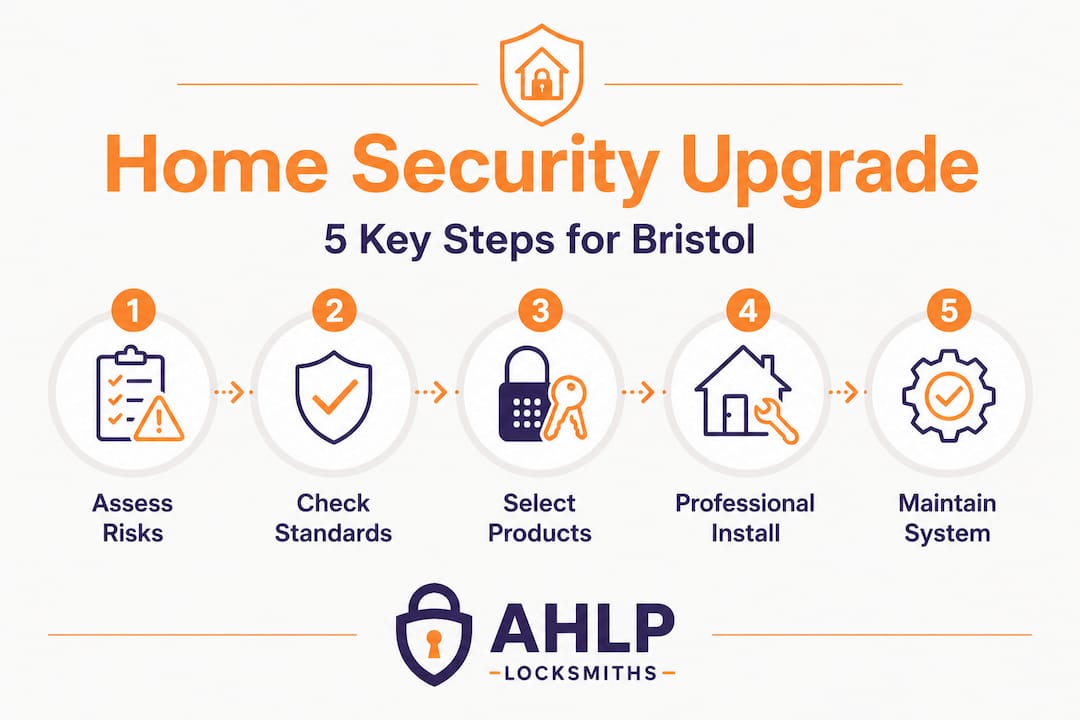
The planning process generally follows four steps:
- Risk assessment: Identify which entry points are most vulnerable and whether your area or property type puts you in a higher risk category
- System selection: Decide between a monitored intruder alarm, a self-monitored smart system, or a combination of both
- Insurance alignment: Speak to your insurer before purchasing anything so you know exactly what they require for premium discounts or compliance
- Professional installation: Confirm whether your preferred system requires a certified installer for the documentation to be valid
One of the most common points of confusion is the choice between DIY and professional upgrade. The table below breaks this down clearly:
| Factor | DIY upgrade | Professional upgrade |
|---|---|---|
| Upfront cost | Lower | Higher |
| Insurance compliance | Risk of non-compliance | Fully certified documentation |
| Installation quality | Variable | Optimised sensor placement and zoning |
| Ongoing cost | Minimal | Service contract may apply |
| Peace of mind | Limited | High |
| Claim approval likelihood | Uncertain | Significantly stronger |
Security upgrade savings: Upgrading your security can yield 5 to 15% insurance premium discounts. Monitored alarms often attract savings of 7 to 15%, while certified smart systems may save you up to 10 to 15%. Savings vary by provider and always require proof of installation and compliance.
That figure is worth sitting with for a moment. On a £900 annual premium, a 12% discount saves you £108 per year. Over five years, a professional installation that costs £500 more than a DIY option pays for itself entirely through insurance savings alone, and that’s before accounting for the reduced risk of an actual burglary.
Understanding the benefits of lock upgrades is a useful starting point when budgeting your plan. Anti-snap Euro cylinders, multi-point locking mechanisms, and British Standard mortice locks all contribute significantly to your overall security rating. Research also suggests that visible deterrents play a powerful role, with burglar deterrence through smart locks and alarm signage among the most effective measures you can take.
Additional physical security add-ons worth factoring into your plan include security shutters, CCTV cameras, motion-activated lighting, and reinforced door frames. Guidance on physical security add-ons such as window shutters can complement your alarm and lock upgrades effectively, particularly for period properties or ground-floor conversions common across Bristol and South Gloucestershire.
Step-By-Step: Upgrading Your Home Security System
With your options lined up, here’s how to execute your upgrade in a clear, methodical way.
Get a written risk assessment. Whether from a professional locksmith or a certified alarm company, document your current vulnerabilities and the recommended upgrades before any work begins.
Choose compliant equipment. If you opt for a DIY approach, verify that every component carries the appropriate BS EN 50131 grade marking. Be aware that DIY installation risks non-compliance and can void your insurance; professional installation ensures optimal sensor placement, correct zoning for night arming, and false alarm reduction through dual-path signalling.
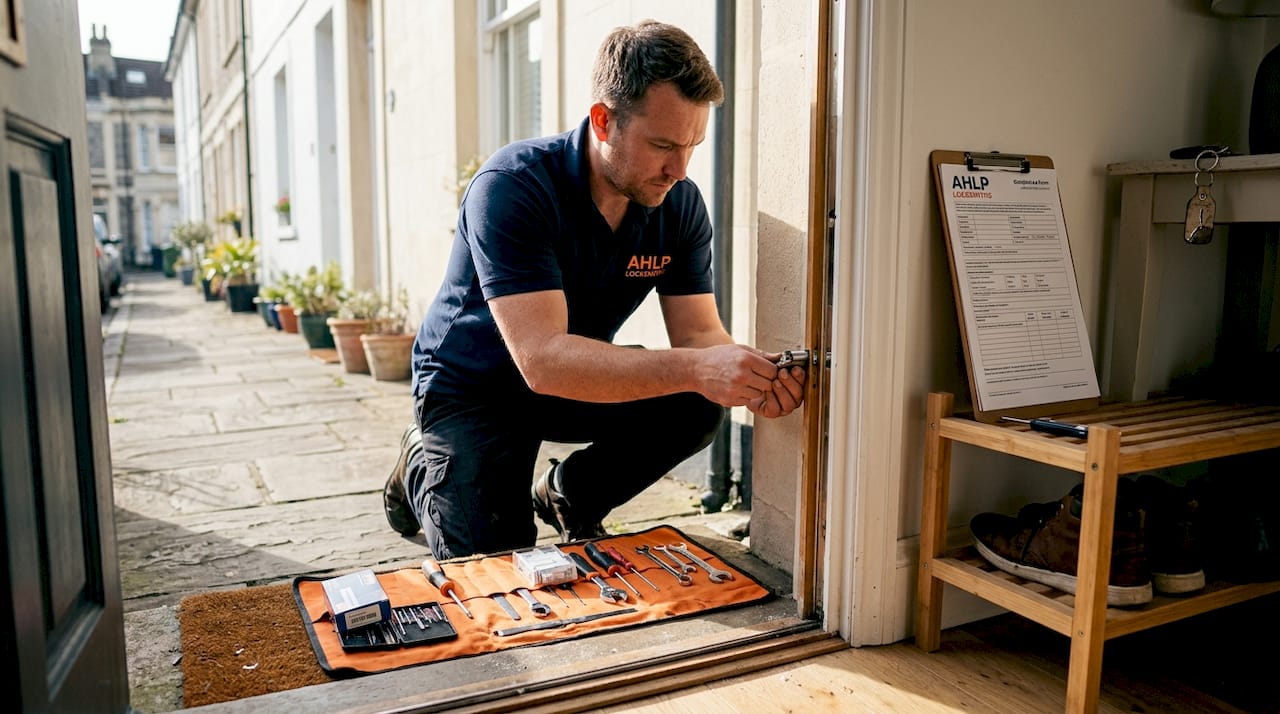
Upgrade your physical locks first. Alarms deter and alert, but locks are your first physical line of resistance. Replacing vulnerable cylinders with TS 007 3 star rated anti-snap locks and fitting BS 3621 mortice deadlocks on timber doors are the most immediately impactful changes you can make.
Book a certified alarm installation. Contact an SSAIB or NSI registered company to install and commission your intruder alarm. Insist on receiving the full commissioning certificate, the grade confirmation, and details of any monitoring contract, including the signalling pathway used.
Apply for a URN if required. If your insurer or the alarm grade requires police response capability, your certified installer will help you register for a Unique Reference Number through the local police. This is a formal requirement for Grade 3 systems and some monitored Grade 2 setups.
Notify your insurer in writing. Once the upgrade is complete, send your insurer a copy of all installation certificates along with a written description of the changes made. Ask them to confirm your updated premium in writing.
Test the system thoroughly. Walk your property and trigger each sensor in turn. Confirm that the monitoring station receives every signal. Check that all delay zones, entry zones, and panic functions operate correctly before signing off any installer’s paperwork.
File all documentation securely. Store physical copies and digital backups of every certificate, installation report, and insurer correspondence. This is what you’ll rely on if you ever need to make a claim.
Pro Tip: Ask your installer to photograph the sensor positions during installation. These images form part of your compliance record and confirm correct placement if a claim is ever challenged.
Reviewing your lock replacement options alongside your alarm upgrade ensures every element of your security works together. For a broader view of everything that goes into a compliant upgrade, our ultimate home security guide covers the full picture in detail.
Verifying, Maintaining, and Maximising Your Upgraded System
Completing your upgrade isn’t the end. Here’s how to get the most value and protection from your new system over the long term.
Start with a post-installation verification checklist:
- Confirm your installation certificate includes the specific BS EN 50131 grade, installer credentials, and commissioning date
- Test every zone of your alarm system, including any external sounders and remote key fobs
- Check that your insurer has received and acknowledged your compliance documentation
- Register your system with the alarm receiving centre if monitored, and confirm they have your correct contact details and access information
- Ensure all household members know how to arm, disarm, and respond to the system
Keeping detailed records isn’t just good practice. It is often a contractual requirement. Many insurers specify that your system must be serviced annually by a certified engineer, and they may ask for proof at renewal. Maintain a log of every service visit, noting the engineer’s name, certification number, the date of the visit, and any components tested or replaced. This simple habit protects your policy compliance and ensures you are never caught short at renewal.
Regular maintenance tasks that keep your system compliant and effective include:
- Annual service by an SSAIB or NSI registered engineer
- Battery replacement in wireless sensors, typically every two to three years
- Checking and cleaning PIR (passive infrared) motion sensors for dust or spider webs that can cause false alarms
- Testing door and window contacts after any building work or redecoration
- Reviewing lock condition, particularly on UPVC doors where the multipoint mechanism can wear or misalign over time
The financial case for staying on top of maintenance is straightforward. As noted earlier, security upgrade discounts of 5 to 15% are available, but they require ongoing proof of compliance, not just a one-off installation. Insurers can and do withdraw discounts if they request service records and you cannot provide them.
Pro Tip: Schedule your annual security service at the same time as your insurance renewal. This makes it easy to present fresh service documentation when negotiating your premium each year, and ensures you never let the compliance window lapse.
Security standards also evolve. NPCC (National Police Chiefs’ Council) requirements for police response, grading thresholds, and manufacturer certifications are reviewed periodically. Ask your installer to flag any upcoming changes that might affect your compliance at each annual review.
Our Take: The Overlooked Truths About Home Security Upgrades
Before you wrap up, consider these overlooked truths from our years of local security experience in Bristol and the surrounding areas.
The home security market is awash with technology. Smart cameras, app-controlled locks, video doorbells, and AI motion detection all promise to revolutionise your safety. And some of them genuinely do add value. But we see a recurring pattern: homeowners invest heavily in technology while neglecting the foundational elements that actually satisfy insurance requirements and resist physical attack. A £400 smart doorbell paired with a 15-year-old standard cylinder lock is not a security upgrade. It is a comfort purchase.
The subscription versus ownership debate is also more significant than most people realise. Subscription-based systems from brands like Ring or SimpliSafe offer slick app control, but they come with ongoing fees and a cloud dependency that creates complications in the UK insurance context. Systems installed by local certified engineers, using ownership-based hardware, typically integrate more cleanly with insurer requirements because all documentation stays with you rather than sitting inside a manufacturer’s platform.
We have also seen the real cost of DIY installation underestimated repeatedly. Homeowners save £300 to £500 on installation, then discover their alarm doesn’t qualify for a police URN, their sensors are positioned incorrectly for the required detection coverage, or their insurer simply won’t accept the paperwork because it wasn’t produced by a registered company. The money they saved is far outweighed by the gap in protection.
Our honest advice: focus on durability, certified documentation, and a relationship with a trusted local security assessor who knows Bristol properties, local crime patterns, and the specific requirements that regional insurers are applying. Technology is a welcome addition, but it should sit on top of a solid, compliant foundation, not replace it.
Get Expert Help With Your Home Security Upgrade
If you want reassurance that your upgrades are genuinely up to standard, we are here to help. At AHLP Locksmiths, we provide trusted locksmith services across Bristol, South Gloucestershire, and Gloucester, covering everything from anti-snap lock replacements and BS-rated mortice deadlocks to full security consultations and insurance-compliant hardware. Our team is DBS-checked, experienced, and transparent about pricing, with no call-out fees and fast response times. Whether you need a targeted lock upgrade or a complete review of your property’s security, we can help you achieve compliance and confidence. Explore our security upgrades for Bristol homes or call us on 07700 100146 to arrange a visit at a time that suits you.
Frequently Asked Questions
What’s the difference between Grade 2 and Grade 3 security systems?
Grade 2 is designed for most homes with low to medium risk profiles, while Grade 3 provides higher security for properties with greater risks, higher-value contents, or specific insurer requirements. Your installer and insurer can confirm which grade applies to your property.
How much could I save on home insurance with a new security system?
Savings range from 5% to 15% depending on your insurer, the type of system installed, and whether you can provide proof of certified installation. Monitored alarm systems and certified smart setups typically attract the highest discounts.
Can I install the system myself or do I need a professional?
DIY installation is technically possible, but it carries a significant risk of non-compliance that can void your insurance at the point of claim. Professional installation ensures certification, correct sensor placement, and all the paperwork your insurer needs to honour your policy.
Do smart home security systems count for insurance requirements?
Yes, smart systems can qualify, but only if they are installed to the required British standards and you can provide documentation proving compliance. Insurer-accepted smart systems must still meet PD 6662 and BS EN 50131 requirements and be installed by a certified company to qualify for discounts or police response registration.