

TL;DR:
- Meeting last year’s security standards is insufficient for current compliance, as frameworks now demand continuous evidence of control effectiveness. Businesses must proactively align with evolving regulations like CMMC, CCPA, NIST CSF 2.0, and NYDFS Part 500, emphasizing ongoing operational security over periodic documentation. Effective compliance requires integrating security controls into daily routines, engaging leadership, and addressing both digital and physical security measures throughout the year.
Meeting last year’s security standards does not make your business compliant today. Business security compliance 2025 is a fundamentally different challenge from what most organisations faced even two years ago. New regulatory frameworks have taken effect, phased enforcement deadlines are arriving, and regulators now expect continuous evidence of control effectiveness rather than an annual snapshot. Whether you are responsible for a defence contractor, a financial services firm, or a California-regulated business, the rules have shifted. This guide gives you a clear, honest picture of what the major frameworks require, how to implement them, and where most businesses fall short before an audit.
Table of Contents
- Key takeaways
- Business security compliance 2025: the key frameworks
- Building security controls that actually hold up
- The pitfalls that trip businesses up
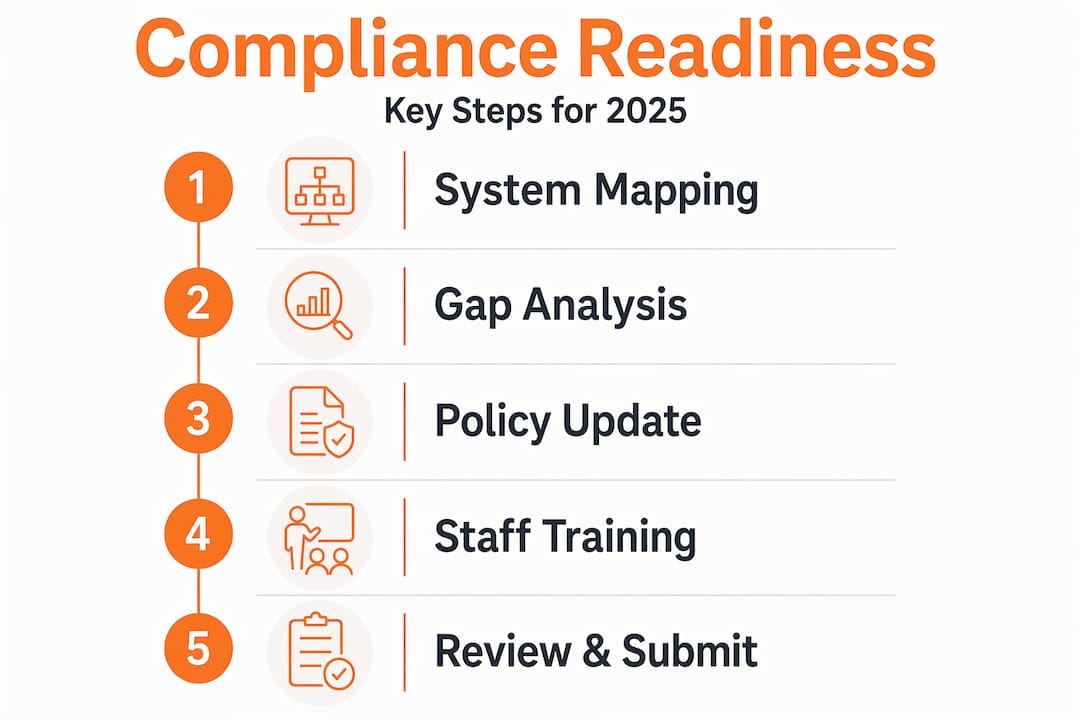
- Practical steps for compliance readiness in 2025
- My view: compliance is not a calendar event
- How Ahlp can support your business security
- FAQ
Key Takeaways
| Point | Details |
|---|---|
| 2025 marks a compliance turning point | Major frameworks including CMMC and CCPA cybersecurity audits are now actively enforced, not theoretical. |
| Continuous evidence collection is required | Auditors expect proof that controls operated all year, not a document assembled the week before review. |
| Physical and digital security both count | Compliance covers access controls, premises security, and documentation alongside cybersecurity measures. |
| Phased deadlines demand early action | Businesses with higher revenues face earlier reporting obligations, making 2026 preparation critical. |
| Leadership must own compliance | Board and executive engagement is now embedded in NIST CSF 2.0 and modern audit expectations. |
Business Security Compliance 2025: The Key Frameworks
There are four regulatory frameworks that business leaders and compliance officers need to understand right now. They overlap in some areas and diverge sharply in others, but all four share one common thread: they treat security as an ongoing operational commitment, not a filing exercise.
California CCPA cybersecurity audit requirements
California’s Consumer Privacy Act cybersecurity audit rules become effective on 1 January 2026, with phased reporting deadlines running from April 2028 through to April 2030 depending on annual revenue. Businesses generating over £100 million in revenue must submit their first audit by April 2028. The £50 to £100 million bracket follows in 2029, and smaller qualifying businesses have until 2030. That timeline sounds comfortable. The problem is that the first audit period starts January 2027, which means evidence collection must begin in 2026. Waiting until 2027 to prepare is not an option.
DoD CMMC phased enforcement
The US Department of Defence Cybersecurity Maturity Model Certification programme entered its enforcement phase on 10 November 2025. CMMC phases run through 2028, with Phase 1 allowing self-assessments, Phase 2 requiring independent third-party assessment, and Phase 3 mandating government-led certification. CMMC is not just a compliance hurdle. It is a condition of contract award, meaning non-certified businesses cannot bid on relevant DoD work at all.
NIST Cybersecurity Framework 2.0
NIST CSF 2.0 is the most broadly applicable framework on this list. It integrates cybersecurity risk with enterprise risk management and workforce planning in a way that earlier versions did not. It expects board-level engagement, not just IT department ownership. That shift is significant.
NYDFS Part 500
The New York Department of Financial Services has issued guidance encouraging regulated entities to go beyond minimum Part 500 requirements when threat levels are elevated. Adaptive compliance is now the expectation, not the exception.
| Framework | Who it affects | Key 2025/2026 milestone |
|---|---|---|
| California CCPA audit | US businesses processing personal data at scale | Evidence collection starts January 2026 |
| DoD CMMC | Defence contractors and subcontractors | Phase 1 enforcement active from November 2025 |
| NIST CSF 2.0 | All organisations seeking a risk management baseline | Published framework supports audit alignment now |
| NYDFS Part 500 | New York financial services entities | Heightened threat guidance issued May 2026 |
Building Security Controls That Actually Hold Up
Knowing what each framework requires is useful. Knowing how to implement security controls that survive an audit is where most organisations struggle. The CCPA cybersecurity audit evaluates 18 distinct components, including authentication, encryption, access control, vulnerability testing, staff training, incident response planning, and business continuity. Each component must be evidenced, not just described.
Here is what effective implementation looks like across the core areas:
- Authentication and access control. Multi-factor authentication is now a baseline expectation, not a premium. Access rights should be reviewed at regular intervals and logged consistently throughout the year.
- Encryption. Data at rest and in transit must be encrypted using current standards. This applies to email, file storage, and any third-party systems handling personal or sensitive data.
- Vulnerability management. Regular scanning, patch management, and penetration testing must be scheduled and documented. Ad hoc scanning that happens once a year will not satisfy an auditor.
- Incident response. You need a documented plan that has been tested. A plan that lives in a shared drive and has never been exercised is unlikely to impress a regulator.
- Workforce training. Training must be ongoing and recorded. One induction session when someone joins the business does not meet the spirit or letter of modern enterprise security standards.
- Physical access controls. This is frequently overlooked in digital compliance frameworks, but access to server rooms, filing areas, and sensitive premises directly affects your audit readiness.
Operationalising security checklists into automated change management workflows and drift detection is one of the most practical ways to maintain continuous compliance without overwhelming your team.
Pro Tip: Do not build your compliance programme around audit preparation. Build it around daily operations, then let the audit evidence collect itself. Every access log, change record, and training completion should be captured automatically as part of normal working processes.

The Pitfalls That Trip Businesses Up
Most compliance failures are not caused by ignorance of the rules. They are caused by misunderstanding what sustained compliance actually requires. Here are the most common traps and how to avoid them.
Treating compliance as a documentation exercise. Effective audit regimes require proof of full-year continuous operation, not a snapshot assembled before the deadline. If your controls only appear to have been running when you need to demonstrate them, an experienced auditor will notice.
Assuming one certification covers everything. For CMMC in particular, certification is contract-specific. You cannot rely on a single enterprise-wide certification to cover all your DoD contracts. Each contract solicitation has its own certification requirements.
Ignoring subcontractors. Businesses handling Federal Contract Information or Controlled Unclassified Information must flow compliance obligations down to subcontractors. If a supplier in your chain is non-compliant, your business carries that risk.
Treating minimum standards as sufficient. Compliance expectations are not static. During heightened threat periods, regulators expect businesses to demonstrate they have gone beyond the minimum. Adaptive risk management is now part of what compliance means.
Leaving leadership out of the loop. Board and executive engagement in cybersecurity risk is now embedded in NIST CSF 2.0 and reflected in audit expectations. If your senior team cannot speak to the organisation’s risk posture, that is a compliance gap in itself.
Pro Tip: Set a quarterly compliance review in your leadership calendar now. Treat it the same way you would treat a board-level financial review. It does not need to be long, but it does need to happen consistently and be minuted.
Practical Steps For Compliance Readiness in 2025
If you are looking for a clear starting point, these are the actions that will make the biggest difference before your first audit period begins.
- Map your personal information systems. You cannot protect what you cannot see. Create an inventory of every system that handles personal, sensitive, or regulated data, including cloud services and third-party processors.
- Conduct a gap assessment. Measure your current controls against the 18-component CCPA audit structure or the relevant CMMC level. Be honest about what is missing.
- Select qualified auditors early. Do not leave auditor selection until the year before your deadline. Experienced auditors are in short supply, and early selection gives you time to prepare with their input.
- Align evidence to regulatory components. Create a mapping document that links each control to the specific regulatory requirement it satisfies. This makes audit fieldwork faster and reduces the risk of gaps being missed.
- Establish an executive certification process. CCPA audit requirements include executives signing off on findings. Set up that governance structure now rather than scrambling to define it under pressure.
- Review physical access alongside digital controls. Door access, key management, and server room security are all relevant to a complete compliance picture. See our key control best practices guide for a practical starting point on the physical side.
| Preparation task | Target completion |
|---|---|
| Information system mapping | Quarter 1 2026 |
| Gap assessment against frameworks | Quarter 2 2026 |
| Auditor selection and engagement | Quarter 2 2026 |
| Control evidence collection begins | January 2026 |
| Executive governance structure in place | Quarter 3 2026 |
| First internal compliance review | Quarter 4 2026 |
My View: Compliance is Not A Calendar Event
I have worked with enough businesses to know that the most common mistake is treating compliance as something you do in the run-up to a deadline. You dust off last year’s policies, run a quick training session, and hope the auditor does not dig too deep. That approach worked when regulators were less sophisticated. It does not work now.
What I have seen make a genuine difference is when senior leaders treat cybersecurity risk the same way they treat financial risk. Not as an IT department matter, but as a board-level issue with real commercial consequences. NIST CSF 2.0 makes this explicit, and the businesses I find most prepared for audit are almost always the ones where the chief executive or a director can walk you through their risk posture without needing to call the IT manager first.
The other thing I would say is this: physical security is still under-counted in compliance conversations. Businesses invest in firewalls and endpoint protection, then leave a server room door held open with a fire extinguisher. Every part of your premises that stores or processes regulated data is part of your compliance picture. Start thinking about what business security really means in the round, not just digitally.
Preparation is not complicated. It is consistent. The businesses that pass audits confidently are simply the ones that stopped treating compliance as a once-a-year task and started treating it as the way they operate every day.
— Martyn
How AHLP Can Support Your Business Security
At Ahlp, we work with businesses across Bristol, South Gloucestershire, and Gloucester to secure their premises as part of a broader security strategy. While cybersecurity frameworks rightly demand rigorous digital controls, physical security remains a core element of compliance readiness. Our professional locksmith services cover everything from anti-snap lock upgrades and master key systems to full security consultations tailored to your business needs.
If your compliance review has highlighted gaps in physical access control, we can help. We install British Standard and insurance-approved hardware, advise on key management, and carry out security assessments that complement your wider compliance programme. Our commercial lock safety advice gives businesses a practical framework for tightening physical access alongside their digital controls.
Call us on 07700 100146 or visit ahlp.co.uk to arrange a security consultation and make sure your premises are as secure as your systems.
FAQ
What is business security compliance in 2025?
Business security compliance in 2025 refers to meeting the active requirements of frameworks such as CMMC, CCPA cybersecurity audits, NIST CSF 2.0, and NYDFS Part 500. These require continuous control operation, documented evidence, and executive oversight rather than periodic policy reviews.
When does the CCPA cybersecurity audit requirement come into effect?
The first audit period starts on 1 January 2027, with reporting deadlines from April 2028 to April 2030 based on business revenue. Businesses should begin evidence collection and gap assessments in 2026 to meet the earliest deadlines.
Does CMMC compliance apply to subcontractors?
Yes. Any subcontractor handling Federal Contract Information or Controlled Unclassified Information must meet the corresponding CMMC level. Prime contractors are responsible for ensuring their supply chain meets these obligations.
How does physical security relate to cybersecurity compliance?
Physical access controls, including door locks, key management, and server room security, are directly relevant to compliance frameworks that require protecting regulated data. A business with strong digital controls but weak physical access management carries real audit risk.
How often should businesses review their compliance status?
Regulators now expect continuous monitoring rather than annual reviews. A quarterly leadership-level compliance review, combined with automated control monitoring throughout the year, reflects current best practice under frameworks like NIST CSF 2.0.
Recommended
- What is business security? Bristol’s essential guide
- Practical Steps To Upgrade Business Security in Bristol
- Security consultation: protect and insure your Bristol property
- Why Upgrade Shop Locks: Enhanced Security for 2026