
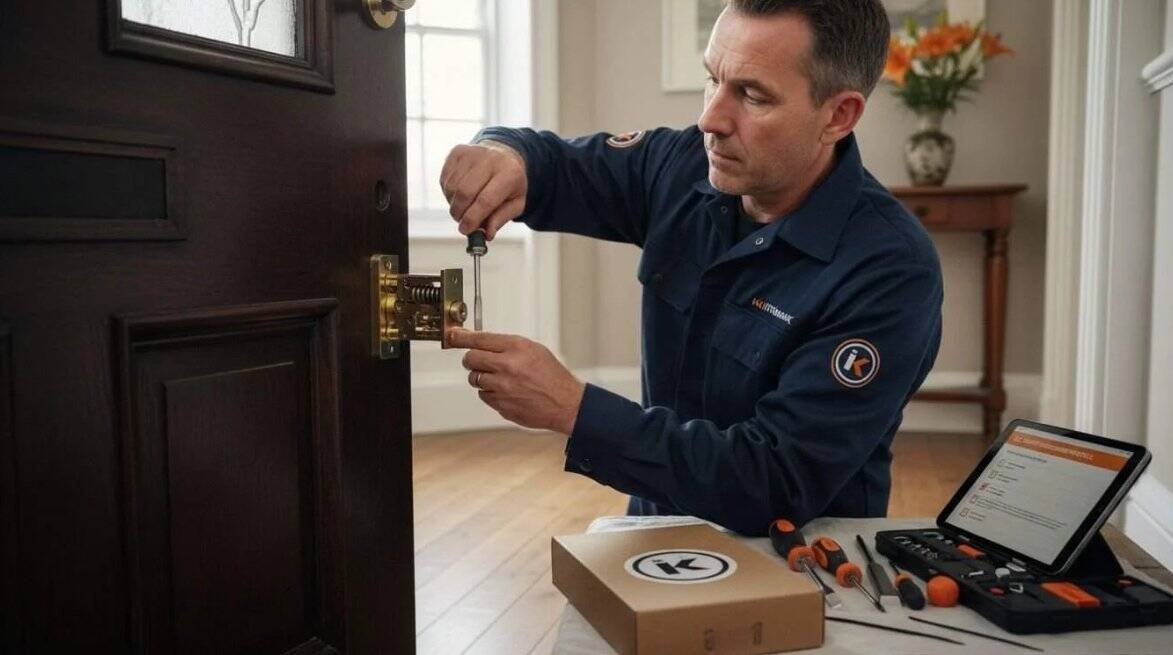
UK homes use several different types of door locks, and the right one depends largely on the door itself. A timber front door may use a mortice lock or night latch, while a modern uPVC or composite door will often have a multipoint locking system operated by a Euro cylinder.
Understanding that difference matters when you need a repair, replacement or security upgrade. Replacing the cylinder, for example, is not the same job as replacing the complete multipoint mechanism.
This guide explains the main types of door locks found in UK homes, what doors they are normally fitted to, how they work and roughly what you can expect to pay to have one replaced or fitted.
UK Door Lock Types at a Glance
| Door lock type | Commonly found on | Main purpose | Typical fitted price* |
|---|---|---|---|
| 5-lever mortice deadlock | Timber doors | Main external door security | £100 to £180 |
| Mortice sashlock | Timber doors | Lock and latch in one mechanism | £100 to £190 |
| Night latch | Timber entrance doors | Automatic latching and convenient access | £90 to £180 |
| Euro cylinder | uPVC and composite doors | Operates compatible locking mechanisms | £80 to £150 |
| Anti-snap Euro cylinder | uPVC and composite doors | Cylinder with enhanced snap resistance | £90 to £170 |
| Multipoint locking system | uPVC and composite doors | Locks the door at several points | £180 to £350+ |
| Rim lock | Mainly timber doors | Surface-mounted locking | £90 to £170 |
| Smart lock | Varies by product and door | Electronic or keyless access | £150 to £400+ |
Prices are approximate fitted ranges for straightforward replacement or installation. The actual price depends on the lock, door, required security specification, labour and whether additional repairs or adjustments are needed.
1. Mortice Deadlocks
A mortice deadlock is fitted into a pocket cut into the edge of a timber door. When the key is turned, a solid bolt extends from the lock into the keep fitted to the door frame.
Because most of the lock body sits inside the door, you will usually see only the keyhole and the metal faceplate along the door edge.
Five-lever mortice deadlocks are commonly found on external timber doors. However, having five levers does not automatically mean a particular lock meets a British Standard, so check its certification rather than relying on the lever count alone.
For an external door where your insurer specifies BS3621, look for the appropriate BSI Kitemark and BS3621 marking on the lock.
Typical fitted price: around £100 to £180, depending on the lock specification and whether the existing mortice needs alteration.
Best suited to: timber front and back doors.
[PHOTO: Sam-fitted mortice deadlock with the door open, showing the faceplate and bolt]
2. Mortice Sashlocks
A mortice sashlock combines a deadbolt with a latch operated by door handles.
This means the handles retract the latch during everyday use, while the key operates the deadbolt when the door needs to be locked securely. Like a mortice deadlock, the main lock body is fitted inside the door.
Sashlocks are common where homeowners want conventional lever handles as well as key-operated locking.
Typical fitted price: approximately £100 to £190 for a straightforward installation or replacement.
Best suited to: timber entrance doors requiring both handles and key locking.
3. Night Latches
A night latch is mounted on the inside surface of a door rather than being recessed completely into it.
When the door closes, the latch engages automatically with the keep on the frame. From outside, the lock is normally operated using a key through a cylinder, while the inside usually has a knob or handle.
Night latches are familiar on many traditional UK front doors. They are sometimes used alongside a separate mortice deadlock, although higher-security night latches are also available.
Do not assume that every night latch provides the same level of security. The construction and certification of the particular product matter.
Typical fitted price: around £90 to £180, with higher-security models potentially costing more.
Best suited to: timber entrance doors where automatic latching is useful.
4. Euro Cylinder Locks
The term Euro cylinder lock usually refers to the removable cylinder that accepts the key.
Euro cylinders are extremely common on uPVC and composite doors, where the cylinder normally operates a separate multipoint locking mechanism inside the door.
This distinction is important. If your key is lost or you want to improve cylinder security, it may be possible to replace only the Euro cylinder. If the hooks, rollers or gearbox inside the door have failed, replacing the cylinder alone will not repair the multipoint mechanism.
Euro cylinders are available in different lengths and configurations, including:
Key operation on both sides
Key operation externally with a thumbturn internally
Different security and anti-snap specifications
The cylinder needs to be correctly sized for the door and surrounding hardware.
Typical fitted price: approximately £80 to £150, depending on the cylinder specification.
Best suited to: uPVC, composite and some aluminium doors.
For a closer comparison between common door constructions, see our guide to uPVC vs wooden door locks.
5. Anti-Snap Euro Cylinders
An anti-snap cylinder is a Euro cylinder designed to provide additional protection against attacks targeting the cylinder itself.
This is particularly relevant to uPVC and composite doors using Euro cylinders. A multipoint mechanism may secure the door at several places, but the cylinder that operates it remains an important part of the complete system.
When comparing cylinders, you may encounter TS007 star ratings. These relate to the security performance of cylinders and associated protective hardware rather than being a general grading system for every type of door lock.
If you want the full explanation of the rating system, see our guide to British Standard locks, TS007 and lock grades.
You can also read more specifically about the advantages of anti-snap locks.
Typical fitted price: approximately £90 to £170, depending on cylinder size, brand and security specification.
Best suited to: uPVC and composite entrance doors using compatible Euro cylinders.
6. Multipoint Locking Systems
A multipoint locking system secures a door at several positions along its edge.
When you lift the handle or operate the mechanism, hooks, bolts, rollers or other locking points engage with keeps around the frame. Turning the key then secures the system.
Multipoint locks are commonly found on:
uPVC front and back doors
Composite doors
French doors
Some aluminium doors
One of the most useful things to understand is that the multipoint mechanism and Euro cylinder are separate components.
If the key turns but the hooks or bolts do not move correctly, the problem may be with the gearbox or multipoint mechanism. If the mechanism operates normally but keys have been lost, a cylinder replacement may be all that is required.
Door alignment also matters. A door that has dropped can place excessive pressure on the mechanism and make locking increasingly difficult even when the lock itself has not yet failed.
Typical fitted price: approximately £180 to £350+ for mechanism replacement, depending on the make, availability of compatible parts and extent of the repair.
Best suited to: uPVC and composite external doors.
For examples of problems that lead to replacement, see our guide to lock replacement for local homes.
7. Rim Locks
A rim lock is fitted to the surface of a door rather than installed into a deep mortice within it.
The lock case remains visible on the inside face of the door, making this type relatively easy to recognise. Traditional rim locks are commonly encountered on older timber doors and may also be used internally.
A rim lock should not automatically be treated as equivalent to a modern security night latch simply because both are surface mounted. Their design, purpose and security characteristics can differ considerably.
Typical fitted price: around £90 to £170, depending on the lock and the work required to fit it.
Best suited to: mainly timber doors and some traditional properties.
8. Smart Door Locks
A smart lock replaces or works with conventional key operation by adding electronic access.
Depending on the product, access may be controlled through:
A smartphone
PIN code
Keypad
Fob
Biometric identification
Remote access permissions
Compatibility is one of the most important considerations. Not every smart lock works with every timber, uPVC, composite or multipoint door.
The mechanical security of the door still matters as well. Electronic access does not compensate for a damaged frame, unsuitable cylinder or failing locking mechanism.
Typical fitted price: approximately £150 to £400+, depending heavily on the device, existing door hardware and installation requirements.
Best suited to: compatible doors where controlled or keyless access is useful.
What Type of Lock Is on My Door?
The easiest way to identify your lock is to look at both the door material and the edge of the open door.
Timber door
If you can see a relatively small rectangular faceplate with a single deadbolt, you may have a mortice deadlock.
If the faceplate has both a spring latch and a separate deadbolt operated by the key, it is likely to be a mortice sashlock.
A lock case visibly mounted to the inside surface of the door may be a night latch or another type of rim-mounted lock.
uPVC or composite door
Open the door and look along its edge.
If there is a long metal strip running vertically with several hooks, rollers or bolts, you have a multipoint locking mechanism. The key will often enter a Euro cylinder positioned near the handle.
Remember that these are two different components: the cylinder controls access, while the multipoint mechanism performs the locking along the door.
Which Door Lock Is Best for a UK Home?
There is no single best lock for every door.
The right choice starts with the door construction:
| Door type | Common locking arrangement |
|---|---|
| Timber front door | Mortice deadlock, mortice sashlock or suitable night latch |
| uPVC door | Multipoint mechanism with Euro cylinder |
| Composite door | Multipoint mechanism with Euro cylinder |
| Traditional timber door | Mortice and/or suitable rim-mounted locking |
| Compatible smart-lock installation | Depends on underlying mechanical lock and door |
Security standards and your insurance requirements should then be considered separately.
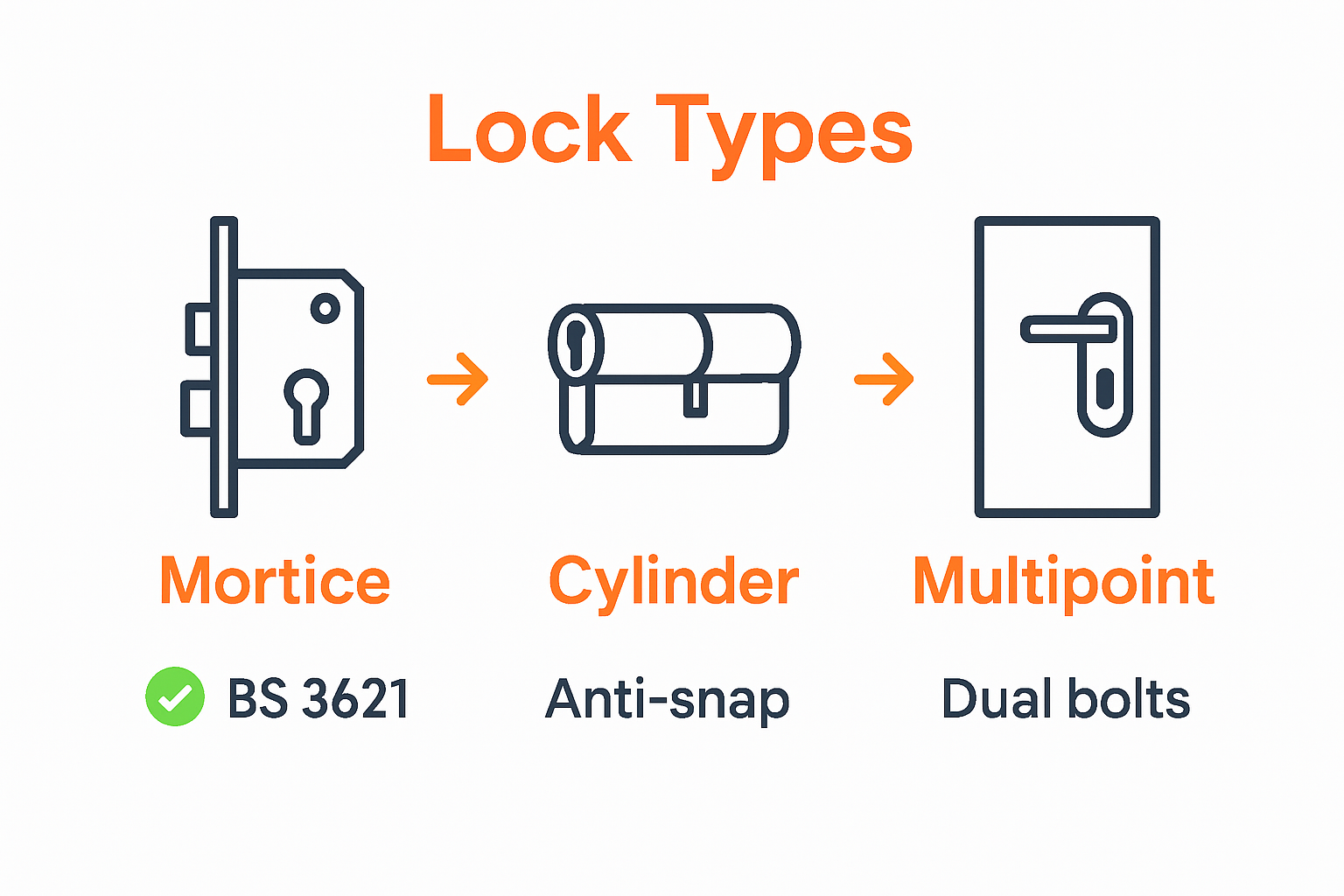
For example, BS3621 may be relevant to qualifying locks on timber doors, while TS007 relates to replacement cylinders and associated security hardware. Our dedicated guide to lock grades and insurance requirements explains these standards without repeating all of that information here.
How Much Does It Cost to Fit a New Door Lock?
For a straightforward residential job, the lock itself is only one part of the price.
The final cost can depend on:
Lock type and manufacturer
Security specification
Door material
Cylinder size
Whether an existing lock is being replaced like for like
Whether the door requires cutting or modification
Condition and alignment of the door
Damage to the gearbox or multipoint mechanism
Availability of compatible replacement parts
Whether the work is an emergency call-out
A simple cylinder change is therefore normally less involved than replacing an entire multipoint mechanism.
If a lock has become difficult to use, it is worth diagnosing the problem before ordering parts. A stiff uPVC door, for example, can sometimes be caused by alignment rather than a failed cylinder.
What Should I Check Before Replacing a Door Lock?
First work out whether the lock itself is actually the problem.
Common warning signs include:
A key becoming increasingly difficult to turn
A loose cylinder or handle
A door needing to be lifted before it locks
Hooks or bolts failing to engage
Visible corrosion or physical damage
A key breaking or repeatedly sticking
Damage following an attempted break-in
If a uPVC or composite door has dropped out of alignment, replacing a perfectly functional cylinder will not solve the underlying problem.
Likewise, if you have lost a key but the multipoint mechanism works correctly, replacing the entire mechanism may be unnecessary.
Our lock changing and upgrade service covers replacement and security upgrades where the existing hardware genuinely needs attention.
What About British Standards and Insurance?
A lock type and a lock standard are not the same thing.
A mortice lock describes the mechanism and how it is installed. BS3621 describes a security standard that qualifying lock assemblies can be certified against.
Similarly, a Euro cylinder describes a type of cylinder, while TS007 provides security requirements and ratings for cylinders and associated hardware.
If your main concern is whether an existing lock meets your insurer’s requirements, use our separate guide to British Standard and insurance-approved locks. It explains what to look for on the lock, including the BSI Kitemark and relevant standard markings.
Always check the actual wording of your insurance policy rather than assuming that one particular lock is required by every insurer.
When Should a Door Lock Be Replaced?
Age alone is not necessarily a reason to replace a functioning lock.
Replacement is worth considering when:
The lock is damaged or unreliable
The mechanism is becoming increasingly difficult to operate
Keys have been lost or stolen
You have moved into a property and cannot account for previous keys
The existing hardware does not meet a security requirement you need to satisfy
The cylinder lacks the level of protection you want
Replacement parts for an obsolete mechanism are no longer practical
The lock has been damaged during an attempted or successful break-in
Where the problem involves a multipoint door, diagnosing the fault first can prevent unnecessary replacement of parts that are still working.
Door Lock Help in Bristol and South Gloucestershire
If you cannot identify your existing lock, take a clear photograph of the door, handles and the metal faceplate or locking strip visible along the door edge. Those details can often help identify the type of mechanism before replacement options are considered.
AHLP Locksmiths provides locksmith services across Bristol, South Gloucestershire and Gloucester, including lock changes, repairs and security upgrades.
If you already know that the lock needs replacing, see our lock changing and upgrades service for more information.
Frequently Asked Questions
What are the main types of door locks used in UK homes?
The main types include mortice deadlocks, mortice sashlocks, night latches, Euro cylinders, multipoint locking systems and rim locks. Modern uPVC and composite doors commonly combine a Euro cylinder with a separate multipoint mechanism, while timber doors are more likely to use mortice or rim-mounted locks. Smart locks are also increasingly available but must be compatible with the underlying door and locking arrangement. Identifying the door material and looking at the edge of the open door are usually the quickest ways to determine what you have.
What type of lock is normally fitted to a uPVC door?
Most modern uPVC entrance doors use a multipoint locking mechanism operated by a Euro cylinder. The multipoint mechanism can engage hooks, bolts or rollers at several positions along the frame when the handle and key are operated. The Euro cylinder is a separate replaceable component, which means changing the cylinder does not necessarily mean replacing the entire mechanism. If the door is becoming difficult to lock, the mechanism and door alignment should therefore be checked before deciding which component needs replacement.
What type of lock is normally used on a wooden front door?
Timber front doors commonly use mortice deadlocks, mortice sashlocks, night latches or a combination suited to the particular door. A mortice lock sits inside a pocket cut into the edge of the timber, while a night latch is generally mounted on the inside surface. The appropriate security standard depends on the product and any requirements in your home insurance policy. If BS3621 is specified, check the relevant lock for the BSI Kitemark and standard marking rather than assuming every five-lever lock qualifies.
How much does it cost to replace a door lock in the UK?
A straightforward cylinder replacement may typically cost around £80 to £150 fitted, while an anti-snap cylinder may be around £90 to £170 depending on specification. Mortice locks and night latches can commonly fall around £90 to £190 fitted, depending on the hardware and installation. Replacing a complete multipoint mechanism is generally more involved and may be approximately £180 to £350 or more. These are guide prices rather than quotations because the door condition, parts, labour, security specification and nature of the fault can all affect the final cost.
Is a Euro cylinder the same as a multipoint lock?
No, although the two are commonly used together on uPVC and composite doors. The Euro cylinder is the component into which you insert the key, while the multipoint mechanism runs along the door and engages with several points in the frame. A cylinder can often be replaced without changing the complete multipoint mechanism. Correctly identifying which component has failed can therefore avoid unnecessary work and expense.